Introduction
Hecate – An Introduction
In the realm of ancient mythology and modern witchcraft, few deities possess the mystique and power of Hecate. This enigmatic goddess, with her multifaceted nature, has captured the imagination of seekers, witches, and scholars alike.
In this article, we will embark on a journey to explore the depths of Hecate’s mythology, symbolism, and her enduring significance in the world of witchcraft and paganism.

Deeper Knowledge
The Mythology of Hecate
Delving into the rich tapestry of Greek mythology, the figure of Hecate emerges as a captivating and multifaceted goddess, weaving her presence through the realms of the moon, magic, witchcraft, and the ethereal spirit world. Her lineage traces back to the Titans Perses and Asteria, establishing her as a divine figure steeped in the antiquity of ancient Greek cosmology.
Hecate’s association with the moon infuses her character with an enigmatic allure. Often depicted in the moonlit shadows, she becomes a celestial force, embodying the waxing and waning lunar phases. This lunar connection ties her intimately to the rhythms of the night sky and underscores her role as a mistress of magic and witchcraft. In the soft glow of moonlight, Hecate’s influence becomes a guiding beacon for those seeking the arcane mysteries and mystical arts.
At the crossroads of mythology, Hecate assumes a dual role that reflects her profound connection to both the living and the dead. Her most renowned mythological role unfolds as she aids Demeter in the fervent search for her abducted daughter, Persephone. The tale weaves a narrative where Hecate’s guidance extends beyond the mortal realm, transcending the boundaries between life and death. It’s within the depths of the underworld that Hecate takes on the mantle of a chthonic goddess, a guardian who navigates the shadowy realms and stands at the crossroads where destinies intertwine.
The myth unfolds as Hecate accompanies Persephone into the depths of Hades, serving as a steadfast companion in the underworld. This journey signifies Hecate’s unique position as a guide between worlds, her influence reaching across the veil that separates the realms of the living and the dead. In this dual role, Hecate becomes a bridge between the mysteries of mortality and the unseen realms, a key figure in the intricate dance between life’s vibrancy and the profound mysteries of the afterlife.
The dual facets of Hecate’s character, as a chthonic goddess and guardian of crossroads, embody a cosmic mediator who navigates the intricate threads of existence. Her chthonic nature brings her close to the earth’s depths, aligning her with the mysteries of the underworld. Simultaneously, her guardianship of crossroads signifies her role as a divine arbiter, overseeing the convergence of paths and choices that shape mortal destinies.
In the grand tapestry of Greek mythology, Hecate’s origins unveil a goddess of complexity, magic, and cosmic influence. Her moonlit mystique, magical mastery, and chthonic connection make her a deity whose influence extends beyond the pantheon, resonating with seekers of wisdom, magic, and the profound mysteries that bind the living and the dead.
Symbolism and Attributes
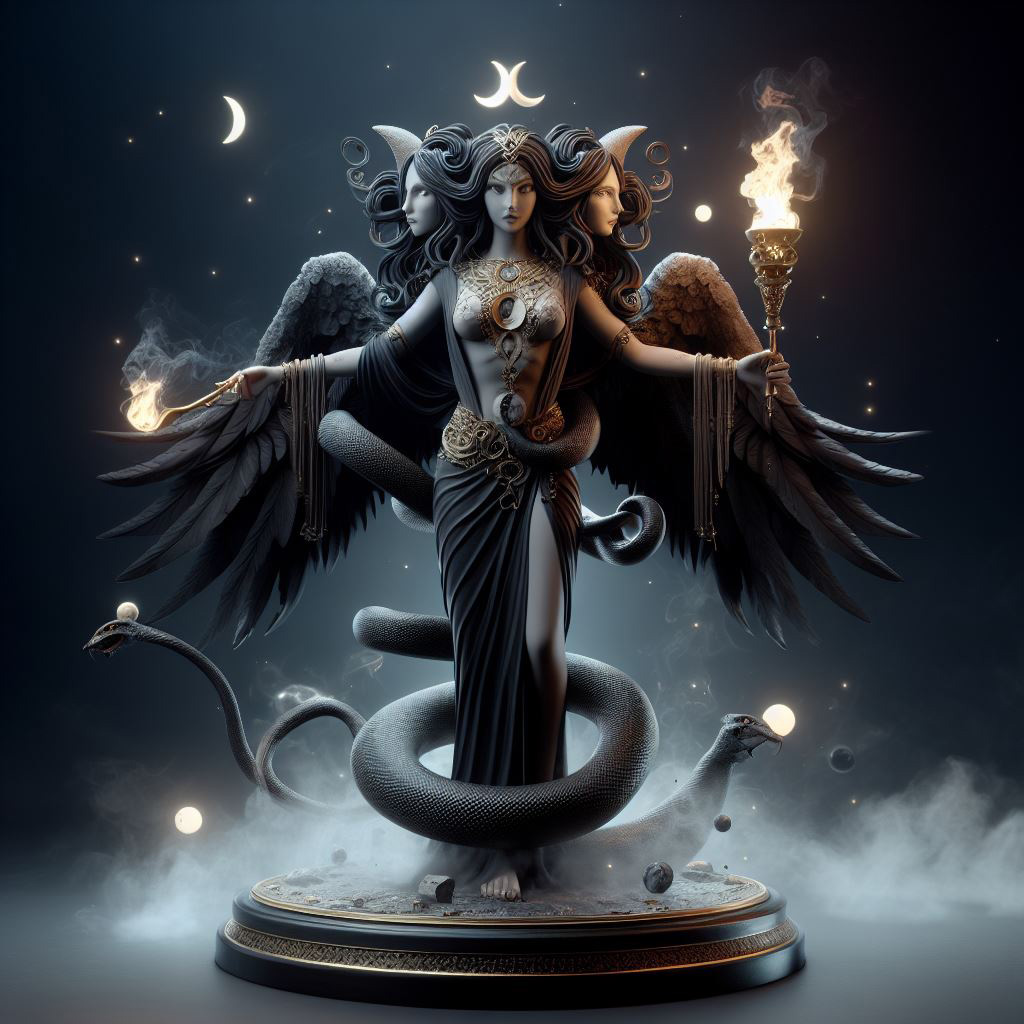
Within the intricate tapestry of her imagery, Hecate emerges as a goddess of triple majesty, a three-headed deity whose symbolic presence speaks volumes about her dominion over the vast expanse of time and space. This portrayal reflects her mastery over the past, present, and future, encapsulating the eternal dance of cosmic cycles.
Hecate’s three-headed visage symbolizes her tripartite sovereignty, each head gazing with watchful eyes upon the realms she governs. The past, cradled in one head, reflects the echoes of history that shape the present. The present, held in another, embodies the unfolding moment, while the third head, focused on the future, casts its gaze towards the mysteries yet to be unveiled. This triadic representation showcases Hecate’s timeless awareness and her ability to navigate the continuum of existence.
Her threefold form not only signifies temporal dominion but also encompasses her mastery over the elemental realms—earth, sea, and sky—enveloping the entirety of the cosmos. Hecate, in her triune aspect, becomes a cosmic force, intricately linked to the natural elements that weave the fabric of the universe.
In one hand, Hecate cradles a torch, its flickering flame illuminating the path through the darkness. This symbolic beacon not only guides lost souls but also serves as a metaphor for Hecate’s role as a guiding light in the shadows of the unknown. On the other hand, she wields a key, a potent symbol of her power to unlock the gates between worlds. This key grants her access to hidden realms and esoteric knowledge, solidifying her position as a guardian of mystical thresholds and unseen dimensions.
Entwined around her arm, a serpent weaves its sinuous form, symbolizing Hecate’s connection to the life force and the transformative power of change. The serpent, an ancient symbol of renewal and regeneration, reflects Hecate’s role as a catalyst for transformation. Through this coiled companion, she channels the potent energies of the life force, invoking the serpent’s wisdom to guide those who seek renewal and evolution.
In the intricate symbolism of Hecate’s portrayal, each element speaks to her multifaceted nature, weaving a narrative of cosmic governance, illumination in the darkness, access to hidden realms, and the transformative power inherent in the cycles of life. The triune majesty of Hecate’s iconography becomes a visual hymn to the complexity and depth of her divine essence.
Hecate in Witchcraft and Pagan Practices
In the sacred circles of modern witchcraft and pagan traditions, Hecate stands as a revered and multifaceted deity, her presence intricately woven into the fabric of magical practices and the exploration of unseen realms. The complexities of magic find resonance in Hecate’s multifaceted nature, making her a guiding force for witches and practitioners seeking profound insights and esoteric wisdom.
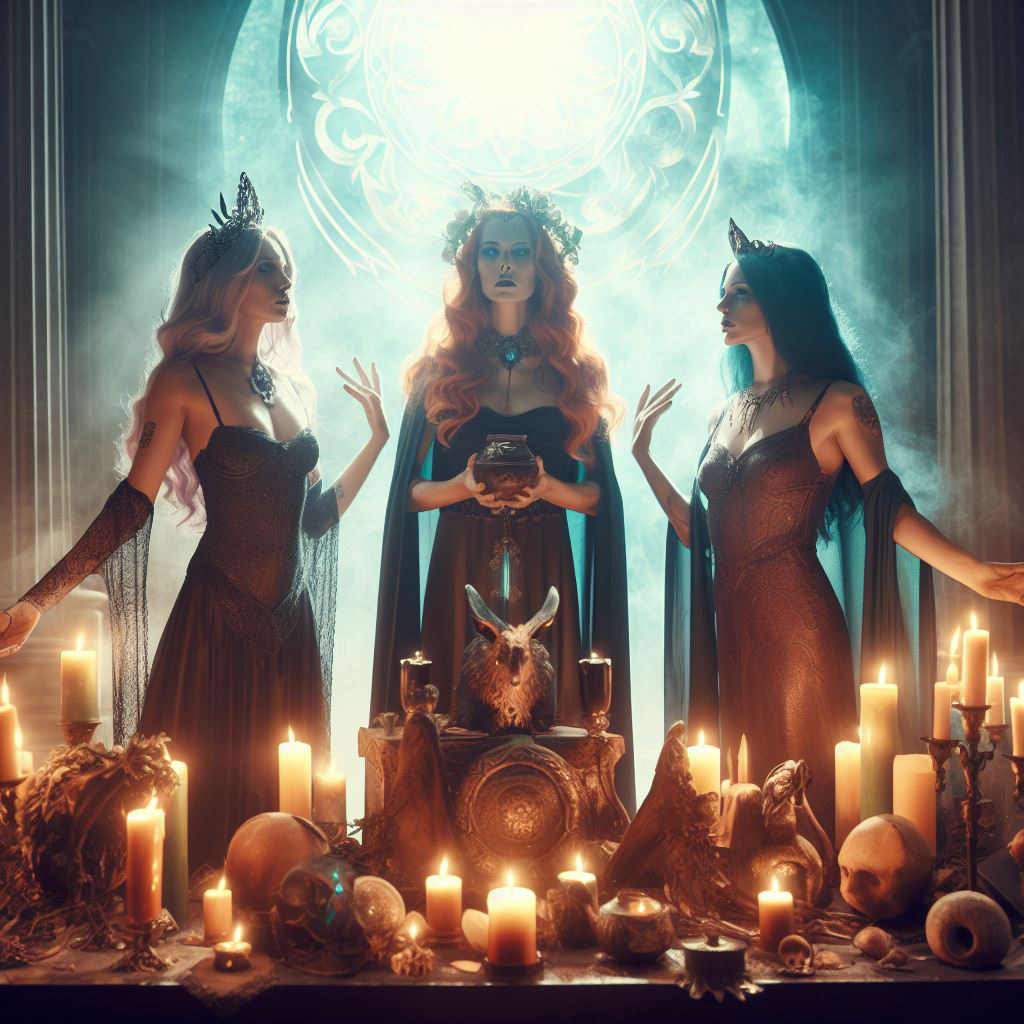
Hecate’s multifaceted nature aligns seamlessly with the intricate tapestry of magic, offering practitioners a multifaceted guide through the mysteries of the unseen. Witches invoke her not only for her symbolic representation of the moon, magic, and the spirit world but also for her unique ability to traverse liminal spaces, particularly the potent crossroads. In these in-between realms, where the veil between worlds is believed to be thin, Hecate becomes a spiritual guide, aiding seekers in their magical endeavors.
Practitioners turn to Hecate for guidance and protection, especially when navigating the threshold spaces of crossroads. These liminal points are seen as conduits between realms, where magical energies converge. Hecate, as a guardian of crossroads, is invoked to assist in safely navigating these mystical junctures, ensuring a harmonious connection with the energies that lie beyond the mundane.
Hecate is a central figure in rituals designed for transformation, where her symbolism of change and rebirth becomes a potent catalyst. Witches and practitioners call upon her during moments of transition, embracing her association with the power of change as they seek to shed old patterns and embrace new beginnings. In these rituals, Hecate becomes a beacon of transformative energy, guiding individuals through the cycles of growth and renewal.
Practitioners turn to Hecate for guidance and protection, especially when navigating the threshold spaces of crossroads. These liminal points are seen as conduits between realms, where magical energies converge. Hecate, as a guardian of crossroads, is invoked to assist in safely navigating these mystical junctures, ensuring a harmonious connection with the energies that lie beyond the mundane.
Hecate is a central figure in rituals designed for transformation, where her symbolism of change and rebirth becomes a potent catalyst. Witches and practitioners call upon her during moments of transition, embracing her association with the power of change as they seek to shed old patterns and embrace new beginnings. In these rituals, Hecate becomes a beacon of transformative energy, guiding individuals through the cycles of growth and renewal.
Her torch, held aloft, becomes a metaphorical beacon that illuminates the shadows within. In rituals for self-discovery and personal growth, Hecate’s torch guides individuals through the depths of their inner landscapes. The flickering flame not only reveals hidden aspects of the self but also symbolizes the illuminating power of knowledge and insight. As seekers journey through the inner realms, Hecate’s torch becomes a steady light, casting light upon the paths of self-discovery.
In modern witchcraft, Hecate’s reverence goes beyond mere ritualistic gestures. She becomes a dynamic presence, a wise guide, and a powerful ally for those who navigate the intricate terrain of magic, seeking wisdom, protection, and transformation along their mystical journeys.
Celebrating Hecate
The devotion to Hecate transcends the constraints of a single day, weaving seamlessly throughout the phases of the lunar calendar. Among the lunar cycles, the dark moon, synonymous with the new moon, emerges as an especially auspicious time for practitioners to pay homage to Hecate. As the moon retreats into shadow, devotees find a sacred space to connect with the goddess, offering tokens of significance and engaging in rituals that seek her guidance, protection, or aid in their magical endeavors.
During the dark moon, devotees craft offerings infused with intention, such as garlic, honey, or eggs, symbolic representations that hold special significance in Hecate’s realm. These offerings become vessels of connection, symbolic gestures that convey the devotee’s reverence and seek to align with the energies of the dark moon. Rituals during this time often focus on invoking Hecate’s presence, drawing on her wisdom, and creating a sacred space where seekers can commune with her across the veils that separate the mundane and the mystical.
Hecate’s Night, celebrated on the eve of August 13th, stands as a festival dedicated to honoring the goddess in a collective outpouring of reverence. This special night unfolds as a tapestry of rituals, offerings, and the kindling of torches or candles at crossroads—an embodiment of Hecate’s sacred domains. Devotees come together to create a harmonious symphony of devotion, inviting Hecate to bless their endeavors, protect their paths, and infuse their lives with her transformative energy.
As the eve of August 13th approaches, practitioners prepare for Hecate’s Night by crafting intricate rituals that reflect the goddess’s multifaceted nature. Offerings are carefully selected to symbolize devotion and respect, and the lighting of torches or candles at crossroads becomes a symbolic act to invoke Hecate’s presence at these mystical intersections. The festival becomes a communal celebration, a collective expression of gratitude, seeking Hecate’s blessings, and acknowledging her timeless influence over the realms of magic and the unseen.
The act of lighting torches or candles at crossroads holds profound significance during Hecate’s Night. Crossroads, representing liminal spaces and choices, become portals for connecting with the goddess. The flickering flames become beacons that draw Hecate’s attention, inviting her to join the revelry and partake in the shared devotion of her devotees. This act of crossroads illumination symbolizes the crossing of thresholds, both literal and spiritual, as practitioners invite Hecate to guide them through the intersections of life’s journey.
In essence, the worship of Hecate unfolds like a celestial dance, moving in synchrony with the lunar phases and culminating in the radiant celebration of Hecate’s Night. Devotees, guided by the moon’s cycles and the goddess’s timeless influence, weave a tapestry of devotion that honors Hecate’s multifaceted nature and seeks her blessings throughout the ever-changing cosmic rhythms.
Conclusion
Hecate, the multifaceted goddess of crossroads and transformation, continues to enchant and inspire those who seek her wisdom and guidance. Her rich mythology, complex symbolism, and enduring significance in witchcraft and pagan practices make her a beloved and powerful figure in the world of spirituality and magic. As we traverse the crossroads of our own lives, Hecate stands as a torchbearer, offering illumination and transformation on our spiritual journeys.