 Reading Time: 21 minutes
Introduction
A Procession of Spirits
As the darkness of Samhain envelops the land and the veil between the living and the dead thins, one of the most haunting myths associated with this time emerges—the tale of the Wild Hunt. This spectral procession of spirits, ghosts, and faeries sweeps through the sky during the darkest nights of the year, riding on the winds of the Otherworld. The Wild Hunt, a powerful and ominous force in European folklore, holds a particularly significant place in Celtic mythology, where it is deeply tied to the liminal energies of Samhain, when the boundaries between the mortal and spirit realms are at their most fragile.

A Terrifying Procession of Spirits
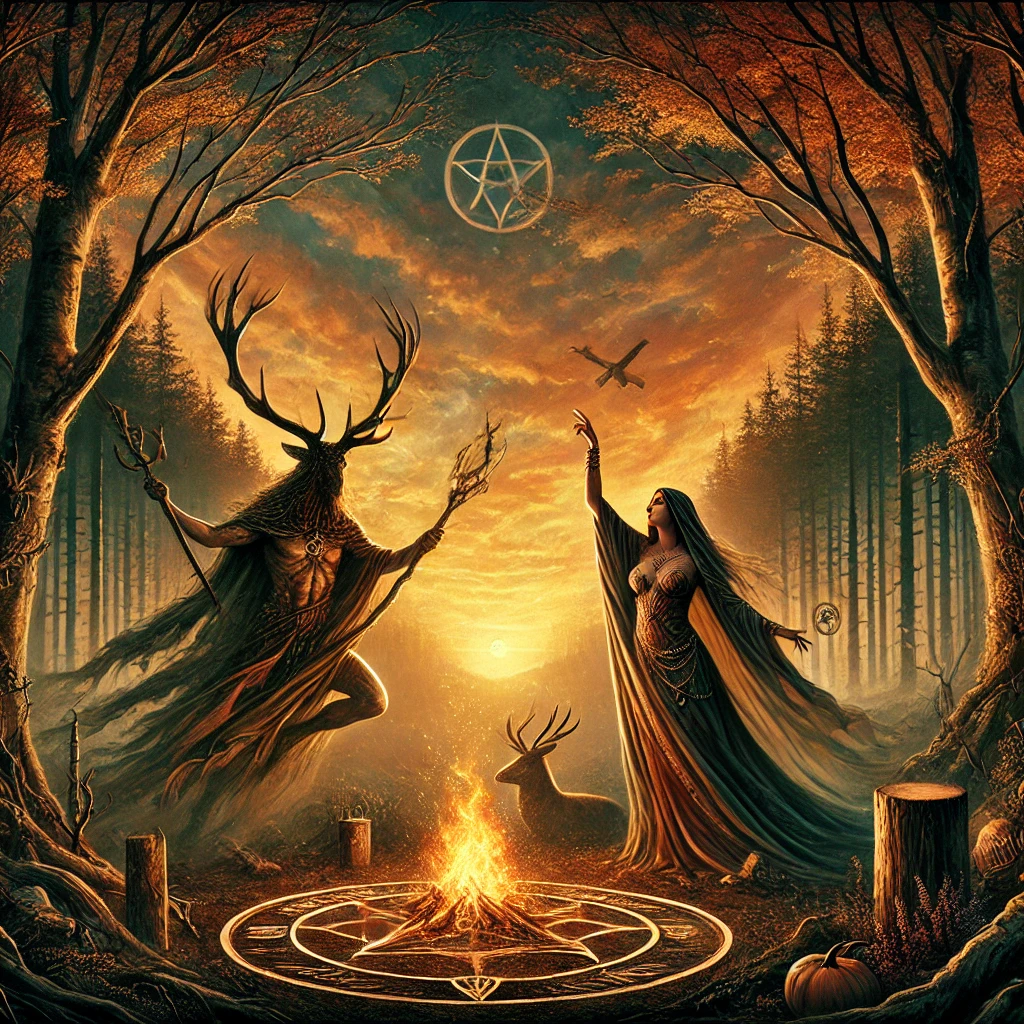
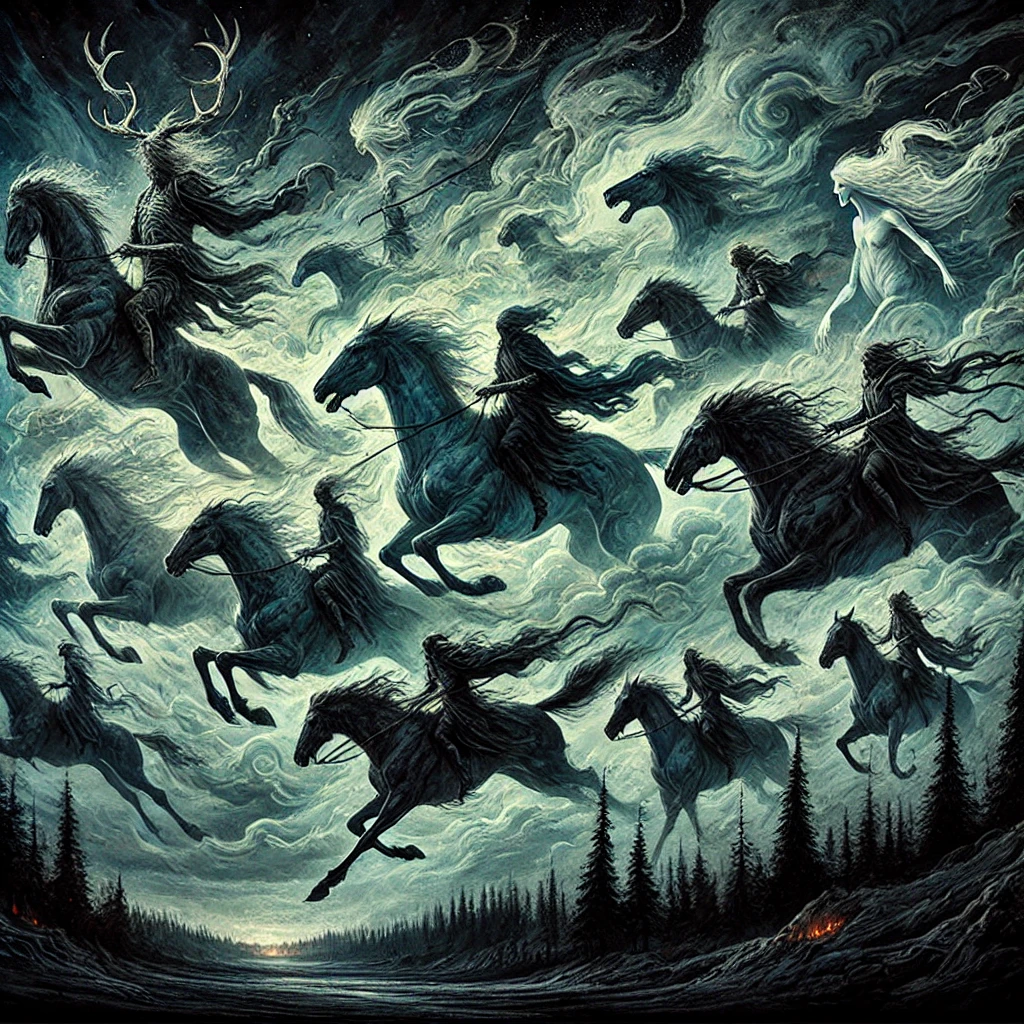
The Wild Hunt is often depicted as a terrifying and supernatural cavalcade, a spectral host of otherworldly riders who sweep through the night sky, led by a powerful deity or spirit. In Celtic mythology, the leaders of the Hunt are sometimes said to be Cernunnos, the Horned God of the Celts, or the King of the Fairies—figures of immense power and command over both the natural and supernatural worlds. These formidable leaders guide the Hunt’s procession of faeries, restless souls, and dark supernatural beings, unleashing their chaotic energies as they traverse the mortal realm during Samhain. This fearsome host moves with wild, untamable power, reflecting the intense and chaotic energy of the season when the veil between the living and the dead is at its thinnest.
In many versions of the myth, the Wild Hunt is composed of the souls of the dead, joining faeries and other dark entities as they ride across the night sky. The spirits, freed from the Otherworld during Samhain, are not benign but driven by wild, uncontrollable forces. Some versions of the tale depict the Hunt as a chaotic storm of spiritual energy, with the sound of galloping hooves and the howling winds carrying the cries of souls and the eerie laughter of faeries. These beings, untethered from the laws of the physical world, traverse the sky with a single, unstoppable purpose: to sweep up anything or anyone unfortunate enough to cross their path.
Witnessing the Wild Hunt is not a passive or trivial experience. It is said that to catch even a fleeting glimpse of this spectral procession can bring severe misfortune, death, or even a curse upon those who dare to gaze upon it. The sight of the Wild Hunt is a harbinger of doom, a dire omen that foretells disaster or death within the community. It is said that those who are caught in the Hunt’s path are at the mercy of these otherworldly riders and may be swept away into the Otherworld, lost forever in the realm of the dead, never to return to the world of the living.
The power and terror of the Wild Hunt instilled a deep fear in communities during Samhain, a time when spirits and other supernatural entities were believed to roam freely across the land. The myth warns that encountering the Wild Hunt can curse entire households or individuals, forever marking them as touched by death. For this reason, people took serious precautions on Samhain night to protect themselves and their loved ones from the malevolent forces that might come with the Hunt. As darkness fell, families would stay indoors, avoid traveling through desolate areas, and light fires in their hearths to keep the spirits at bay. These fires were not only symbols of warmth and light but also potent wards against the otherworldly energies unleashed during Samhain. Offerings of food and drink were often left outside to appease the spirits, ensuring that they would not bring harm to the household.
Prayers were also said to invoke protection from the Wild Hunt and other malevolent forces. These prayers served as invocations to ancestors, gods, or protective spirits, calling upon them to shield the living from the supernatural dangers of the night. In some traditions, people would disguise themselves in costumes or masks, blending in with the spirits and faeries in an attempt to confuse the Wild Hunt and avoid drawing attention to themselves. This act of disguising oneself was more than just a form of defense—it was a symbolic recognition that on Samhain night, the line between the human and the supernatural blurred, and survival depended on finding ways to coexist with these powerful forces.
The myth of the Wild Hunt encapsulates the fear and reverence that ancient cultures held for the unseen forces that govern life and death. The terrifying procession of spirits represents the uncontrollable forces of nature, death, and chaos—forces that, during Samhain, are believed to spill over into the mortal realm. To witness the Wild Hunt is to be confronted with the raw, untamed power of the Otherworld, a reminder that life is fragile and that the unknown is always close, waiting just beyond the edge of the darkness.
The Liminal Power of Samhain
The appearance of the Wild Hunt during Samhain is far from a mere coincidence; it is deeply intertwined with the festival’s profound liminal energies and its significance as a time of death, transformation, and the crossing of boundaries. Samhain, often seen as the Celtic New Year, marks the end of the harvest and the beginning of winter—a time when the natural world shifts from light to darkness, mirroring the cyclical nature of life and death. This seasonal transition is more than just the physical change from autumn to winter; it also symbolizes a metaphysical opening between the worlds of the living and the dead, creating the perfect environment for the spectral Wild Hunt to roam.
At Samhain, the veil between the realms of the living and the dead is said to be at its thinnest, allowing spirits, faeries, and other supernatural beings to cross into the mortal world. This thinning of the veil makes Samhain a potent time for communication with ancestors and the Otherworld, but it also brings with it the risk of encountering darker, more malevolent forces. The Wild Hunt, with its fearsome procession of spirits and souls, embodies this convergence of realms. It serves as a powerful reminder that the boundaries separating life and death are fragile during Samhain, and that the Otherworld is never far away.
The liminal power of Samhain is most clearly expressed through the Wild Hunt’s chaotic and uncontrollable nature. As the Hunt rides through the skies, it carries with it both the terror and beauty of the unknown. The spirits that make up the Hunt reflect the duality of Samhain itself—where death is both feared and honored, and where the passage between worlds is a natural part of the cycle of existence. These spirits, unleashed from the Otherworld, remind the living that death is not a distant concept but an inevitable reality that must be confronted. Much like the changing of the seasons, death is an integral part of life’s cycles, and the Wild Hunt is a vivid representation of this inescapable truth.
In many ways, the Hunt represents the fear of death and the uncertainties that accompany it. Its appearance during Samhain is a stark reminder of mortality, of the finite nature of life, and of the inevitability of change. Yet, the Hunt is not merely a harbinger of doom; it also symbolizes the natural order of things. Just as the seasons change from the warmth of summer to the cold of winter, so too does life move from birth to death and, ultimately, to rebirth. The Wild Hunt embodies this cyclical movement, sweeping up the souls of the dead and signaling the transition from one phase of existence to another.
At its core, Samhain is a time to honor the dead and acknowledge the forces of mortality, but it is also a time of renewal. The Wild Hunt, with all its terrifying grandeur, mirrors this duality. As the spirits ride through the night sky, they carry with them the souls of the dead, reminding the living that death is not an end but a passage into the next stage of existence. Samhain, like the Hunt, marks the close of one cycle and the beginning of another. It is a time of reflection, a moment to confront the darkness within and around us, and an opportunity to embrace the transformative power of the shadowy half of the year.
In this way, the Wild Hunt serves as a potent metaphor for the journey that Samhain represents. It forces the living to confront their fears of death and the unknown, while also reminding them of the importance of transformation and letting go. Much like the winter that follows Samhain, the Hunt brings a sense of closure, but within that closure lies the promise of renewal. As the old year dies and the new year is born, so too do the spirits of the Wild Hunt move through the realms, guiding souls to the Otherworld while heralding the start of a new cycle.
For practitioners of modern Paganism and those who honor Samhain as a spiritual time, the Wild Hunt’s liminal presence during the festival underscores the idea that death and life are part of the same continuum. Just as the Hunt crosses between the worlds of the living and the dead, Samhain provides a sacred space where individuals can reflect on their own cycles of growth and transformation. The Hunt is not simply a terrifying spectacle to be avoided but a reminder of the forces that shape all existence—the cycles of death, rebirth, and the eternal passage between worlds.
In essence, the Wild Hunt’s appearance at Samhain is a powerful symbol of the liminal space between life and death, a space that becomes accessible during this sacred time of year. It reminds us that the Otherworld is always close, waiting just beyond the edges of the visible world, and that we must honor both the light and the dark forces that shape our existence. The Hunt is a reminder that death, like the changing of the seasons, is a necessary part of life, and that through death, new beginnings are always possible. As the Wild Hunt sweeps through the skies, it invites us to embrace the mysteries of Samhain and to honor the cyclical nature of life, death, and transformation.
Protective Rituals and Superstitions
Throughout Celtic history, the Wild Hunt was a fearsome presence, and its potential appearance on Samhain night was taken seriously. People believed that the spectral procession of spirits could bring misfortune, illness, or even death to individuals or entire communities. With its reputation for sweeping up those who crossed its path, spiriting them away to the Otherworld, the Wild Hunt was a force to be respected and avoided. In response, Celtic communities developed a variety of protective rituals and superstitions designed to safeguard themselves and their loved ones from being caught in the Hunt’s terrifying wake. These rituals, performed in the days leading up to and during Samhain, served not only to protect against the Hunt but also to honor the powerful unseen forces that roamed the earth during this liminal time.
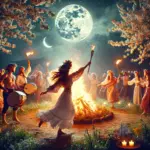
One of the most widespread protective rituals was the lighting of fires in homes and hearths. These flames were seen as more than just sources of warmth during the increasingly cold nights; they symbolized light, protection, and life. Fires were believed to ward off spirits and malevolent entities that could otherwise enter homes during Samhain, when the veil between the worlds of the living and the dead was thin. Hearth fires were kept burning throughout the night, and bonfires were sometimes lit in communal spaces to protect entire villages. The light from these fires was thought to create a barrier against the dark, wild forces that roamed the land, including the Wild Hunt itself. In many traditions, the act of lighting these fires was also an invitation for ancestors’ spirits to visit, ensuring that only benevolent forces could cross the threshold into the world of the living.
In addition to the protective power of fire, offerings of food and drink were left outside the home as an act of respect and appeasement for the wandering spirits. These offerings, often placed on doorsteps or windowsills, typically included bread, fruit, and wine or ale. The belief was that by providing sustenance to the spirits, particularly the souls of the dead and faeries, one could ensure their favor and prevent them from entering the house to cause harm. These offerings were simple yet profound, reflecting an acknowledgment of the Otherworld’s presence and a desire to coexist peacefully with the spirits that crossed into the mortal realm during Samhain. This practice was also a way to honor deceased ancestors, inviting them to share in the bounty of the harvest before the long winter set in.
The importance of showing respect to these unseen forces was central to the protective rituals of Samhain. It was understood that spirits, both benevolent and malevolent, could be unpredictable, and by offering them hospitality, communities could protect themselves from their wrath. In some versions of the tradition, food offerings were specifically meant to placate the Wild Hunt itself, ensuring that the riders would pass by without sweeping anyone away. The fear of being caught by the Hunt was pervasive, and these rituals reflected the deep respect people had for the powerful forces at work during Samhain.
Another important protective practice was the wearing of disguises or costumes. This tradition, which has since evolved into the modern Halloween costume, had its roots in the belief that spirits, faeries, and other supernatural beings roamed freely during Samhain, and the living needed to take precautions to avoid being recognized. People would don masks, animal skins, or other costumes to confuse the spirits, effectively blending in with the otherworldly forces. By hiding their true identities, they hoped to protect themselves from being targeted by malevolent entities or swept up by the Wild Hunt. This practice was both a practical form of protection and a symbolic acknowledgment that during Samhain, the lines between the human and spirit worlds were blurred, and the living had to coexist with the dead.
Costuming was also a way of participating in the liminal energy of Samhain, embracing the idea that the living and the dead coexisted during this time. It allowed people to walk among the spirits, becoming part of the supernatural realm for a brief period. This act of transformation, mirroring the shapeshifting nature of spirits and faeries, reflected the deeper themes of death and rebirth that were central to Samhain. In some regions, people would go door-to-door in disguise, collecting food or offerings for the dead, a practice that has clear parallels to modern trick-or-treating.
These protective rituals, rooted in both respect and fear, were more than just superstition—they were integral to the way people navigated the liminal space that Samhain represented. The rituals acknowledged the power and presence of the Otherworld while attempting to maintain a sense of control over the unpredictable forces unleashed during this time. Fires, offerings, and disguises all served as ways to protect the living from the dangers of the Wild Hunt and the spirits that walked the earth during Samhain. They were acts of humility and reverence, recognizing that while the Wild Hunt and other supernatural forces were beyond human control, there were ways to coexist with these forces without falling victim to their wrath.
In the days leading up to Samhain, communities would often engage in communal rituals to ensure collective protection. Bonfires would be lit in central locations, and offerings might be made on behalf of entire villages to appease the spirits and protect everyone from the dangers of the Wild Hunt. These communal acts strengthened the bonds between people and reminded them that, in the face of the unknown, unity and respect for the forces of nature were vital.
Ultimately, the protective rituals and superstitions surrounding the Wild Hunt reflect a deep understanding of the balance between life and death, and the respect for the unseen forces that govern both realms. Samhain was not just a time to fear the dead or the Wild Hunt—it was a time to honor the cyclical nature of existence, to recognize the power of the Otherworld, and to ensure that the living and the dead could coexist in harmony, even if only for one night. Through these rituals, the ancient Celts found a way to protect themselves from the dangers of the Wild Hunt while simultaneously embracing the transformative power of Samhain, when death and life were most closely intertwined.
The Cyclical Nature of the Wild Hunt
Though terrifying in its form, the myth of the Wild Hunt is more than just a tale of danger and spectral riders; it also reflects the deep, cyclical nature of life and death—one of the core themes of Samhain itself. At its heart, the Wild Hunt embodies the natural transitions between birth, death, and rebirth, just as the seasons move from the warmth and light of summer into the darkness and dormancy of winter. This procession of spirits, with its raw and untamed energy, signifies the inevitable shift from life to death, but it also holds within it the promise of renewal and transformation. Much like winter heralds the beginning of a quiet, regenerative period for the earth, the Hunt reminds us that death is not an end, but a phase in the larger cycle of existence.
As the Wild Hunt rides through the night during Samhain, sweeping through the skies and crossing the threshold between worlds, it mirrors the transition from one phase of existence to the next. The spirits and faeries that make up the Hunt are not merely harbingers of death; they are messengers of change, emphasizing that the passage from life into death is a necessary part of the greater cosmic order. Death, in this context, is not something to be feared, but something to be embraced as part of the ongoing rhythm of life—just as the earth must experience the cold barrenness of winter before the rebirth of spring can begin.
This concept is closely aligned with the overall themes of Samhain, which marks the Celtic New Year and symbolizes a period of transformation. At Samhain, the old year dies, the harvest is completed, and nature prepares for the stillness of winter. The Wild Hunt, appearing during this liminal time, embodies this same shift, riding out as the last echo of the old cycle and the first whisper of what is to come. The spirits that accompany the Hunt, whether they are faeries, the restless dead, or otherworldly beings, remind us that death clears the way for renewal and that every ending paves the way for a new beginning. In this way, the Wild Hunt serves as a powerful symbol of both the inescapable nature of death and the promise of rebirth that follows.
In modern Pagan practices, the Wild Hunt is sometimes invoked as a ritual metaphor for this cyclical process of death and rebirth. It serves as a potent symbol for confronting personal fears, releasing what no longer serves, and embracing the unknown as we enter the dark half of the year. Just as the spirits of the Hunt sweep through the skies, practitioners can use this image to help them “sweep away” old habits, negative patterns, or outdated ways of thinking, clearing the path for new growth. The Hunt becomes a symbol of inner transformation, where practitioners face their own inner demons or shadows, allowing these aspects of themselves to be carried away by the wild energy of the Hunt.
In this sense, the Wild Hunt is not only an external force to be feared but also an internal force of reckoning and change. The wild, untamable nature of the Hunt can represent the chaotic yet necessary process of confronting the darker aspects of the self—fears, traumas, and unresolved conflicts that may be holding back personal or spiritual growth. By invoking the Wild Hunt in ritual, practitioners acknowledge that just as death is a natural part of life, so too is the process of shedding the old to make way for the new. In doing so, they tap into the transformative energy of the Hunt, using it as a catalyst for deep personal change.
Some modern Pagans even perform rituals during Samhain in which they visualize the Wild Hunt as a force that sweeps through their lives, taking with it all that needs to be released. These rituals often involve symbolic acts, such as writing down fears, unhealthy behaviors, or emotional burdens on slips of paper and then burning or burying them as an offering to the Wild Hunt. The act of releasing these burdens mirrors the Hunt’s role in cleansing the old cycle, allowing practitioners to move forward unencumbered by the past.
The cyclical nature of the Wild Hunt also speaks to the larger spiritual lesson that death is a necessary part of the journey toward rebirth and renewal. In a world that often shuns or fears death, the Wild Hunt serves as a reminder that endings are as important as beginnings, and that death—whether physical, emotional, or metaphorical—is a crucial part of the natural order. By confronting death and decay through the imagery of the Wild Hunt, practitioners can come to terms with the fact that in order to grow, certain parts of themselves or their lives must “die” and be swept away.
In this way, the Wild Hunt is not just a myth of terror, but a symbol of the transformative power that comes with accepting the cycles of life. The spirits that ride with the Hunt are not merely forces of destruction, but also forces of renewal, clearing the old and preparing the way for what is to come. By invoking the Wild Hunt, whether in rituals of release or as a metaphor for personal change, modern Pagans align themselves with this powerful cycle, embracing the darkness of winter and the unknown it brings, while trusting that this darkness will eventually give birth to light.
Thus, the Wild Hunt stands as a vivid reminder of the cyclical nature of existence. Just as the seasons turn and the natural world shifts from summer’s abundance to winter’s stillness, so too do our lives follow a similar pattern of growth, death, and rebirth. The Wild Hunt, with all its fearsome power, encapsulates this cycle, urging us to let go of what has passed and trust in the transformative power of the unknown. By embracing the Hunt’s message, we are reminded that within every death lies the seed of new beginnings, and within the darkness, there is always the promise of light.
The Wild Hunt in Modern Pagan Rituals
In modern Pagan rituals, the myth of the Wild Hunt has evolved beyond its traditional associations with terror and chaos, taking on new layers of meaning that emphasize personal transformation, release, and spiritual renewal. For many practitioners, the Wild Hunt is not just a spectral procession to fear but a powerful metaphor for the cycles of death and rebirth, as well as the internal journeys we all must undertake. During Samhain, when the veil between the worlds of the living and the dead is at its thinnest, the energy of the Wild Hunt is invoked as a way to confront the past, release what no longer serves, and embrace the unknown future.
One of the key aspects of modern Pagan rituals that invoke the Wild Hunt is the focus on personal transformation. Just as the spirits and faeries in the myth are swept through the night sky, practitioners see the Hunt as a force that can sweep away the emotional, psychological, and spiritual debris that accumulates over time. During Samhain, which marks the transition from the light half of the year to the dark half, individuals are encouraged to let go of old habits, fears, and emotional burdens—those things that prevent growth and renewal. The Wild Hunt, with its raw, untamable power, becomes a symbol of this release, helping practitioners clear the way for new beginnings as winter approaches.
Rituals centered on the Wild Hunt during Samhain often involve meditations, visualizations, or ceremonial offerings to align oneself with the forces of death and rebirth. In meditation, practitioners may visualize the Hunt as a powerful, swirling energy that passes through them, taking with it the remnants of the past—the regrets, anxieties, or old patterns that are no longer needed. This visualization allows individuals to experience a symbolic death of these old aspects of themselves, clearing space for new opportunities and growth. For some, this ritual can be a deeply cathartic experience, a way to confront and release the fears that have held them back.
Ceremonial offerings are also a common component of rituals invoking the Wild Hunt. These offerings are typically left outside, often on doorsteps, windowsills, or near trees, to acknowledge the presence of the spirits of the Hunt and seek their favor. These offerings might include food, drink, or small tokens that represent what the practitioner is willing to let go of. The idea is that by making an offering to the spirits, individuals show respect for the forces of the Wild Hunt and ask for their protection and safe passage through the darker months of the year. In some traditions, the offerings serve as both an act of appeasement and an invitation for the spirits to carry away the old, stagnant energy that no longer serves the practitioner’s highest good.
For others, invoking the Wild Hunt during Samhain is a way to honor their ancestors. Since the Wild Hunt is often seen as a procession of souls and spirits, calling upon its energy allows practitioners to connect with the spirits of their deceased loved ones. By aligning themselves with the Hunt, they seek to honor those who have passed while also accepting the natural cycle of life and death. In this way, the Wild Hunt becomes a symbol of the ancestral lineage, reminding practitioners that they, too, are part of an unbroken cycle that will one day lead them to join the spirits of the dead in the Otherworld.
Additionally, many modern Pagans use the Wild Hunt as a metaphor for the internal battles we all face—the struggle to confront our shadow selves, face our fears, and let go of the patterns that keep us trapped in cycles of suffering. The Wild Hunt, with its ferocity and relentless pursuit, serves as a reminder that these internal struggles cannot be avoided forever. The Hunt represents the forces of change and transformation, which must eventually sweep through our lives, forcing us to confront the aspects of ourselves we often hide from. By embracing the Wild Hunt in ritual, practitioners willingly engage with these internal forces, asking for the strength and clarity to navigate their own personal darkness.
Rituals that focus on confronting the shadow self often involve symbolic acts of release. Practitioners may write down their fears, regrets, or emotional burdens on slips of paper, which are then burned, buried, or left as offerings for the Wild Hunt. This act of releasing what no longer serves is a powerful way of working with the energy of the Hunt, acknowledging that just as the Wild Hunt clears the path between the worlds, we too must clear the path for new growth in our lives. This symbolic shedding of the old is in keeping with the themes of Samhain, which emphasize both the end of one cycle and the beginning of another.
By aligning with the energy of the Wild Hunt, practitioners tap into the transformative power of Samhain itself. The Hunt becomes a tool for personal evolution, allowing individuals to release the past and embrace the promise of renewal that comes with winter’s descent. Just as the Wild Hunt signals the thinning of the veil between life and death, these rituals encourage practitioners to confront the mysteries of their own lives, making space for healing and new possibilities to emerge.
In some cases, practitioners might also ask for the protection of the Wild Hunt as they move through their own transformations. While the Hunt is often associated with destruction and chaos, its power can be harnessed as a protective force, clearing away obstacles and ensuring that the practitioner is able to navigate the darker half of the year with strength and resilience. By invoking the Wild Hunt in this way, individuals not only seek to confront their fears but also ask for the courage to face whatever challenges lie ahead.
Ultimately, the Wild Hunt in modern Pagan rituals serves as a multifaceted symbol of death, transformation, and renewal. Whether used as a metaphor for personal struggles or as a way to honor ancestors and connect with the Otherworld, the Hunt’s presence during Samhain reinforces the idea that life is a continuous cycle of endings and beginnings. By engaging with the energy of the Wild Hunt, practitioners are reminded that through the darkness of winter and the death of the old year, there is always the promise of rebirth and the hope of new life on the horizon.
The Wild Hunt: A Symbol of Samhain’s Power
The myth of the Wild Hunt is an enduring and vital part of Samhain’s lore, embodying the complex energies of death, transformation, and the thinning of the veil between the living and the dead. During Samhain, this spectral procession of spirits, faeries, and otherworldly beings takes on an especially potent role, symbolizing the forces that govern life’s natural cycles. While the Wild Hunt may inspire fear due to its association with death, chaos, and the unknown, it also serves as a profound reminder that these forces are an essential part of the cycle of existence. Through the lens of the Wild Hunt, Samhain is revealed to be more than just a festival of death; it is a time to honor the unseen forces that shape our lives, to release what no longer serves us, and to prepare for the inevitable rebirth that follows death.
Samhain is traditionally the time of year when the boundaries between the worlds of the living and the dead grow thin, allowing spirits and energies from the Otherworld to cross into the mortal realm. The Wild Hunt rides during this liminal time, sweeping through the skies as a force of transition. As a myth, it embodies the idea that the veil between realms is not just a metaphor, but a lived reality during Samhain—a time when death and life intermingle, and the mysteries of the afterlife brush against the mortal world. The Hunt, with its cacophony of spirits, faeries, and spectral riders, symbolizes the chaotic energy of transformation, which can be both terrifying and necessary.
While the Wild Hunt may evoke fear with its wild, untamable power, it also represents the inevitable end of one cycle and the beginning of another. Death, in this context, is not something to be feared or avoided but embraced as a necessary part of life’s rhythm. The Hunt’s journey through the sky reflects the natural process of shedding the old and making way for the new, much like the changing seasons. Just as winter follows autumn, death follows life, but both carry within them the seeds of renewal. The Wild Hunt, with its focus on death, reminds us that every ending is followed by a rebirth—whether in the physical world, the spiritual realm, or within our own lives.
The transformative power of the Wild Hunt is central to its role in Samhain’s mythology. As it rides through the night, sweeping up spirits and souls, it carries with it the energy of transition—a time when the old is cleared away, and space is made for something new. This sweeping away is not just a literal representation of death, but a metaphor for the internal changes we must undergo during Samhain. Just as the spirits of the dead are carried away by the Hunt, we too must let go of old patterns, fears, and emotional burdens that no longer serve us. In this way, the Wild Hunt becomes a powerful symbol of personal transformation, urging us to confront the darker aspects of our lives and embrace the changes needed for growth.
Samhain, as the Celtic New Year, marks the end of the harvest season and the beginning of winter—the dark half of the year. It is a time for reflection, introspection, and the acceptance of the cyclical nature of life. The Wild Hunt, as a mythological force, aligns perfectly with this theme, representing the death of the old year and the preparation for the rebirth of the new. Its presence during Samhain reminds us that the darkness of winter is not a time of stagnation, but a period of gestation and potential. Just as the Wild Hunt clears the way for the spirits of the dead to move into the Otherworld, it also makes room for new life and new beginnings in the spring.
For many modern practitioners of Paganism, the Wild Hunt is more than a mythological curiosity—it is a living symbol of Samhain’s transformative power. Rituals invoking the energy of the Wild Hunt often focus on personal release, transformation, and renewal. Whether through meditation, ceremonial offerings, or symbolic acts of letting go, practitioners align themselves with the energy of the Hunt, asking it to carry away the emotional, spiritual, or psychological baggage that holds them back. In this way, the Wild Hunt serves as a force for deep personal change, clearing the path for new growth and understanding.
Some modern rituals involve visualizing the Wild Hunt as a great sweeping force that moves through one’s life, clearing away the past and making way for the future. Others see the Hunt as a symbolic way of confronting fears, anxieties, or shadow aspects of the self. Just as the Wild Hunt moves through the sky, its chaotic energy can be channeled into breaking through internal blockages, allowing individuals to confront what they fear most and emerge stronger on the other side. By tapping into the energy of the Wild Hunt, practitioners embrace the natural cycles of death and rebirth, recognizing that darkness is not something to be feared, but a necessary stage in the process of growth and renewal.
Despite its fearsome reputation, the Wild Hunt also represents protection. In some traditions, it is believed that the spirits of the Hunt, while chaotic, can be called upon for guidance and protection during the darker months. Just as the Hunt clears away the old, it can also act as a guardian, protecting practitioners as they move through their own transformations. Invoking the Wild Hunt for protection involves recognizing its dual nature—both destructive and regenerative—and aligning oneself with its energy to navigate the challenges of the dark season with strength and resilience.
Ultimately, the Wild Hunt is a symbol of Samhain’s immense power, embodying the festival’s themes of death, transformation, and the thinning of the veil between worlds. Whether viewed as a terrifying omen or a powerful symbol of change, the Hunt serves as a reminder that we are never far from the mysteries of the Otherworld, even in the darkest nights of the year. As the Wild Hunt rides through the sky, it brings with it the promise of endings and new beginnings, urging us to embrace the natural cycles of life and death and to trust that even in the darkness, there is always the potential for light.
In this way, the Wild Hunt stands as a key part of Samhain’s mythology, symbolizing the dual forces of destruction and creation. Its presence during Samhain serves as a powerful reminder that death and darkness are not the end but are part of the eternal cycle of life. By acknowledging and honoring the Wild Hunt, we open ourselves to the transformative power of Samhain, releasing the past, embracing the present, and preparing for the inevitable rebirth that follows.
Conclusion: The Wild Hunt and Samhain’s Transformative Power
The Wild Hunt, with its chaotic energy and spectral riders, is far more than a myth of fear; it is a powerful symbol of Samhain’s transformative essence. As the dark procession sweeps through the sky, it reminds us of the delicate balance between life and death, light and darkness, and the inevitability of change. The Wild Hunt embodies the mysteries of the Otherworld, urging us to confront our deepest fears, let go of the past, and embrace the cycles of death and rebirth that define existence. Whether viewed as a terrifying force or a symbol of inner transformation, the Wild Hunt serves as a key part of Samhain’s mythology, guiding us through the darkness of the season and toward the promise of renewal. In honoring the Wild Hunt, we acknowledge the unseen forces that shape our lives and prepare ourselves for the new beginnings that follow the darkest nights of the year.