Posted on Leave a comment

Myths & Lore: The Morrigan

The Morrigan
The Morrigan

Introduction

Goddess of War, Death, and Fate in Samhain’s Mystical Realm

As the ancient festival of Samhain draws near, the veil between the living and the dead thins, allowing spirits and energies from the Otherworld to intermingle with our own. One of the most powerful mythological figures who presides over this liminal time is The Morrigan, the Irish goddess of war, death, and fate. Known for her fearsome presence on the battlefield, The Morrigan also reigns over transformation and the cycles of life and death, making her deeply connected to the themes of Samhain.

The Morrigan’s Role as a Shapeshifter and Death Goddess

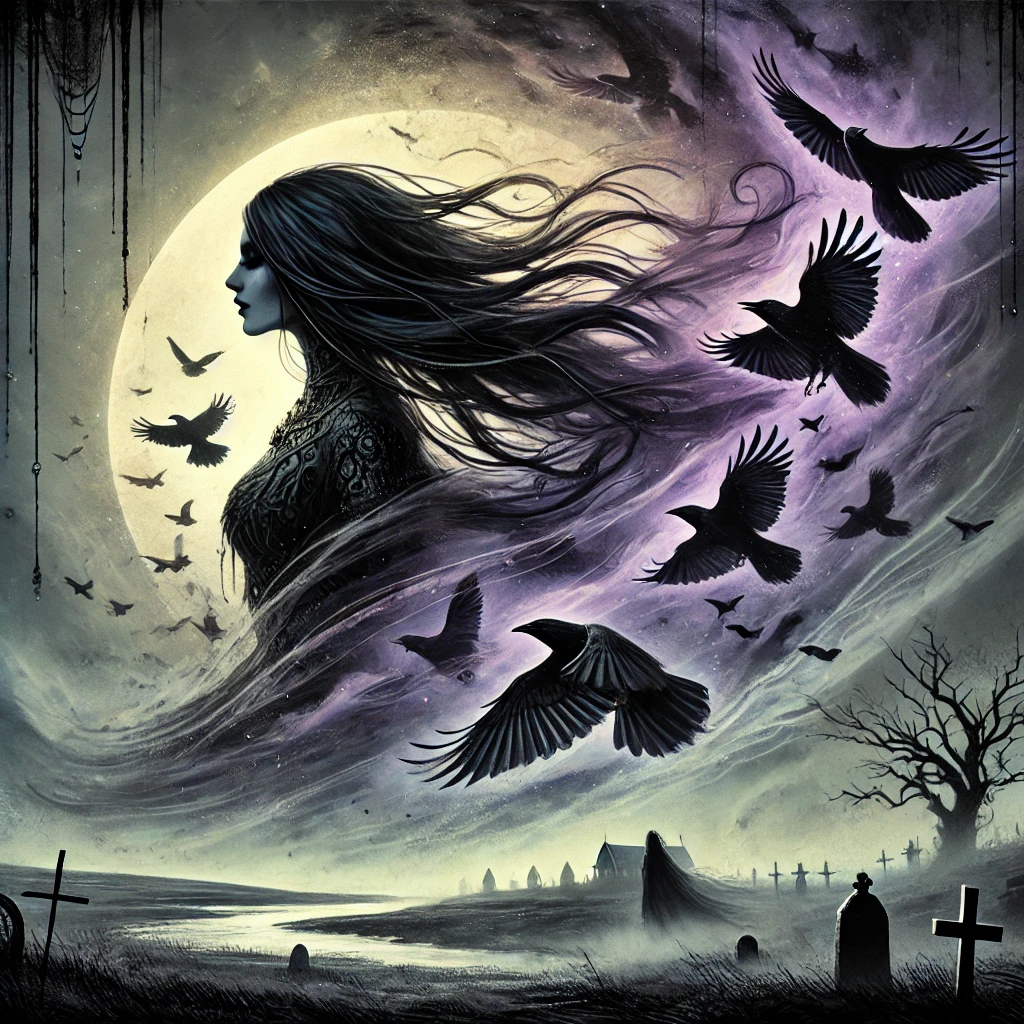
The Morrigan, one of the most formidable deities in Irish mythology, is often portrayed as a shapeshifter, with her most common form being that of a crow or raven. These dark, foreboding birds have long been associated with death and battle, and in The Morrigan’s case, they serve as manifestations of her presence on the battlefield. As these ominous creatures circle overhead, they represent The Morrigan’s omnipotent gaze, surveying the fates of warriors as she decides who will live and who will perish. The sight of crows or ravens above a battlefield was not just a common occurrence but a symbolic reminder of The Morrigan’s influence over the cycle of life, death, and fate.

The Morrigan’s ability to shapeshift underscores her fluid, ever-changing nature, much like the cyclical forces of life, death, and rebirth that she governs. Her form is not static; she moves effortlessly between worlds, adopting the shape most suited to her purpose—whether to guide souls, deliver warnings, or sow fear in the hearts of mortals. This ability to transform highlights her dominion over the liminal spaces where the boundaries between the known and the unknown, the living and the dead, become blurred. The Morrigan’s fluidity reflects the essence of transformation itself, where endings give way to new beginnings and where the veil between worlds thins.

As a goddess of death and transformation, The Morrigan represents the dark, mysterious energies that come into play during Samhain. This sacred festival marks the time of year when the boundary between the living and the dead is at its most permeable, allowing for a deeper connection with spirits and the Otherworld. The Morrigan’s presence during Samhain is a powerful reminder that death is not the final end but a necessary transition—a passage into the unknown that is crucial to the cycle of existence. In her role as a goddess of death, she ensures that death is treated as an essential phase of life, not as something to be feared but as something to be embraced as part of nature’s order.

Just as Samhain signals the end of the harvest and the quiet onset of winter’s descent, The Morrigan stands as a guardian at the threshold of change, guiding souls into the Otherworld. Her role is not one of destruction for its own sake but of transformation. She leads the dead through the process of dying, ensuring that this journey into the afterlife is not chaotic but part of a cosmic rhythm. In this way, she mirrors the natural cycles of death and rebirth, showing that life continually renews itself even in the midst of endings.

Through her shapeshifting, The Morrigan embodies the unpredictability and inevitability of change, emphasizing that just as life moves through stages, so too does the soul move through different states of existence. Her ability to cross between forms—raven, wolf, maiden, or crone—illustrates her mastery over transformation and her intimate connection with the mysteries of life and death. Each form she takes serves a purpose in fulfilling her role as both a destroyer and a creator, reminding us that transformation often requires the death of old ways before new growth can occur.

Her appearance during Samhain is particularly potent because this time of year is associated with endings, whether the literal end of the harvest season or the metaphorical end of the old self. The Morrigan’s energy during Samhain offers a path forward for those willing to confront the darker aspects of life and embrace the transformative power that comes with facing death, both in the physical sense and in the sense of letting go of old patterns, fears, or identities. She shows that within every death—whether of the body, the ego, or an outdated way of thinking—there is a promise of renewal and rebirth, echoing the cycles of the earth itself.

In this way, The Morrigan serves not only as a goddess of war and death but also as a guide through the darker, transitional periods in life. She leads the souls of the dead into the Otherworld while simultaneously helping those still living to navigate their own transformations. Just as the world grows quieter with the onset of winter, The Morrigan’s influence during Samhain teaches us that it is within this stillness, this liminal space between the old and the new, where true change occurs.

The Morrigan’s role as a shapeshifter and goddess of death underscores her profound connection to the mysteries of transformation, making her one of the most potent and revered figures during Samhain. As the cycle of life continues to turn, The Morrigan stands at the threshold of change, guiding souls through death and transformation and ensuring that the seeds of renewal are planted even in the darkest times. Her presence reminds us that no matter how final death may seem, it is always the precursor to something new, a reminder that endings are not the cessation of life but the foundation upon which new growth emerges.

The Morrigan’s Connection to Samhain

The Morrigan’s connection to Samhain is both profound and symbolic, embodying the dark, transformative energy that defines this ancient festival. Samhain, which marks the end of the harvest and the beginning of winter, is a time when the veil between the living and the dead is at its thinnest, allowing for the communion between both realms. As a festival that honors death, transformation, and the cycle of life, Samhain is the time of year when The Morrigan’s presence is most keenly felt in rituals and mythological narratives. As a goddess of death, fate, and transformation, The Morrigan holds a powerful role during this sacred time, guiding practitioners through the mysteries of life, death, and rebirth.

Often depicted as presiding over death, The Morrigan is more than a bringer of physical death. Her role encompasses the death of old ways, outdated habits, and aspects of the self that must be shed for personal growth and renewal. This symbolic aspect of her connection to death is crucial during Samhain, as the festival is not just a time to honor those who have passed into the Otherworld, but also a moment to reflect on one’s own internal cycles of transformation. The Morrigan, in this way, becomes an essential figure for those seeking personal evolution, helping them let go of the past and embrace the potential for rebirth that lies beyond.

During Samhain, The Morrigan’s presence in rituals reminds practitioners that death, in all its forms, is a natural and necessary part of life’s cycle. The death she oversees is not an end, but rather a gateway to transformation. Her energy guides individuals through the darkness of endings, helping them confront their fears, release what no longer serves them, and prepare for the new possibilities that will emerge. Just as the leaves fall and the earth grows quiet in winter’s approach, The Morrigan’s influence at Samhain encourages a deep introspection, urging individuals to examine the parts of their lives that must be surrendered to allow new growth to take root.

The Morrigan’s association with Samhain reflects the deeper truths woven into the fabric of the festival: that life and death are intimately connected, and that within every ending lies the potential for new beginnings. The Morrigan stands as a guardian of these cycles, reminding us that transformation is often born out of darkness and that the decay of one phase of life is necessary to fertilize the soil for the next. Her role in Samhain rituals encourages practitioners to embrace this natural flow and to trust in the regenerative power of letting go.

In many mythological narratives, The Morrigan’s power over fate and transformation is intricately tied to Samhain’s themes. She is often depicted overseeing the transition between life and death, whether through her presence on battlefields or her role in guiding souls into the Otherworld. This symbolism becomes even more potent during Samhain, when the dead are honored, and the mysteries of mortality are faced with reverence. The Morrigan, as both a warrior goddess and a guide through the unknown, embodies the courage needed to face death—whether it is the death of the physical body or the metaphorical death of the self.

For those practicing modern witchcraft or Pagan traditions, The Morrigan’s energy during Samhain becomes an anchor for personal rituals centered on transformation. Whether through meditation, divination, or ceremonial offerings, practitioners invoke her power to aid in releasing old patterns, inviting renewal, and deepening their understanding of life’s cyclical nature. She encourages those who call upon her to confront their fears of death and change and to recognize that what is feared often holds the key to greater strength and wisdom.

The Morrigan’s shapeshifting abilities further align her with the transformative power of Samhain. As a figure who can move between forms, shifting from maiden to crone, from woman to crow, she embodies the fluidity and changeability inherent in the cycles of life and death. Her transformations remind us that just as she can shift between states, so too can we transform ourselves. This makes her an especially potent deity to invoke when seeking to release old identities and embrace new possibilities during the liminal time of Samhain.

At its core, Samhain is a time of surrender and reflection—a moment to pause before the winter’s descent, to honor the ancestors, and to confront the mysteries of the Otherworld. The Morrigan’s connection to this sacred festival serves as a reminder that death is not an ending to be feared, but a transformation to be embraced. Her presence during Samhain rituals provides a sense of comfort for those seeking to confront their own mortality and the changes they must undergo to grow.

Ultimately, The Morrigan’s deep ties to Samhain mirror the festival’s themes of death, transformation, and renewal. She stands as a guide through the darkness, a powerful figure who shows that within the mysteries of death lies the potential for new life. By embodying the energies of endings and rebirth, The Morrigan reminds us that within the darkest moments of the year, there is always the seed of something new waiting to grow. Her energy, at its most potent during Samhain, helps practitioners move through the cycles of their own lives, accepting death as a natural part of existence and preparing for the inevitable renewal that follows.

The Morrigan and the Legend of Cúchulainn

One of the most captivating and well-known tales involving The Morrigan is her complex relationship with the legendary Irish hero, Cúchulainn. In this myth, The Morrigan’s role as a goddess of fate, death, and transformation is powerfully illustrated through her interactions with the great warrior, revealing both her fierce nature and her undeniable influence over the cycles of life and death.

As the story unfolds, The Morrigan appears to Cúchulainn just before his final, fateful battle. In this critical moment, she offers him her favor in the form of seduction, a gesture that could be interpreted as both a test of his character and a symbolic offering of protection. By aligning herself with the hero, The Morrigan offers Cúchulainn a chance to alter the course of his fate, potentially securing victory and survival in battle. However, Cúchulainn, fiercely independent and determined to rely on his own strength, rejects her advances. This rejection is not merely a dismissal of The Morrigan’s offer—it is a refusal to accept her role in his destiny. In rejecting the goddess, Cúchulainn also defies the forces of fate that she embodies.

Angered by Cúchulainn’s rejection, The Morrigan curses him, setting the stage for his ultimate downfall. Her curse is not simply an act of vengeance but a powerful reminder that no mortal, no matter how strong or heroic, can escape the grasp of fate. The Morrigan, as the weaver of destiny, ensures that Cúchulainn’s defiance comes with consequences. Her curse foreshadows his doom, signaling that his final battle will end not in triumph, but in death.

The story of Cúchulainn and The Morrigan reaches its tragic climax as the battle unfolds. True to her prophetic curse, Cúchulainn meets his fate on the battlefield, struck down in his final moments. As he lies dying, The Morrigan appears once more, this time in the form of a crow—one of her most iconic shapeshifted forms. Perched on his shoulder, she watches over him as he takes his last breath, a silent yet powerful witness to his demise.

The image of The Morrigan as a crow watching over Cúchulainn’s death is steeped in symbolism. Crows and ravens, often associated with death and the battlefield, are The Morrigan’s favored forms, and their presence serves as a reminder of her dominion over both life and death. By taking the shape of a crow, The Morrigan asserts her authority over the cycle of mortality and reinforces the idea that death, like fate, is inescapable. No matter how heroic or mighty a warrior may be, they cannot evade their destiny.

The legend of Cúchulainn and The Morrigan is a powerful illustration of the goddess’s control over fate and her connection to the inevitable end that awaits all mortals. In her rejection and curse of Cúchulainn, The Morrigan demonstrates that fate is not something that can be negotiated or avoided—it is an inescapable force that governs the lives of both heroes and ordinary mortals alike. Cúchulainn’s attempt to defy The Morrigan, and by extension fate, is ultimately futile, as he learns that even the greatest warriors cannot escape their destined end.

Furthermore, The Morrigan’s presence at Cúchulainn’s death, in the form of the crow, highlights her role as a guide through the transition from life to death. She is not merely a distant observer of death, but an active participant in the process of crossing from the mortal world into the Otherworld. In her role as a death goddess, The Morrigan is both a harbinger of death and a guardian who oversees the passage of souls into the afterlife. Her appearance at the moment of Cúchulainn’s death underscores her dominion over the cycles of existence, ensuring that death, while inevitable, is part of the natural order that she oversees.

The myth of The Morrigan and Cúchulainn also speaks to a deeper understanding of fate and mortality in Celtic mythology. The Morrigan’s role is not one of cruelty or vengeance, but of enforcing the natural balance between life and death. In rejecting her, Cúchulainn rejects the acceptance of this balance, but The Morrigan ensures that he ultimately meets his fate, as all mortals must. Her curse is a reminder that while mortals may strive for greatness, they are still bound by the inescapable cycles of life and death, which The Morrigan herself governs.

By appearing in her crow form to witness Cúchulainn’s death, The Morrigan further reinforces her role as a deity who oversees not only the physical deaths of mortals but also the spiritual passage into the afterlife. Her presence signifies that death is not merely an ending, but a transition—a crossing over into a new realm, guided by the hands of a goddess who understands both the darkness of death and the potential for rebirth that lies within it.

In this tale, The Morrigan serves as a powerful figure, embodying the themes of fate, mortality, and transformation that are central to her identity as a goddess. The legend of Cúchulainn reminds us that, while we may strive to control our own destinies, there are forces beyond our understanding that ultimately shape our lives and determine our fates. The Morrigan stands as the embodiment of these forces, a goddess who, through her interactions with Cúchulainn, asserts her dominion over life and death, reminding us that fate is a force we cannot escape, and that within every death, there is the potential for transformation and rebirth.

The Morrigan’s Invocation in Samhain Rituals

During Samhain, a time when the veil between the living and the dead is at its thinnest, The Morrigan’s dark and transformative energies are invoked in powerful rituals that focus on themes of personal transformation, release, and the mysteries of death. As the goddess of war, fate, and death, The Morrigan embodies the liminal space between life and the afterlife, guiding individuals through both physical and spiritual transitions. Her presence in Samhain rituals allows practitioners to confront the darker aspects of life, encouraging them to embrace the necessary process of letting go and shedding what no longer serves them, while preparing for the renewal that lies ahead.

Samhain is a festival intimately connected to death, not just in the literal sense, but also symbolically—the end of the harvest, the waning of the year, and the natural conclusion of cycles. It is a time for deep introspection, and The Morrigan’s energy is perfectly suited to help guide individuals through this process. Rituals invoking her often center on personal growth and the release of old habits, fears, and patterns, which mirrors the death of the old self in preparation for transformation and rebirth.

Rituals of Letting Go and Personal Transformation

One of the key themes in Samhain rituals invoking The Morrigan is the act of letting go. Just as The Morrigan watches over the battlefield, deciding the fates of warriors, she stands at the threshold of our own personal battles, helping us confront the aspects of our lives that must be relinquished. These rituals often involve symbolic acts of release—such as writing down fears, regrets, or old patterns on slips of paper and burning them as an offering to the goddess. By releasing these symbols of the past, practitioners honor The Morrigan’s transformative power and create space for new growth.

In addition to acts of release, The Morrigan is often invoked to guide individuals through the process of confronting personal fears and uncertainties about death and change. This can be done through meditation, where practitioners visualize The Morrigan’s presence, perhaps in the form of a crow, guiding them through the darkness of their inner landscape. During this introspective practice, The Morrigan’s energy helps them face what they may have been avoiding—whether that is emotional wounds, unresolved conflicts, or fears of the unknown.

Ceremonial Offerings and Connection with The Morrigan

Ceremonial offerings play a vital role in connecting with The Morrigan during Samhain. Practitioners may leave offerings such as black feathers, stones, wine, or food at an altar dedicated to the goddess, often outdoors where the natural elements can carry the offering to her. Crows and ravens are frequently viewed as messengers of The Morrigan, so leaving food for these birds as part of the ritual can be a direct offering to her, inviting her presence and guidance.

In return, practitioners seek The Morrigan’s wisdom, asking her to guide them through transitions, whether they are dealing with literal death or metaphorical endings in their lives. Her presence is invoked as a protector and a source of strength, as she helps them navigate the unknown and face the challenges that come with transformation. These offerings serve not only to honor the goddess but also to invite her into the practitioner’s life, allowing her transformative power to work on both the internal and external aspects of their existence.

Embracing Darkness and the Promise of Rebirth

The Morrigan’s role in Samhain rituals also highlights the importance of embracing the darkness rather than fearing it. In these rituals, darkness is not seen as something to be avoided but as a source of wisdom and growth. The Morrigan, who reigns over the battlefield and guides souls into the Otherworld, teaches that within darkness lies the potential for healing and rebirth. She encourages practitioners to move through the dark night of the soul, knowing that this journey is necessary for personal evolution.

As a guide through these transitions, The Morrigan helps practitioners recognize that every ending is a precursor to a new beginning. Just as the earth enters a period of dormancy during winter, awaiting the rebirth of spring, so too does The Morrigan guide us through the personal “winters” in our lives, reminding us that even in the darkest moments, there is always the promise of renewal. Her presence ensures that within the process of letting go, there is wisdom to be gained, and within every ending, the seeds of something new are already beginning to grow.

Facing the Mysteries of Death with The Morrigan

One of the most profound aspects of The Morrigan’s role in Samhain rituals is her guidance in confronting the mysteries of death. In many traditions, Samhain is a time to honor the dead, and The Morrigan, as a goddess deeply connected to death and the Otherworld, is often invoked to help facilitate this connection. Through rituals, practitioners may seek her guidance in communicating with ancestors or honoring the dead, trusting in her ability to navigate the liminal space between life and death.

In confronting the mysteries of death, The Morrigan offers reassurance that death is not an ending but a transformation. This understanding of death as part of the larger cycle of life is central to her energy. As practitioners invoke her during Samhain, they are reminded that death—whether it is the death of a loved one, a phase of life, or an aspect of the self—is a natural part of the greater cycle, and that there is always potential for growth and rebirth on the other side.

Her role as a psychopomp, guiding souls through death and beyond, adds to her significance during Samhain. Whether the practitioner is dealing with personal grief or existential fears of mortality, The Morrigan offers her strength and wisdom, helping them understand that death is a transition to be embraced rather than feared. By invoking The Morrigan, practitioners align themselves with the natural cycles of life and death, acknowledging that even in the face of great change, there is always a path forward.

The Morrigan as a Guide for Personal Growth

Ultimately, The Morrigan’s invocation during Samhain is about embracing transformation in all its forms. Whether through rituals of release, offerings, or meditative introspection, practitioners call upon The Morrigan to help them shed the past and prepare for what lies ahead. She stands as both a witness to their personal struggles and a guide through the process of change, offering her fierce strength as they navigate the darkness.

In invoking The Morrigan, practitioners accept the cyclical nature of life and the inevitability of endings, but also the infinite potential for rebirth that follows. Just as she watches over the battlefield, determining the fates of warriors, she watches over the personal battles we all face, offering her wisdom and protection as we move through our own transitions. Her energy, dark and transformative, reminds us that within every challenge, there is the possibility for growth, and within every ending, there is the promise of new life.

The Morrigan: A Goddess of Transformation and Power

The Morrigan, the formidable Irish goddess of war, death, and fate, holds a profound connection to the festival of Samhain—one as deep as the mysteries of death itself. As the goddess who oversees the passage from life to death, she stands as a guardian of transformation, guiding souls into the Otherworld and helping those who remain confront their own fears of change. Her presence during Samhain serves as a powerful reminder that endings are not something to fear but rather to embrace, for they are an integral part of the great cycles of existence that govern both the spiritual and physical realms.

Samhain, marking the end of the harvest and the approach of winter, is a liminal time—a threshold where the boundaries between the worlds of the living and the dead grow thin. In this moment of transition, The Morrigan’s energy is especially potent, reminding practitioners of the inevitability of change and the importance of embracing it. As the goddess of death and transformation, she oversees not only physical death but also the metaphorical deaths we experience throughout life—the end of relationships, phases, beliefs, and identities. Her presence at Samhain emphasizes that these endings are necessary steps in the journey of growth and renewal, just as death is a necessary part of the eternal cycle of life.

Through the invocation of The Morrigan during Samhain, practitioners tap into the ancient and potent energy of fate, death, and transformation. The Morrigan embodies the very essence of change, acting as both a catalyst and a guide through life’s most challenging transitions. Her ability to shapeshift, often taking the form of a crow or raven, mirrors the constant changes that individuals must endure throughout life—whether these changes are external or internal. Her symbolism as a shapeshifter underscores the fluidity of existence, reminding us that we, too, must be adaptable and open to transformation.

The Morrigan’s role as a goddess of battle further emphasizes her connection to personal transformation. Battles, whether fought on physical battlefields or within the confines of the self, are moments of intense challenge and change. They force us to confront what we fear and what we are attached to, often leading to profound transformation. In this sense, The Morrigan is not just a goddess who oversees war in the literal sense, but also a deity who guides individuals through the inner battles that accompany growth and change. Through her influence, we are encouraged to face our personal struggles with courage, knowing that these battles are a necessary part of the transformative process.

In the context of Samhain, The Morrigan’s dark, transformative power becomes even more significant. Samhain is a time to honor the dead, and The Morrigan, as the goddess who guides souls to the Otherworld, plays a crucial role in this process. Her presence helps practitioners come to terms with death, not as an ending, but as a transition into a new state of being. She reminds us that death, whether literal or metaphorical, is a doorway to new possibilities. Within every ending, there is the seed of a new beginning waiting to be awakened.

For those seeking guidance on matters of life and death during Samhain, The Morrigan offers her wisdom and protection. Her power is not only in her ability to oversee the passage into death but also in her role as a catalyst for inner transformation. Whether practitioners are honoring ancestors, releasing old patterns, or seeking clarity about their own future, The Morrigan stands as a timeless figure who holds the wisdom of life’s cycles. She helps individuals confront their fears of change and mortality, illuminating the path forward even in the darkest of times.

The Morrigan’s presence during Samhain also serves as a reminder that transformation is rarely comfortable or easy. As the goddess of war, she represents the chaos and upheaval that often accompany significant change. However, her energy teaches that through this chaos, there is the potential for growth, healing, and renewal. Just as the earth enters a period of rest and renewal during winter, so too must we embrace periods of stillness and darkness in our own lives, trusting that these moments of quiet transformation will eventually give way to new life.

In many ways, The Morrigan embodies the spirit of Samhain itself. This festival, which honors both the living and the dead, is a time when the veil between worlds is thin and the mysteries of life and death are most accessible. Through The Morrigan, we are reminded that death is not an end, but a transformation—one that is essential for the continuation of the cycles of existence. Her dark, transformative power teaches us that within the stillness of death, there is potential for new life, and within every ending, there is a seed of rebirth waiting to be awakened.

By invoking The Morrigan during Samhain, practitioners align themselves with the natural cycles of life and death, embracing the inevitability of change. The goddess stands as a guide through these transitions, offering her strength and wisdom to those who seek it. Her energy is a reminder that transformation is a necessary part of life’s journey, and that even in the face of darkness, there is always the promise of new beginnings.

Ultimately, The Morrigan’s connection to Samhain is a powerful symbol of the cycles of death and rebirth that govern all existence. She stands at the threshold of these cycles, guiding both the living and the dead through the transitions that define life. Her presence reminds us that within the darkest moments of the year, there is always the potential for transformation, and that within every ending, the seeds of renewal and rebirth are already beginning to take root.

Conclusion: The Morrigan, Guardian of Transformation and Fate

In the mystical embrace of Samhain, The Morrigan emerges as a formidable force, embodying the cycles of life, death, and rebirth. Her presence as a goddess of war, death, and fate serves as both a guide and a reminder that transformation is an inescapable part of existence. As the veil between worlds thins during Samhain, The Morrigan leads the way through the darkness, urging us to confront our fears, release what no longer serves us, and embrace the changes that lie ahead.

Her shapeshifting nature reflects the constant ebb and flow of life’s challenges and transformations, while her role as a guardian of death teaches that endings are not final—they are the fertile ground from which new beginnings emerge. Whether overseeing the battlefields of warriors or the inner struggles of individuals, The Morrigan holds the power to guide us through the most profound transitions, reminding us that even in moments of chaos and loss, there is always the potential for healing, renewal, and rebirth.

As a goddess deeply connected to Samhain, The Morrigan’s energy invites practitioners to align with the natural cycles of death and transformation, offering her wisdom to those willing to face the unknown. In invoking her during Samhain, we honor not only the dead but also the continual process of transformation that shapes our lives. Through The Morrigan, we are reminded that within every ending lies the seed of a new beginning, waiting for the darkness to give way to light.
Posted on Leave a comment

Ritual: Ancestor Altar for Samhain

Ritual Samhain Ancestor Altar

Introduction

Honoring Our Roots: Creating an Ancestor Altar for Samhain

Samhain, often referred to as Halloween or the Witches’ New Year, is a time of powerful connection between the living and the dead. Traditionally celebrated by Pagans and Wiccans, Samhain marks the thinning of the veil between the physical world and the spirit world, making it an ideal time to honor our ancestors and loved ones who have passed on. One of the most cherished rituals of this season is the creation of an ancestor altar, where offerings and memories come together to create a sacred space for reflection, remembrance, and communication with the spirits of those who came before us.

Ritual Basics

Before beginning any ritual, it is important to prepare yourself mentally and physically. You may want to take a cleansing bath, or shower, and meditate or perform some grounding exercises to center yourself. Gather any materials you will need, such as candles, incense, and offerings for the forest spirits.

You can read a more detailed Ritual Preparation guide here.

The Significance of the Ancestor Altar

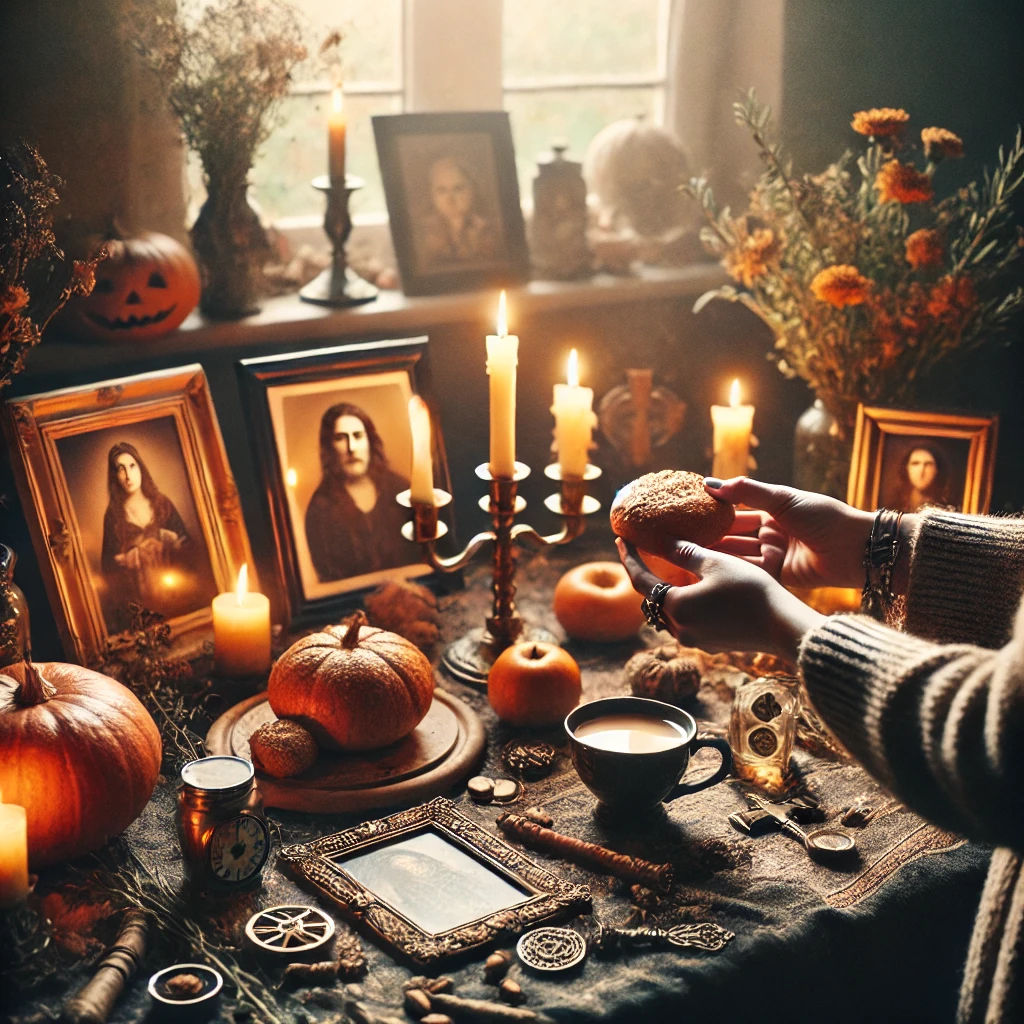
An ancestor altar is more than a decorative display; it is a symbolic connection to your familial and spiritual roots. At Samhain, this altar serves as a beacon, inviting the spirits of your ancestors to join you in celebration and honoring their legacy. The items placed on the altar hold personal significance, acting as a bridge between the past and present. Whether performed indoors or outdoors, this ritual creates a sacred space for reflection, gratitude, and the honoring of lives lived and memories cherished. Traditionally, Samhain falls on October 31st, but this ritual can be performed anytime during the thinning of the veil, from late October to early November.

Crafting an Ancestor Altar for Samhain

This ritual involves creating an altar dedicated to your ancestors, adorning it with personal and meaningful items, and offering it as a space of respect and gratitude during Samhain.

  • Surface
  • Cloth
  • Candles
  • 1 – Photos or heirlooms of ancestors (to represent those being honored)
  • 1 – Offering dish (for food or drink offerings)
  • 1 – Handful of seasonal flowers or herbs (such as marigolds, rosemary, or chrysanthemums)
  • 1 – Cup Apple cider or wine (symbolizing offerings to your ancestors)
  • 1 – Plate – Small serving of food (such as nuts, fruit, or bread)

Selecting the Altar Surface:

  1. Choose a surface that feels sacred to you, whether it is a table, a shelf, or something connected to nature, like a tree stump or rock. Outdoor altars can provide a direct connection with the Earth, but indoor altars may feel more private. Place this altar in a space that feels quiet, personal, and sacred for you.

Covering the Altar:

  1. Once you have selected the surface, cover it with a cloth. Colors like black or deep purple are traditional for Samhain, symbolizing the connection with the spirit world. However, choose a color that resonates with your intention. Each color holds its own symbolic meaning:
  2. Black or Purple – Associated with Samhain and the spirit realm
  3. White – Symbolizing purity and remembrance
  4. Green – Representing life and growth, perfect for ancestral healing

Arranging the Items:

  1. Now, begin to arrange items that honor your ancestors:
  2. Photographs and Heirlooms: Place photos, mementos, or heirlooms of your ancestors in a prominent position. These items serve as a focal point for the altar.
  3. Candles: Light two candles, one on each side of the altar. White candles are often used to symbolize the spirits of loved ones, while black candles can be used to honor the cycle of life, death, and rebirth.
  4. Offerings: Prepare offerings of seasonal fruits, nuts, or a small plate of bread and place them in front of the photos or heirlooms. Pour a cup of apple cider or wine as a symbolic gesture of gratitude.
  5. Flowers or Herbs: Add fresh flowers or dried herbs to enhance the natural beauty of the altar. Rosemary is traditionally used for remembrance, while marigolds or chrysanthemums symbolize the connection to the spirit world.

Blessing and Invocation:

  1. Once your altar is arranged, take a moment to sit quietly in front of it. Reflect on the lives of your ancestors, what they have passed down to you, and the legacy they left behind. Light the candles and say:
  2. "Spirits of my ancestors, I honor you on this sacred night.

    As the veil between worlds thins, I welcome your presence in my life.

    Through this altar, may you feel my love, respect, and gratitude.

    Guide me with your wisdom, protect me with your love,

    And bless me with the strength of our lineage.

    Blessed be."

Offering to the Ancestors:

  1. Take a small piece of bread or fruit, and lift the offering up, saying:
  2. "I offer this gift to you,

    To nourish your spirit as you have nourished mine.

    With this food and drink, I honor your presence.

    Blessed be."

  3. Leave the offerings on the altar overnight or until the next morning as a sign of respect.

Reflection and Meditation:

  1. After your offering, sit quietly and meditate on the connection with your ancestors. Allow any thoughts, feelings, or memories to surface, and feel the warmth of their presence. Write down any insights or messages that come to you in a journal or notebook.
  • Always ensure candles are safely placed on the altar, away from any flammable materials. If leaving the altar overnight, extinguish candles after your ritual for safety.
  • Children can be involved in the process by helping gather items, arranging them, or even creating drawings of ancestors to place on the altar.
  • The offerings left on the altar can be returned to nature the next day. Pour the drink into the soil and leave food offerings in a garden or forest area as a way of giving back to the Earth.
Samhain
Rituals

Conclusion

Setting up an Ancestor Altar during Samhain is a beautiful way to honor and connect with the spirits of your loved ones. This ritual strengthens the bond between you and your ancestors, offering a space for remembrance, reflection, and gratitude. By dedicating this sacred space, you open a portal for wisdom, love, and guidance from beyond the veil. As the flames flicker and the offerings are made, may your heart be filled with warmth, and may the presence of your ancestors bring peace and blessings to your life. Blessed Be.

Posted on Leave a comment

Recipe: Sage and Apple Stuffing

making Apple & Sage stuffing

Introduction

A Savory Side for Honoring Ancestors

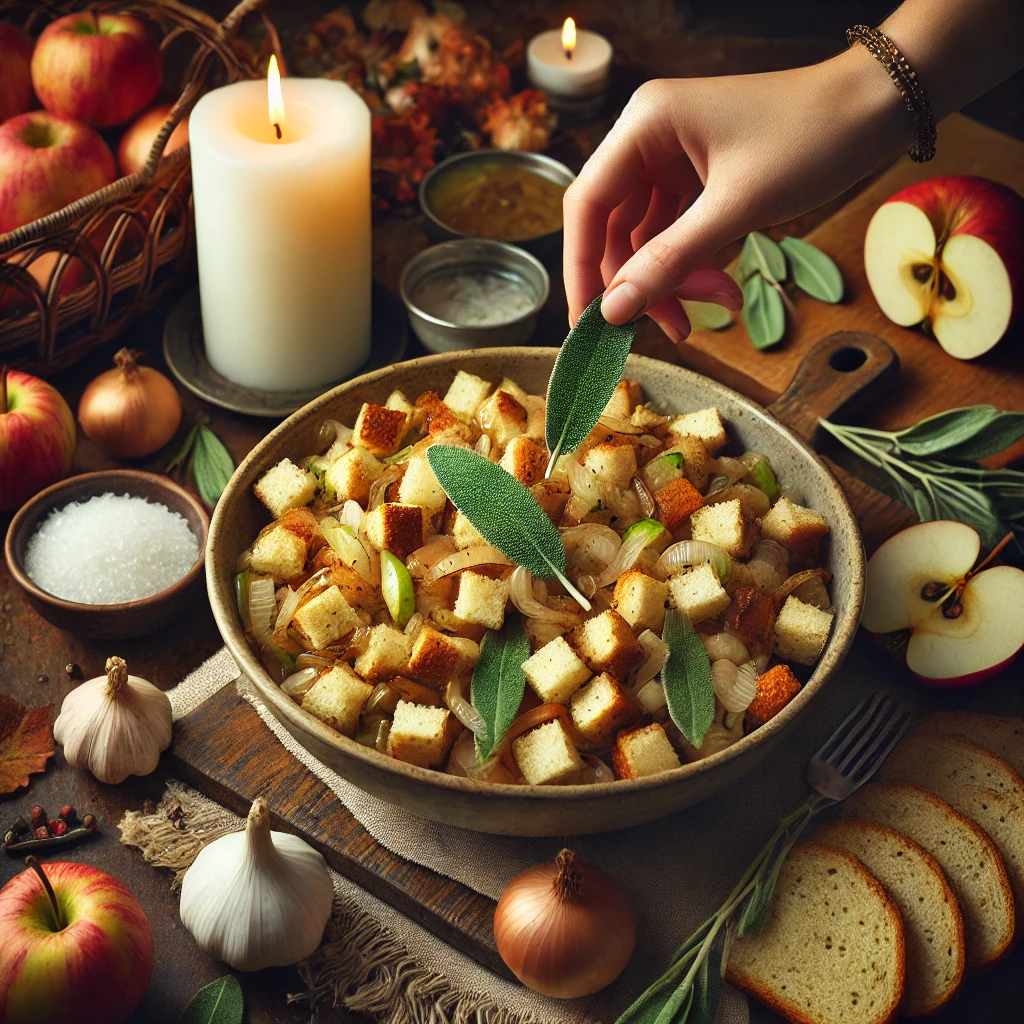
Samhain, the time when the veil between the worlds is thinnest, invites us to honor our ancestors and remember those who have passed. As part of the Dumb Supper feast, Sage and Apple Stuffing is a deeply symbolic dish that connects us to the earth’s abundance and the wisdom of those who came before. This stuffing, made with sage (an herb for wisdom and remembrance), apples (for life and rebirth), and hearty bread, reflects the harvest season’s bounty and provides a flavorful, grounding side dish for your Samhain table.

The Magic of Mabon Harvest Stuffed Acorn Squash

Stuffing is a traditional dish for autumn feasts and gatherings, often evoking memories of past celebrations and loved ones. During Samhain, Sage and Apple Stuffing takes on a deeper significance as it embodies both remembrance and gratitude for the harvest. Sage is known for its protective and cleansing properties, making it a powerful herb for working with spirits and inviting wisdom from the past. Apples, associated with the Otherworld and the cycle of life and death, serve as a symbolic offering to ancestors.

This dish is ideal for the Dumb Supper because it allows you to honor both the living and the dead through nourishment and intention. Every bite is filled with the essence of harvest, wisdom, and connection to the cycles of life.

Spell for Wisdom and Ancestral Connection

As you prepare this dish, use this spell to invite wisdom and guidance from your ancestors.

  1. Light a white candle to symbolize clarity and wisdom.
  2. As you chop the ingredients, focus on your intention to connect with the wisdom of your ancestors.
  3. As you stir the stuffing, chant:

“Sage of wisdom, apple of life,
Connect me with ancestors, free of strife.
Through this feast, their love flows,
Their guidance and knowledge, I now know.”

When serving the dish, take a moment to sit in silence and reflect on the lessons you have learned and the wisdom your ancestors may offer.armony you wish to cultivate in your life.

Magical Properties of Sage and Apple Stuffing

This dish includes ingredients with strong magical properties:

Bread: Represents nourishment, sustenance, and the connection between the physical and spiritual worlds.

Sage: Represents wisdom, protection, and purification. It is commonly used in rituals to cleanse the space and invite ancestral wisdom.

Apples: Symbolize life, death, rebirth, and the Otherworld. They are considered sacred during Samhain and are often used as offerings to the spirits of the dead.

Onions: Associated with protection and clarity, onions help to create a protective barrier between realms and invite clear communication.

Celery: Symbolizes grounding and health, helping to keep one balanced during spiritual work.

Sage and Apple Stuffing

A savory stuffing made with fresh sage, apples, onions, and hearty bread, perfect for a Samhain Dumb Supper feast.

  • Baking dish
  • Large skillet
  • Knife
  • Cutting board
  • 6 cups cubed stale bread (sourdough or whole grain work well)
  • 2 medium apples (peeled and chopped)
  • 1 medium onion (chopped)
  • 2 celery stalks (chopped)
  • 3 tbsp fresh sage (chopped (or 1 tbsp dried sage))
  • 2 tbsp olive oil or butter
  • 2 cups vegetable broth (or chicken broth for non-vegetarian)
  • Salt and pepper to taste

Prepare the Bread:

  1. Preheat the oven to 350°F (175°C).
  2. Spread the cubed bread on a baking sheet and toast in the oven for about 10 minutes until golden and slightly crisp. Set aside.

Sauté the Vegetables:

  1. In a large skillet, heat the olive oil or butter over medium heat.
  2. Add the chopped onions and celery and sauté until softened, about 5 minutes.
  3. Stir in the chopped apples and sage, cooking for another 3-4 minutes until the apples are slightly softened.

Combine Ingredients:

  1. In a large mixing bowl, combine the toasted bread cubes with the sautéed vegetables and apples.
  2. Pour in the vegetable broth gradually, stirring to combine. The bread should be moist but not soggy.
  3. Season with salt and pepper to taste.

Bake the Stuffing:

  1. Transfer the stuffing mixture to a greased baking dish.
  2. Cover with foil and bake in the preheated oven for 20 minutes.
  3. Remove the foil and bake for an additional 10 minutes until the top is golden and crispy.

Serve:

  1. Allow the stuffing to cool for a few minutes before serving.
  2. Serve warm as a savory and grounding side dish for your Samhain Dumb Supper.

For added flavor, you can incorporate other autumn ingredients such as cranberries or walnuts into the stuffing. This dish can be prepared a day in advance, allowing the flavors to deepen overnight. Reheat it gently before serving at your Dumb Supper.

Side Dish
Autumn, Samhain
Recipe

Conclusion

Sage and Apple Stuffing is the perfect side dish for your Samhain Dumb Supper, honoring the wisdom of your ancestors while celebrating the earth’s final harvest. With its grounding, protective, and nurturing qualities, this dish not only nourishes the body but also strengthens your connection to the past. May this stuffing bring you closer to the wisdom and guidance of those who came before, and may it offer comfort and reflection during your Samhain celebrations.

Posted on Leave a comment

Ritual: Dumb Supper for Samhain

Samhain Dumb Supper
Samhain Dumb Supper

Introduction

Silent Reflections: Honoring Our Ancestors Through a Dumb Supper

Samhain is the sacred time of year when the veil between the worlds thins, allowing us to connect more deeply with our ancestors and loved ones who have passed on. One of the most profound and meaningful ways to honor the spirits of our ancestors is through the ritual of the “Dumb Supper,” also known as the “Silent Supper.” This ancient practice invites us to share a meal in complete silence, creating a space of reverence, reflection, and connection with those who have crossed into the spirit world. The ritual is performed with deep intention, setting the stage for communication, introspection, and gratitude for the wisdom and presence of our ancestors.

Ritual Basics

Before beginning any ritual, it is important to prepare yourself mentally and physically. You may want to take a cleansing bath, or shower, and meditate or perform some grounding exercises to center yourself. Gather any materials you will need, such as candles, incense, and offerings for the forest spirits.

You can read a more detailed Ritual Preparation guide here.

About the Dumb Supper

The origins of the Dumb Supper date back centuries and are rooted in various cultures that believe in maintaining a connection with those who have passed on. The tradition is particularly prevalent among Pagans and Wiccans during Samhain, a festival celebrated on October 31st that marks the Witches’ New Year. The “dumb” in Dumb Supper refers to the act of remaining silent throughout the meal, creating a solemn and reflective atmosphere.

Samhain is seen as the perfect time for this ritual due to the belief that the veil between the physical and spiritual realms is at its thinnest. This makes it easier to connect with the spirits of ancestors, listen to their guidance, and express gratitude for their presence. Through this ritual, we honor the cycles of life, death, and rebirth, acknowledging the wisdom that comes from those who walked before us.

Ritual: Dumb Supper

The Dumb Supper is a meditative meal where participants invite their ancestors to join them at the table. Each place is set with intention, and the entire supper is conducted in silence to honor the presence of spirits and allow for spiritual communication.

  • Table or surface (required) – to set the place settings for the meal
  • Black or dark-colored cloth (required) – to cover the table, symbolizing the veil between worlds
  • 1 – Place setting per honored ancestor (plate, utensils, cup)
  • 1 – Candle per honored ancestor (to symbolize their presence)
  • 1 – Photograph or meaningful item per ancestor (optional, to represent each spirit at the table)
  • 1 – Meal (any meal special to you or to your ancestors)
  • 1 – Glass or cup for offerings (optional)

Setting the Table:

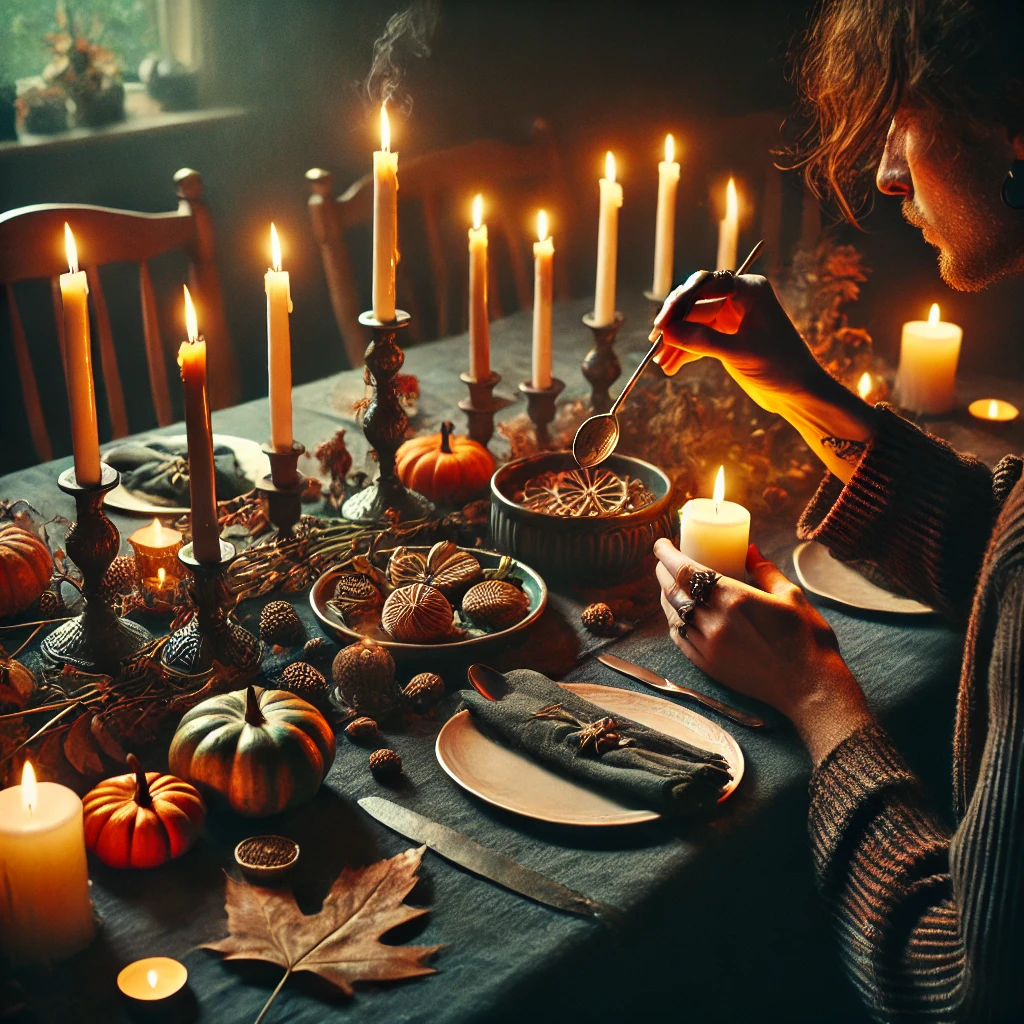
  1. To begin, select a table or surface for the Dumb Supper. Cover the table with a black or dark-colored cloth, symbolizing the thinning veil between worlds and the mystery of the season. Set a place for each ancestor you wish to honor. Each place setting should include a plate, utensils, and a glass or cup. You may choose to add candles to represent each ancestor’s presence, photographs, or other meaningful objects such as heirlooms. Leave an empty chair at the table to signify the physical absence of your ancestors but their spiritual presence.

Preparing the Meal:

  1. Prepare a meal that holds significance for you, your family, or your ancestors. This could be a dish that was a favorite of a loved one who has passed, or a meal that evokes memories of family gatherings. The preparation of this meal should be done in silence, with intention and reverence. Each step taken in preparing the food becomes a form of connection with the spirits of your ancestors, inviting them into your home.
  2. Note: Silence is key to this ritual. As you cook, remain in a state of reflection, focusing on your connection with those who have passed.

Beginning the Supper:

  1. When you are ready to begin the Dumb Supper, light the candles on the table, symbolizing the flame of life and the guiding light for the spirits. Sit down at the table and allow yourself to feel the presence of your ancestors. Begin the meal in complete silence, reflecting on the memories of your loved ones, their impact on your life, and the wisdom they have passed down.
  2. Focus: Throughout the meal, maintain silence to honor the spirits. Focus your attention on your connection with them, remaining open to any sensations, emotions, or subtle messages that may arise.

Offering to the Spirits:

  1. At any time during the meal, take a portion of your food or drink and place it in a separate dish or cup. This offering is for your ancestors, symbolizing your gratitude for their presence, guidance, and continued influence in your life. These offerings can remain on the table throughout the meal or be placed on your ancestor altar afterward.

Reflecting in Silence:

  1. As you eat, take the time to meditate on the presence of your ancestors. Reflect on the cycles of life, death, and rebirth, and how you continue their legacy through your actions. If any thoughts, emotions, or sensations arise, allow yourself to fully experience them. This is a time for introspection, reflection, and spiritual communion.

Closing the Supper:

  1. After the meal, take a moment to thank your ancestors for joining you. A simple prayer or blessing can help conclude the supper:
  2. “I thank you, spirits of my ancestors, For your guidance, protection, and love. May your wisdom continue to flow through me, As I honor your memory and walk in your light. Blessed be.”
  3. You may also leave any remaining food offerings on your altar or outside in nature as a final gesture of gratitude.

• The silence during the Dumb Supper is crucial as it allows for undistracted communion with your ancestors. It fosters a deep spiritual atmosphere where messages and insights from the spirit realm may be more easily received.
• Families with children may find this ritual particularly meaningful. Involving children in setting the table and preparing the meal can help teach them about their ancestry, family traditions, and the importance of honoring those who have passed on.

Samhain
Rituals

Wrapping Up

The Dumb Supper is a beautiful and powerful way to connect with our ancestors during Samhain. It provides a space for reflection, reverence, and deep gratitude for the spirits of those who have walked before us. Whether practiced alone or with family, this ritual allows for a sacred connection that transcends time, inviting the presence of our loved ones back into our lives, even if only for a fleeting moment. Through this practice, we remember that the bonds of love, wisdom, and spirit never truly fade, and that those who have passed continue to guide us with their light. Blessed Be.

Posted on Leave a comment

Samhain Explained

Samhain
Samhain

Introduction

A Journey into the Roots and Modern Celebrations of the Festival of the Dead

As the wheel of the year turns toward the darker half, Samhain (pronounced “sow-en”) emerges as one of the most significant festivals in the Pagan calendar. Celebrated on the night of October 31st through November 1st, Samhain is not only the Pagan New Year but also a time when the veil between the worlds of the living and the dead is at its thinnest. It is a liminal time, filled with magic, mystery, and the ancient tradition of honoring ancestors and embracing transformation. In this detailed article, we will delve into the origins, history, modern interpretations, customs, and the symbols that make Samhain a beloved and sacred festival for Pagans and Wiccans today.

The Origins of Samhain

The name “Samhain” is derived from the Old Irish words meaning “summer’s end,” signaling the close of the warm, fertile months and the onset of the cold, dark half of the year. It marks the final harvest and a significant transition from the season of light to the season of darkness, a change deeply woven into the fabric of ancient Celtic culture. Samhain is not merely a celebration of the harvest, but a profound moment of change, when the natural world retreats into dormancy, and the boundaries between the physical and spiritual realms grow thin.

Samhain’s roots lie deep in ancient Celtic traditions, dating back over 2,000 years to a time when communities across Ireland, Scotland, and other parts of the Celtic world held festivals to honor the cyclical nature of life and death. This period marked the end of the harvest season and the preparation for the cold, dark winter months ahead. The Celts believed that during Samhain, the wheel of the year turned toward the darker half, symbolizing both an ending and a new beginning.

In ancient Ireland, Samhain was one of the four most important fire festivals, alongside Imbolc, Beltane, and Lughnasadh. These festivals served as pivotal markers of the changing seasons and the cycles of nature. Samhain stood as a time when the last of the crops were gathered, and the community prepared for winter. It was also when the livestock, which had grazed in the summer pastures, were brought down to more protected areas for the winter months. As the agricultural cycle came to a close, Samhain represented both the literal and symbolic harvesting of the land’s bounty, as well as the harvesting of wisdom, reflection, and spiritual insight.

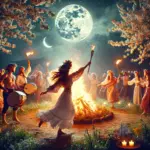
One of the defining features of Samhain was the lighting of great bonfires, a tradition that was both practical and spiritual. These bonfires, often lit on hilltops, symbolized light and protection during the dark winter months. The flames were believed to hold protective powers, warding off malevolent spirits and guiding the community through the challenges of the season. Bonfires were also seen as purifying and cleansing, helping to protect livestock and homes from harm during this liminal time when the veil between the worlds was thin. Families would often extinguish the hearth fires in their homes and relight them from the communal bonfire, symbolizing unity, purification, and the collective strength of the community.

A Liminal Time Between Worlds

Samhain is regarded as a liminal time, a moment when the boundaries between the human world and the Otherworld—the realm of spirits, ancestors, and the fae—were at their most permeable. The ancient Celts believed that during Samhain, the veil separating the living and the dead thinned, allowing spirits, both benevolent and mischievous, to cross into the mortal world. It was a time of heightened spiritual energy, where communication with the dead and the spirit realm was not only possible but actively sought. The Celts welcomed the spirits of deceased loved ones, setting places at the table and offering food to honor and nourish them on their journey.

While the spirits of ancestors were honored and welcomed, Samhain was also a time of caution. It was believed that not all spirits were benevolent, and mischievous or malevolent beings, such as the Aos Sí (the fairy folk), might wander the earth, causing harm or playing tricks on the living. To protect themselves from these wandering spirits, the Celts would dress in costumes and masks, disguising themselves as spirits or creatures to avoid being recognized or harmed. This practice is one of the early roots of modern Halloween traditions.

Samhain was not only a time to honor the dead but also a season of divination and prophecy. The Druids, who were the spiritual leaders, priests, and wise ones of the Celtic people, played a central role in conducting rituals and ceremonies during Samhain. They believed that the liminal nature of the festival made it the ideal time to gain insight into the future and seek guidance for the coming months. Methods of divination, such as scrying, using runes, or reading animal bones, were employed to foretell important events, such as the outcome of battles, weather patterns, or the success of crops in the next growing season.

Additionally, fire was central to the divinatory rituals performed by the Druids during Samhain. The Celts believed that the sacred bonfires held the power to reveal omens and portents for the future. Participants in the Samhain festivities would often carry a burning ember from the communal bonfire back to their homes, using it to rekindle their hearth fires. This act was not only symbolic of protection and unity but also a way to carry the spiritual blessings of the Samhain fires into their personal spaces.

For the Celts, Samhain was a time of profound reflection—a moment to acknowledge the death of the old year and the inevitable approach of winter. It was a time of endings, when the sun’s warmth faded, and nature itself withdrew into the quiet of the dark months. But, as with all things in Celtic belief, death was never an ending but a passage to rebirth. Just as the land would sleep through the winter and awaken in spring, so too did the Celts believe that the souls of the dead would rest and eventually be reborn.

Samhain marks a powerful moment of transition, both in the natural world and the spiritual realm. It is a festival that celebrates the end of the harvest, the coming of winter, and the thinning of the veil between life and death. Samhain’s origins are deeply intertwined with the rhythms of the earth and the cycles of life, death, and rebirth, making it one of the most spiritually significant festivals of the Celtic year.

The History of Samhain

The celebration of Samhain dates back over 2,000 years and was primarily observed by the ancient Celts of Ireland, Scotland, and parts of Wales. As one of the most important and solemn festivals in the Celtic calendar, Samhain signified the end of the harvest and the beginning of the long, dark winter. It was a time to gather the last crops, prepare for the cold months ahead, and offer thanks for the bounty that sustained life through the year. However, more than just a harvest festival, Samhain was a liminal time—a moment when the boundaries between the living and the dead blurred, allowing communication between the two realms.

Samhain’s connection to the Celtic understanding of life and death is profound. The Celts believed that time was cyclical rather than linear, and just as the seasons turned, so too did the journey of the soul. Death was not viewed as an ending but a transition to another phase of existence. The belief in the Otherworld, where the dead resided, was a central part of Celtic spirituality. During Samhain, the veil between the worlds of the living and the dead was at its thinnest, making it easier for spirits to cross over and interact with the living. This spiritual aspect of Samhain made it a time to honor the dead and ancestors, offer hospitality to visiting spirits, and seek guidance from the Otherworld through divination and rituals.

As a pre-Christian festival, Samhain was deeply rooted in the cycles of nature and the spiritual connection between life and death. Ancient Celts recognized that the natural world was a reflection of these cycles, with the sun’s waning light and the earth’s retreat into dormancy mirroring the inevitability of death. Yet, this death was not feared—it was a natural part of the cycle that would give way to rebirth in the spring. Samhain, therefore, became a time of reflection on mortality, the passage of time, and the mysteries of the afterlife.

The Christianization of Samhain

When Christianity spread throughout Europe in the early medieval period, it sought to assimilate and adapt many of the existing pagan festivals rather than completely eradicate them. Samhain was no exception. As Christian missionaries encountered the Celts, they recognized the importance of Samhain in Celtic culture and incorporated elements of the festival into Christian observances. This led to the establishment of All Saints’ Day (November 1st) and All Souls’ Day (November 2nd), two Christian holidays that honored saints and prayed for the souls of the dead. These new Christian holidays overlapped with many of the customs and themes of Samhain, particularly the remembrance of the dead and prayers for the departed, helping to facilitate the transition from paganism to Christianity in Celtic regions.

However, while Samhain customs were integrated into these Christian celebrations, many of the older, pre-Christian traditions endured. Bonfires, which were originally lit to protect the community and ward off evil spirits during Samhain, continued to be part of the observance of All Hallows’ Eve (October 31st), the night before All Saints’ Day. In addition, the belief that the dead could return to the world of the living persisted in folk traditions, especially in rural areas, where feasts for the dead, lighting candles for spirits, and rituals of protection continued to be practiced by the people.

Many of the superstitions surrounding ghosts, spirits, and supernatural beings that were part of Samhain were transformed into Halloween customs. For example, the practice of dressing in costumes or masks to avoid being recognized by malevolent spirits during Samhain evolved into the modern-day Halloween tradition of children wearing costumes to ward off evil or to “trick” spirits. Similarly, the practice of offering food to spirits—either to honor deceased ancestors or placate mischievous spirits—became the foundation for trick-or-treating.

Samhain’s Revival in Neo-Paganism

By the late 19th and early 20th centuries, as Neo-Paganism and Wicca began to emerge as spiritual movements, there was a renewed interest in reviving the old Celtic festivals in their original form. As part of this spiritual revival, Samhain became one of the most widely celebrated festivals among Wiccans, Druids, and other Neo-Pagans. These groups sought to reclaim the ancient pagan heritage, rejecting the Christianization of the festival and returning to the original themes of honoring the dead, celebrating the harvest, and preparing for the dark winter months.

For many modern Pagans, Samhain is seen as the most important of the eight festivals in the Wheel of the Year—the calendar of annual festivals that mark the changing of the seasons. Samhain is often regarded as the Pagan New Year, as it symbolizes both an ending and a beginning. It marks the end of the agricultural cycle and the completion of the harvest, but it also represents the beginning of a new cycle of growth and rebirth. It is a time for introspection, for looking back on the past year and letting go of what no longer serves, and for setting intentions for the year ahead.

Modern practices of Samhain among Neo-Pagans often include ancestral rites, where practitioners create altars or shrines to their ancestors, leaving offerings of food, drink, and candles to honor the dead. Rituals are performed to communicate with spirits, often through scrying, tarot readings, or other forms of divination, to gain insight into the future or receive guidance from the Otherworld. Some Pagans also light bonfires or candles, continuing the ancient tradition of using fire as a protective and purifying force during this spiritually potent time.

The history of Samhain is a rich tapestry of ancient Celtic traditions, Christian adaptations, and modern Pagan revivals. Despite its transformation over the centuries, the core elements of Samhain—honoring the dead, celebrating the harvest, and recognizing the cycles of death and rebirth—have endured. Today, Samhain is a time for reflection, spiritual connection, and renewal, continuing to offer profound meaning to those who observe it.

Modern Interpretations of Samhain

While Samhain has its roots in ancient Celtic traditions, it has evolved and been adapted to suit modern Pagan and Wiccan practices. For contemporary practitioners, Samhain is not only a time to honor the final harvest but also a significant spiritual event that marks the end of one cycle and the beginning of another. In many Pagan and Wiccan traditions, Samhain is considered the beginning of the spiritual new year—a time to reflect on the past, release old patterns, and embrace personal transformation. This time of year, is seen as an opportunity to commune with ancestors, explore the mysteries of death and rebirth, and engage in deep introspection as the season transitions into the colder, darker months.

Samhain remains a powerful time of transition, much like it was in ancient times. The festival’s themes of death and rebirth have resonated through the ages and continue to inspire modern practitioners. Reflecting on the past year is central to Samhain rituals today, as practitioners use this period to assess their accomplishments, challenges, and personal growth. This reflection allows them to release what no longer serves them—whether it’s old habits, relationships, or emotional patterns—so they can move forward unburdened into the next phase of their lives. In this way, Samhain is a time for letting go and for renewal, echoing the ancient practice of completing the harvest and preparing for the winter ahead.

A significant aspect of Samhain in modern practice is the honoring of the dead. This is often done through the creation of altars dedicated to ancestors and departed loved ones. These altars may be adorned with photographs, mementos, candles, and offerings of food or drink that the ancestors enjoyed in life. Practitioners might light candles for deceased family members and friends to guide their spirits and show respect. Many also believe that during Samhain, the veil between the worlds of the living and the dead is at its thinnest, making it an ideal time to communicate with the spirit world. Practitioners often engage in rituals aimed at connecting with the dead, whether through divination, mediumship, or scrying. This connection with the spirit realm offers an opportunity to gain insight, receive guidance, or simply commune with those who have passed.

Divination is a key aspect of modern Samhain practices. Since the veil between the worlds is believed to be thinner during this time, practitioners use tools such as tarot cards, runes, pendulums, or scrying mirrors to access spiritual messages and insights into the future. Many believe that this enhanced spiritual energy aids in receiving clearer guidance from the beyond, making it an ideal time for seeking wisdom from the Otherworld. Practitioners may use this time to ask questions about the coming year, seek clarity on personal matters, or connect with spirit guides for wisdom and support.

Samhain is also a time of celebration—a final nod to the harvest season before winter fully takes hold. In modern Pagan and Wiccan traditions, offerings of apples, pumpkins, grains, and other seasonal produce are made to deities and spirits. These offerings serve as symbols of gratitude for the bounty of the earth and as a farewell to the growing season. Feasts are often held in honor of the season, with meals that incorporate harvest foods like root vegetables, squash, and apples. Some traditions may include ritual toasts, where wine, cider, or mead is shared in honor of the ancestors, spirits, and gods who have blessed the harvest.

Bonfires remain a prominent feature in many modern Samhain celebrations, much like they did in ancient times. These fires represent protection, purification, and transformation, helping participants let go of the old and make space for the new. Many Pagans also perform candle magic, lighting candles in the colors of the season—orange, black, and white—to represent the balance of light and darkness, the life-death cycle, and the guidance of the spirit world. Participants may write down intentions or things they wish to release and burn them in the fire, symbolizing the transmutation of energy and personal renewal.

In addition to rituals of release, introspective meditation plays an important role during Samhain. Practitioners often take time to reflect on their spiritual journey, contemplate the darker aspects of life, and embrace the mystery of death and transformation. This meditation allows for deep personal insight and emotional healing, as participants confront their fears and uncertainties and learn to find peace within the cyclical nature of life and death.

In modern Paganism, Samhain is more than just a time to remember the dead or celebrate the harvest; it is a time to explore the mysteries of life and death, to find balance within oneself, and to harness the energies of transformation that are present in the natural world. Whether through ancestral veneration, divination, or harvest celebrations, Samhain invites us to connect with the cycles of life, death, and rebirth, reminding us that change is constant and that, like the seasons, we too are always in flux. As modern practitioners embrace these ancient customs and give them new meaning, Samhain continues to be a powerful time of spiritual reflection and renewal.

Traditions and Customs of Samhain

Samhain is a festival rich with ancient traditions, many of which have been passed down through the centuries and continue to be celebrated in both old and modern forms. These customs reflect Samhain’s deep connection to the cycles of life and death, as well as the transition between the world of the living and the spirit world. Here are some of the most prominent Samhain traditions that remain integral to modern-day celebrations:

Bonfires

In ancient Celtic societies, bonfires were a central feature of Samhain celebrations. These great fires were believed to hold protective power, warding off evil spirits that were thought to roam the earth during this liminal time. Bonfires were also a communal event, gathering people together to provide warmth and protection as the colder months approached. The act of lighting a fire was symbolic, representing light in the darkness and the community’s strength as they prepared for the winter ahead.

Today, modern Pagans continue this tradition by lighting bonfires or gathering around candles during their Samhain rituals. Fire represents purification, transformation, and the connection to the otherworld. Many people cast offerings of herbs or written intentions into the fire, asking for protection, clarity, or blessings as they prepare for the new year. In both its ancient and modern forms, the Samhain bonfire is a powerful symbol of communal strength, protection, and transformation.

Feasts and Offerings

Feasts have long been an important part of Samhain traditions. As Samhain marks the final harvest, the feast is a celebration of the season’s abundance, featuring foods that represent the end of the agricultural cycle. Seasonal ingredients, such as apples, nuts, root vegetables, grains, and freshly baked bread, take center stage on the Samhain table. These foods embody the harvest’s bounty, nourishing the body and soul during the darker, colder months ahead.

A particularly poignant custom during Samhain feasts is the setting of a place at the table for deceased ancestors. This practice is a way to honor and invite the spirits of loved ones to join in the celebration, maintaining the connection between the living and the dead. Many Pagans and Wiccans also prepare offerings for the dead, which are placed on altars or left outside as gifts for wandering spirits. These offerings may include food, drink, or symbolic tokens that represent the love and respect still held for those who have passed on.

Ancestor Altars

During Samhain, many Pagans and Wiccans create ancestor altars to pay homage to their deceased loved ones. These altars often feature photographs, personal items, and mementos that hold memories of those who have passed. Candles, incense, and offerings are placed on the altar as symbols of reverence and to help guide spirits during this liminal time when the veil between worlds is at its thinnest.

Ancestor altars are a focal point for reflection and connection. Practitioners may sit in meditation at the altar, offering prayers of gratitude or asking for guidance from their ancestors. This practice reminds us of the cyclical nature of life and death and helps maintain an ongoing relationship with those who have crossed over into the spirit world. The altar becomes a sacred space for honoring lineage, expressing gratitude, and keeping memories alive.

Costumes and Masks

The tradition of wearing costumes and masks during Samhain has its origins in ancient Celtic customs. The Celts believed that during Samhain, the veil between the living and the spirit world was at its thinnest, allowing spirits—both benevolent and malevolent—to roam freely. To protect themselves from harm, people would don disguises that mimicked the spirits, thus confusing or warding off any malevolent beings that might cross their path.

This practice of wearing costumes to avoid detection by wandering spirits is the origin of modern Halloween costumes. Today, both Pagans and non-Pagans alike continue the tradition of dressing up during Samhain, albeit for different reasons. For modern Pagans, wearing ritual masks or costumes may still symbolize a connection to the spirit world or the act of stepping into a different role or identity as part of their Samhain rituals. In this way, the tradition of dressing up retains its mystical origins and continues to be a vital part of Samhain celebrations.

Divination and Scrying

Divination is an integral part of Samhain, as the thinning veil is believed to enhance one’s ability to connect with the spirit world and gain insight into the future. In ancient times, Druids and wise folk would perform rituals to foresee the coming winter and predict important events.

Today, many modern Pagans and Wiccans use tools such as tarot cards, runes, pendulums, and scrying mirrors during their Samhain rituals. Scrying—gazing into a reflective surface such as a mirror, water, or crystal ball—allows the practitioner to receive visions or messages from the spirit world. Divination during Samhain is often focused on seeking guidance from ancestors or spirit guides or gaining insight into the coming year. Whether through traditional methods or modern tools, divination remains a central part of Samhain’s mystical energy.

Carved Turnips and Pumpkins

The tradition of carving turnips or pumpkins into Jack-o’-lanterns originates with Samhain. In ancient Celtic tradition, turnips were hollowed out and carved with grotesque faces to scare away malevolent spirits that might wander the earth during Samhain night. The flickering light inside these lanterns represented a guiding flame to protect homes and individuals from harm.

When Irish and Scottish immigrants brought this tradition to North America, they began carving pumpkins, which were more readily available and easier to carve than turnips. Thus, the modern-day Jack-o’-lantern was born. Today, carving pumpkins remains a central custom of Samhain and Halloween alike, serving as a symbol of protection and as a celebration of creativity and harvest.

Trick-or-Treating

Although it is more commonly associated with modern Halloween, the practice of trick-or-treating has its roots in ancient Samhain traditions. People would leave out food and offerings to appease wandering spirits and prevent them from causing mischief or harm. This practice evolved into the medieval tradition of “souling,” where children and the poor would go door-to-door offering prayers for the dead in exchange for soul cakes—a precursor to the treats given out today. While trick-or-treating has become largely secular, its origins remain tied to the ancient customs of Samhain and the interaction between the living and the spirit world.

These traditions and customs—some ancient, some evolved—make Samhain a festival of profound spiritual depth, communal connection, and introspection. Whether honoring ancestors, performing rituals of divination, or gathering around a fire, these customs keep alive the magic and mystery of Samhain in the modern world.

Modern Practices and Celebrations of Samhain

Samhain, while rooted in ancient Celtic traditions, has continued to evolve, gaining popularity both within and outside Pagan and Wiccan communities. Its association with Halloween has introduced elements of Samhain to mainstream culture, but for those following a Pagan path, Samhain remains a deeply spiritual and introspective celebration. Modern Samhain practices reflect a blend of ancient customs and contemporary rituals, focusing on honoring the cycles of nature, connecting with the spirit world, and commemorating the memories of ancestors. Below are some of the most common modern practices associated with Samhain:

Ritual Circles

For many Pagans and Wiccans, ritual circles are a central part of Samhain celebrations. Groups—whether covens or informal gatherings of practitioners—come together to create a sacred space in which to perform rituals. The participants often begin by casting a circle, a protective barrier that serves as a designated space for magical work. This act of creating a circle of protection symbolizes a boundary between the physical world and the spiritual realm, providing a secure environment for ritual work.

During these rituals, the four quarters (also known as the four cardinal directions) are invoked, representing the elements of earth, air, fire, and water. These elements are called upon for guidance, protection, and energy. Rituals may include lighting candles, chanting, reciting prayers, or making offerings to ancestors and deities. At Samhain, the focus is often on transformation, renewal, and honoring the dead. Participants might meditate, visualize, or engage in symbolic acts, such as burning paper inscribed with old habits they wish to release or lighting candles to symbolize new beginnings.

The ritual circle during Samhain is often somber and introspective, reflecting the themes of death, rebirth, and transformation. Participants honor their ancestors, seek spiritual guidance, and prepare for the coming winter. In many ways, these circles echo the ancient bonfires of Samhain’s past, creating a sacred space for community, reflection, and the acknowledgment of the changing seasons.

Samhain Sabbat

Within Wiccan traditions, Samhain is considered one of the most important Sabbats of the year, marking the final harvest and the beginning of the spiritual new year. Wiccans celebrate the Samhain Sabbat by honoring the God and Goddess in their respective aspects of death and rebirth. At this time of year, the God, who was sacrificed during Lammas (Lughnasadh), is journeying through the underworld, preparing to be reborn at Yule, the Winter Solstice. The Goddess, in her role as the Crone, embodies wisdom and transformation, guiding the soul through the mysteries of life and death.

The Samhain Sabbat often includes rituals that acknowledge the cycle of life and death. Offerings are made to the God and Goddess, prayers are spoken to honor the dead, and rituals may be performed to release old patterns and embrace new growth. This is a time for quiet introspection, where participants reflect on the year that has passed, the lessons they have learned, and the personal transformations they hope to undergo in the coming year. The Sabbats allow Wiccans to align their personal spiritual journey with the natural cycles of the earth, reinforcing the themes of balance, continuity, and renewal.

Quiet Reflection

While group rituals are a central part of Samhain for many practitioners, quiet reflection plays an equally important role, especially for those who celebrate in solitude. Samhain’s connection to death and rebirth encourages personal contemplation of one’s own life, ancestors, and spiritual path.

Many Pagans use this time for journaling, writing down their thoughts, emotions, and intentions. This might involve reflecting on the past year, identifying what needs to be released, and setting intentions for the future. Meditation is also a common practice during Samhain, allowing practitioners to still their minds and listen for guidance from the spirit world or their inner selves.

Spending time in nature is another powerful way to connect with the energy of Samhain. A walk through the woods, a visit to a cemetery, or simply sitting in a quiet outdoor space can provide a deeper connection to the cycles of life and death unfolding in the natural world. The falling leaves, the crisp air, and the shortening days all serve as reminders of the impermanence of life and the eternal cycle of decay and renewal.

Storytelling

Storytelling has long been a tradition associated with Samhain. In ancient times, oral traditions were used to pass down the wisdom of ancestors, legends of gods and goddesses, and folklore that connected communities with the spiritual world. This custom continues in modern Pagan practices, where storytelling takes on a central role during Samhain celebrations.

Many Pagans gather with friends, family, or their spiritual community to share myths and legends that honor the gods and goddesses associated with death, rebirth, and the cycles of nature. Myths of the Morrigan, Persephone, and Hades are particularly popular during Samhain, as they reflect the themes of transformation, underworld journeys, and the cyclical nature of life. These stories not only entertain but also provide a sense of continuity with the past, reinforcing the deep spiritual lessons Samhain offers.

Storytelling is also a way to honor the ancestors, keeping their memory alive by sharing tales of their lives and experiences. By recounting family stories, personal memories, or even ancestral history, modern practitioners connect with their lineage and reinforce the ancestral bonds that are so central to Samhain. For many, storytelling during Samhain is both a spiritual practice and a way to strengthen community ties.

These modern practices and celebrations of Samhain reflect a blend of ancient traditions and contemporary interpretations. Whether participating in group rituals, solitary reflection, or honoring ancestors through storytelling, Samhain serves as a sacred time for acknowledging the cycles of life, death, and rebirth. It allows practitioners to connect with the mysteries of the spirit world, embrace the wisdom of the ancestors, and align themselves with the natural rhythms of the earth. Through these rituals and celebrations, the magic of Samhain continues to thrive, bridging the gap between the ancient past and the modern world.

The Magic of Samhain’s Symbols

Samhain is rich with symbolism, with each object representing different aspects of the festival’s core themes: death, rebirth, and transformation. These symbols serve as powerful tools in rituals and spellwork, helping practitioners connect to the spiritual energies of the season. Below are some of the most commonly used symbols in Samhain rituals, along with their significance:

Pumpkins and Gourds: The Harvest’s Final Gift

Pumpkins and gourds are iconic symbols of Samhain, representing the final harvest and the abundance of the Earth as autumn gives way to winter. Their round shape and vibrant colors remind us of the fertility of the land and the bounty that has been gathered before the darker months settle in.

Traditionally, pumpkins are carved into Jack-o’-lanterns to protect homes from wandering spirits. The practice of carving faces into pumpkins originates from an old Celtic custom where turnips were hollowed out and carved to scare away malevolent entities. As pumpkins became more common in North America, they replaced turnips due to their size and ease of carving. Today, these carved pumpkins are placed in doorways and windows as a protective symbol, helping ward off evil spirits during the thinning of the veil between the living and the dead.

In modern Samhain rituals, pumpkins and gourds are often used to decorate altars or create offerings to deities and spirits, symbolizing the cycle of growth, harvest, and decay. They serve as reminders that while the Earth now enters a period of rest, it will once again provide sustenance in the future.

Candles: Guiding Lights for the Spirits

Candles hold significant symbolic value during Samhain. In many traditions, candles—especially black, white, or orange—are used to honor the dead, invite spirits, and provide a spiritual light during the darker months. Black candles represent protection, banishing negative energy, and marking the end of a cycle, while white candles signify purity, remembrance, and connection to higher spiritual realms.

The flickering flame of a candle is believed to attract souls of the dead and the energies of the spirit realm, guiding them to the light. Lighting candles during Samhain creates a bridge between the living and the dead, allowing practitioners to communicate with ancestors and spirits. In some traditions, a candle is left burning in a window or at an altar to guide wandering souls safely through the night and back to the otherworld. This ritual symbolizes a deep respect for the dead and reinforces the idea that death is not the end, but a transformation in the cycle of life.

Skeletons and Skulls: Reminders of Mortality

Skeletons and skulls are powerful symbols of mortality, representing both the ancestors and the inevitability of death. Their presence during Samhain serves as a stark reminder of the natural cycles of life, death, and rebirth. The use of skulls or skeletal imagery in rituals helps practitioners confront their own mortality and honor the wisdom of those who have passed before them.

In some traditions, skulls are placed on ancestor altars to represent the deceased, and offerings are made in their honor. These symbols can also be used as focal points during meditation on death and transformation, helping practitioners accept the fleeting nature of life while acknowledging the continuous cycle of existence.

Skulls also carry protection symbolism, warding off negative entities and offering a reminder of the resilience of the soul beyond physical death. During Samhain, they represent the idea that although the body may perish, the spirit endures, transitioning into a new phase of existence.

Apples: The Fruit of Life and Immortality

Apples have long been associated with life, immortality, and divination. In Celtic mythology, the apple tree is known as the Tree of Knowledge and the Tree of the Otherworld, often symbolizing the entrance to the spiritual realm. Apples are a symbol of fertility and eternal life, making them a central figure in Samhain rituals.

One of the most well-known Samhain traditions is apple divination, which involves bobbing for apples or slicing apples to reveal hidden symbols or messages. For example, slicing an apple horizontally reveals a five-pointed star at its core, symbolizing protection, and the interconnectedness of the elements. Practitioners often use apples in offerings to spirits, leaving them on altars or graves to honor deceased loved ones.

As a symbol of renewal and eternal life, apples embody the core theme of rebirth that is central to Samhain. Whether eaten, offered, or used in divination, apples remind us that life continues beyond death, cycling back into existence in new and ever-changing forms.

Crows and Ravens: Messengers of the Otherworld

Crows and ravens, often associated with death, transformation, and the mysteries of the underworld, are frequently seen as symbols of Samhain. In Celtic mythology, the Morrigan, a goddess of battle and fate, is often depicted in the form of a crow or raven, making these birds powerful symbols of both destruction and renewal.

Crows and ravens are believed to be messengers between the physical and spiritual worlds, carrying the wisdom of the dead and the divine to those who remain in the living world. Their dark plumage and haunting calls invoke the mysteries of death and the unknown, making them ideal companions for rituals that involve spirit communication or ancestor work.

Seeing a crow or raven during Samhain can be interpreted as a sign that spirits or deities are near, watching over the living and offering guidance. Practitioners may also use imagery or feathers from these birds in rituals of protection, transformation, and divination. In particular, the raven’s association with prophecy makes it a powerful symbol in Samhain scrying or tarot readings.

Section Wrap Up

Each of these symbols—pumpkins, candles, skeletons, apples, crows, and ravens—offers a unique representation of Samhain’s profound themes of death, rebirth, and transformation. Incorporating these symbols into Samhain rituals allows practitioners to tap into the magical energies of the season, honoring the ancestors, connecting with spirits, and embracing the mystery of life’s cycles. These sacred symbols not only hold historical significance but also invite a deeper understanding of the interwoven forces of nature and spirituality that Samhain brings to light.

Mythological Tales Associated with Samhain

Samhain’s themes of death, rebirth, and the veil between worlds are reflected in several ancient mythological tales, which have been passed down through generations of Celtic storytelling. These stories not only capture the supernatural aspects of the festival but also serve as allegories for the cycles of nature and life, themes that are central to the Samhain celebration.

The Morrigan: Goddess of War, Death, and Fate

One of the most prominent mythological figures associated with Samhain is The Morrigan, the Irish goddess of war, fate, and death. She is often depicted as a shapeshifter who appears as a crow or raven, surveying battlefields and deciding the fate of warriors. As a goddess of death and transformation, The Morrigan embodies the dark, liminal energies that come into play during Samhain, when the veil between the living and the dead is thinnest.

The Morrigan’s connection to Samhain is deeply symbolic. She is often depicted as presiding over death and the afterlife, guiding souls who have passed into the Otherworld. Her presence at Samhain reminds practitioners that death is not the end, but rather a transformation—a passage into the unknown and a precursor to rebirth.

In some tales, The Morrigan is linked with Cúchulainn, the great Irish hero. One story tells of how she attempted to seduce the warrior before his final battle. When he rejected her advances, she cursed him, appearing as a crow to watch over his eventual demise. The Morrigan’s role in this myth underscores her authority over fate and mortality, and her connection to the cycles of life and death that are honored during Samhain.

At Samhain, The Morrigan’s dark and transformative energies are invoked in rituals, particularly those that deal with personal transformation, letting go of the past, and confronting the mysteries of death. She serves as a reminder that within darkness, there is potential for growth, healing, and rebirth.

The Wild Hunt: A Procession of Spirits

Another myth associated with Samhain is the tale of the Wild Hunt, a spectral procession of ghosts, spirits, and faeries that rides through the sky during the darkest nights of the year. The Wild Hunt is a common motif in European folklore, but its appearance in Celtic mythology is particularly tied to the liminal energies of Samhain.

The Wild Hunt is often depicted as a terrifying cavalcade, led by a powerful deity or spirit, such as Cernunnos, the Horned God of the Celts, or the King of the Fairies. This otherworldly host is believed to roam the skies during Samhain, when the boundaries between the living and the dead are thinnest. In some versions of the myth, the Wild Hunt is composed of the souls of the dead, faeries, or other supernatural beings that have been unleashed into the mortal realm.

It is said that to witness the Wild Hunt can bring misfortune, death, or a curse, as those caught in the Hunt’s path are swept away into the Otherworld, never to return. Some legends warn that seeing the Wild Hunt is a bad omen, foretelling impending disaster or death within the community. To protect themselves from the Hunt, people would stay indoors, light fires, and offer prayers to ward off the malevolent forces during Samhain night.

Despite the fearsome nature of the Wild Hunt, the myth also reflects the cyclical nature of life and death, much like Samhain itself. The spirits that ride out during the Hunt remind us that the Otherworld is never far away, and that during Samhain, the living must coexist with these unseen forces.

In modern Pagan rituals, the Wild Hunt is sometimes invoked to represent the cycle of death and rebirth, or as a metaphor for confronting inner demons and facing one’s fears. Some practitioners use this myth as a way to honor their ancestors, or to release old patterns as they prepare for the darkness of winter and the promise of renewal that follows.

The Myth of Fionn Mac Cumhaill and the Salmon of Knowledge

Another significant myth tied to Samhain involves the legendary Irish hero Fionn Mac Cumhaill (also known as Finn McCool) and the Salmon of Knowledge. According to this tale, Fionn was a member of the Fianna, a band of warriors in Irish mythology. As a young boy, he was entrusted with watching over the salmon that swam in the sacred river Boyne, a creature said to possess all the wisdom of the world.

During Samhain, the story goes, Fionn accidentally tasted the salmon’s flesh, thereby gaining its wisdom. This knowledge allowed him to become a great leader and a master of prophecy and divination. Fionn’s transformation from a youth into a wise warrior and leader is a key theme of the myth, symbolizing the transformation that comes with knowledge, experience, and rebirth—all themes that resonate deeply during Samhain.

The myth of Fionn and the Salmon of Knowledge emphasizes the importance of seeking wisdom during the darker half of the year. Samhain is traditionally a time for divination, when the veil between worlds is thin, and practitioners seek guidance from the spirits or ancestral wisdom to help navigate the challenges ahead. Like Fionn, those who celebrate Samhain hope to gain insight and clarity for the coming year, trusting in the wisdom that emerges from their rituals, meditations, and divinatory practices.

The Goddess and the Horned God: The Eternal Dance of Death and Rebirth

In Wiccan and neo-Pagan traditions, Samhain is often framed as the time when the Horned God dies, only to be reborn again at Yule. The Goddess, in her aspect as the Crone, mourns his passing, yet she also understands that death is a part of the eternal cycle of life, death, and rebirth. Together, the Goddess and the Horned God embody the natural cycles that are honored during Samhain—the end of one cycle and the promise of renewal in the next.

This myth is enacted in Samhain rituals as a way to honor the sacrifices made during the harvest, as well as to confront personal transitions or endings. It serves as a reminder that death is not something to be feared, but rather, it is a necessary part of the cycle of existence. The Horned God will rise again, just as the sun returns after the longest night at Yule, and the Goddess, ever eternal, will continue to oversee the cycles of life.

Section Wrap Up

Mythological tales associated with Samhain, such as those of The Morrigan, the Wild Hunt, Fionn Mac Cumhaill, and the Horned God and Goddess, offer powerful narratives that echo the themes of death, rebirth, and transformation central to this festival. These stories not only help explain the mystical significance of Samhain but also offer timeless lessons about the cyclical nature of life, the power of transformation, and the interconnectedness between the living and the dead. By engaging with these myths, practitioners of Samhain can deepen their connection to the ancient energies of the season and find guidance and inspiration in their spiritual journey.

Conclusion

Samhain is a powerful celebration of the eternal cycles of life, death, and rebirth, a festival that transcends time by weaving ancient traditions with modern practices. It serves as a profound reminder to honor our ancestors, commune with the spirit world, and acknowledge the impermanence and transformation that define our existence. Whether we engage in rituals by the flickering glow of a bonfire, light candles in remembrance of the departed, or quietly reflect on the past year, Samhain invites us to embrace the magic of change. It offers a sacred space to release old burdens, welcome new beginnings, and express gratitude for the wisdom passed down through the ages. As we stand at the threshold of the darker half of the year, Samhain becomes a time not only for remembering those who have come before us but also for finding clarity, balance, and renewal as we journey forward, guided by the flicker of ancestral light and the eternal rhythms of the Earth.

Posted on Leave a comment

Halloween and Samhain

Halloween and Samhain

Introduction

Unveiling the Ancient Origins and Modern Traditions

Halloween, a holiday celebrated annually on October 31st, has gained widespread popularity as a day of spooky festivities, costumes, and treats. However, few are aware of the ancient Celtic festival known as Samhain, which forms the foundation of Halloween as we know it today. In this article, we will explore the rich history and origins of Halloween, its connection to Samhain, the evolution of modern Halloween traditions, and safety considerations to ensure a memorable yet safe celebration.

What is Halloween?

Halloween, known as All Hallows’ Eve, is a widely celebrated annual holiday that takes place on the evening of October 31st, preceding All Saints’ Day on November 1st. Originating from Christian traditions, Halloween has transformed into a vibrant and joyous occasion celebrated in numerous countries, particularly within Western cultures. Today, Halloween is synonymous with a plethora of festive customs, including costumes, jack-o’-lanterns, haunted houses, and the beloved tradition of trick-or-treating.

At its core, Halloween serves as a precursor to All Saints’ Day, which is a significant feast day in the Christian calendar commemorating the saints and martyrs. All Hallows’ Eve is observed as a time to prepare for this solemn occasion, but over time, it has also developed its own distinct character.

One of the most prominent features of Halloween is the opportunity for people of all ages to engage in playful self-expression through imaginative costumes. From witches and ghosts to superheroes and fictional characters, Halloween grants individuals the freedom to temporarily transform themselves into whoever they desire, blurring the lines between reality and fantasy.

Another iconic element of Halloween is the use of jack-o’-lanterns. Derived from an Irish folklore tale of Stingy Jack, these carved pumpkins with flickering candles inside serve as whimsical and eerie decorations. They are often crafted with expressive faces and placed on porches, doorsteps, and windowsills to symbolize the spirits of the departed and ward off malevolent entities.

Haunted houses, whether professionally organized or creatively decorated by enthusiasts, have become a cherished part of the Halloween experience. These temporary attractions immerse visitors in a world of fright and anticipation, offering an adrenaline rush through chilling encounters, eerie sounds, and spine-tingling surprises. Haunted houses capture the thrill and excitement associated with the supernatural and macabre, further enhancing the Halloween spirit.

Perhaps the most eagerly anticipated aspect of Halloween, especially for children, is the age-old tradition of trick-or-treating. Dressed in their imaginative costumes, young ones embark on an adventure from door to door, exclaiming “trick or treat!” in exchange for sweets and treats. This custom harkens back to the ancient Celtic belief that offering food to roaming spirits would protect homes from mischief and misfortune during the transition into winter.

Halloween has transcended its religious origins to become a universally celebrated occasion, filled with enchantment, creativity, and community spirit. The amalgamation of customs such as costumes, jack-o’-lanterns, haunted houses, and trick-or-treating has solidified Halloween’s place as a cherished holiday where individuals of all ages can indulge in the magic of imagination and embrace the thrill of the unknown.

History and Origin

To truly understand the origins of Halloween, we must delve into the ancient Celtic festival of Samhain. Celebrated by the Celts in Ireland, Scotland, and the Isle of Man, Samhain was a significant event that marked the end of the harvest season and the beginning of winter. It was a time when the agricultural community prepared for the long, dark months ahead.

In Celtic belief, Samhain held a profound spiritual significance. It was believed that during this transitional period, the boundary between the realms of the living and the dead became blurred, allowing spirits, fairies, and other supernatural beings to freely roam the earthly plane. The Celts viewed this interaction between the living and spirit realms as an opportunity to communicate with their ancestors and seek guidance for the future.

During Samhain, the Celts engaged in various rituals and practices to honor and appease these spirits. They lit immense bonfires, symbolizing the cleansing power of fire and the protective barrier it provided against malevolent entities. People would gather around these bonfires, offering sacrifices of crops and livestock to honor the spirits and seek their favor.

Costumes played a significant role during Samhain. The Celts would dress in animal skins and don eerie masks to mimic the spirits they believed were wandering among them. This practice aimed to confuse and ward off any harmful entities that may be lurking, while also serving as a form of sympathetic magic to ensure a bountiful harvest in the following year.

Divination and fortune-telling were also an integral part of Samhain. The Celts believed that on this night, the veil between the present and the future was thinnest, allowing them to gain insights into their destiny. Various methods of divination, such as apple bobbing or scrying into mirrors, were used to seek glimpses of what lay ahead.

With the spread of Christianity, Samhain gradually assimilated into Christian traditions. In the 8th century, Pope Gregory III designated November 1st as All Saints’ Day, or All Hallows’ Day, to honor saints and martyrs. The evening prior, Samhain became known as All Hallows’ Eve, later evolving into Halloween.

As the centuries passed, Halloween absorbed influences from various cultures and regions. The influx of Irish and Scottish immigrants to the United States during the 19th century brought with them their cherished Samhain traditions. Over time, these customs merged with other Halloween practices, resulting in the unique blend of festivities we celebrate today.

Halloween finds its roots in the ancient Celtic festival of Samhain, a time when the Celts recognized the end of the harvest season and believed that the boundaries between the living and spirit worlds became permeable. The rituals, bonfires, costumes, and divination practices of Samhain have evolved and intertwined with Christian traditions, shaping the modern Halloween we celebrate with joy and enthusiasm.

Connection to Samhain

The connection between Halloween and Samhain is deeply rooted in the ancient Celtic festival’s beliefs, practices, and customs. Samhain, derived from the Gaelic term meaning “summer’s end,” held immense significance for the Celts and serves as the foundation for many Halloween traditions observed today.

Central to both Samhain and Halloween is the concept of the spirit world intersecting with the realm of the living. The Celts believed that on the night of October 31st, as the season shifted from autumn to winter, the veil between these worlds grew thin, allowing the spirits of the dead to return to Earth. This belief formed the basis for the Halloween custom of spirits and supernatural beings wandering among the living.

To honor and appease these returning spirits, the Celts engaged in various practices during Samhain. One such practice was the lighting of bonfires. These grand fires served multiple purposes. Firstly, they provided warmth and protection against the encroaching winter darkness. Secondly, the bonfires were believed to have a cleansing effect, purging the land of evil spirits and negative energies. These bonfires were ancestors to the jack-o’-lanterns we see today, as carved pumpkins with candles inside were used to ward off malevolent entities during Samhain.

Costuming played a crucial role in both Samhain and Halloween. The Celts would dress in costumes made from animal skins, often wearing masks and disguises. These outfits served multiple purposes. Firstly, they helped the Celts to blend in with the wandering spirits, ensuring they were not targeted or harmed. Secondly, the costumes were intended to confuse and deceive any malevolent spirits, preventing them from recognizing or causing harm to individuals.

Offerings of food and drink were a central part of Samhain’s practices. The Celts believed that by providing sustenance to the spirits of the dead, they could honor their ancestors and seek their blessings for the coming year. This tradition finds resonance in the modern Halloween practice of trick-or-treating, where children go from door to door, asking for treats and sweets, symbolizing the ancient act of providing offerings to wandering spirits.

Divination rituals were another significant component of both Samhain and Halloween. The Celts believed that the thinning of the veil between worlds granted them insight into the future and the ability to communicate with the spirit realm. They would engage in various forms of divination, such as apple bobbing, mirror scrying, or reading omens from the natural world, to gain glimpses of what lay ahead. Though modern Halloween has shifted away from divination practices, the idea of seeking glimpses into the mysterious and unknown remains a core theme.

The connection between Halloween and Samhain lies in their shared beliefs and customs surrounding the interaction between the living and spirit realms. The practices of lighting bonfires, wearing costumes, making offerings, and engaging in divination rituals during Samhain have been woven into the fabric of Halloween celebrations, ensuring that the ancient Celtic festival’s spirit continues to thrive in the modern world.

Evolution of Halloween Traditions

Throughout its history, Halloween has undergone a remarkable evolution, assimilating diverse cultural influences to become the holiday we celebrate today. With the merging of Celtic traditions and Christian practices, Halloween gradually transformed into a distinct occasion filled with unique customs and festivities.

The influence of Christianity on the Celtic festival of Samhain was a pivotal point in the evolution of Halloween. In the 8th century, Pope Gregory III declared November 1st as All Saints’ Day, or All Hallows’ Day, to honor saints and martyrs. The evening preceding this holy day became known as All Hallows’ Eve, eventually abbreviated to Halloween. This fusion of Samhain and Christian traditions laid the foundation for the holiday’s continued development.

As Halloween spread across different regions, it absorbed the customs and traditions of various cultures. In the United States, Irish and Scottish immigrants played a significant role in shaping Halloween as we know it today. These immigrants brought with them their cherished Samhain practices, which blended seamlessly with existing Halloween customs.

One of the most enduring elements of Halloween is the tradition of dressing up in costumes. The practice of wearing costumes during Samhain, where the Celts disguised themselves as spirits to ward off malevolent entities, found resonance among the Irish and Scottish immigrants. Over time, this tradition expanded to include a wide range of characters, from classic monsters to superheroes, allowing individuals to express their creativity and embrace the festive spirit of the holiday.

Another prominent tradition that emerged from the fusion of cultures is trick-or-treating. This custom can be traced back to the ancient Celtic practice of leaving offerings of food and drink for roaming spirits during Samhain. As Halloween developed in America, it transformed into a door-to-door activity where children would go from house to house, dressed in costumes, and request treats. This practice evolved into the modern tradition of trick-or-treating, where children eagerly collect candies and other goodies from their neighbors.

Over the years, Halloween has also been influenced by various cultural aspects. Immigrants from different backgrounds brought their unique customs and traditions, adding richness and diversity to the holiday. For example, the Mexican celebration of Día de los Muertos (Day of the Dead) infused Halloween with colorful imagery, honoring deceased loved ones and celebrating their lives.

Halloween has embraced pop culture as well. With the rise of movies, television shows, and literature focused on horror and the supernatural, Halloween became an opportunity for fans to pay homage to their favorite characters and themes. This led to the emergence of costume parties, haunted attractions, and themed events that further enhanced the festive atmosphere surrounding the holiday.

Halloween has evolved over time through a fascinating amalgamation of Celtic, Christian, and cultural influences. The merging of Samhain with Christian traditions, the impact of Irish and Scottish immigrants, and the incorporation of various customs have all contributed to the rich tapestry of Halloween. The evolution of Halloween traditions, including costumes, trick-or-treating, and cultural influences, has shaped the holiday into a vibrant and celebrated occasion enjoyed by people around the world.

Modern Halloween Traditions

As Halloween has evolved over the centuries, it has grown into a cherished holiday filled with an array of modern traditions. While still rooted in the ancient Celtic festival of Samhain and influenced by Christian practices, Halloween has embraced new customs and experiences that reflect the spirit of the present age. From creative costumes and elaborate decorations to festive parties and community events, the modern traditions of Halloween have transformed the holiday into a time of imagination, excitement, and shared celebration. Let’s delve into the vibrant tapestry of contemporary Halloween traditions and explore how they have shaped the way we celebrate this beloved holiday today. Halloween is celebrated in diverse ways. Common traditions include:

Costumes and Dressing Up: People of all ages don costumes ranging from spooky creatures to pop culture icons. Costume parties and contests are held, providing an opportunity for creative expression.

Jack-o’-Lanterns: Carving pumpkins into ghoulish faces and placing candles inside them has become a quintessential Halloween tradition. It is said to originate from an Irish myth about a man named Stingy Jack, who was doomed to wander the Earth with only a hollowed-out turnip as a lantern.

Trick-or-Treating: Children dressed in costumes visit houses in their neighborhoods, knocking on doors and saying “Trick or treat!” in exchange for candy or other treats. This tradition symbolizes the ancient practice of offering food to wandering spirits.

Haunted Houses and Parties: Many people enjoy visiting haunted houses, which are temporary attractions designed to provide scary experiences. Costume parties, themed events, and community gatherings are also common during Halloween.

Safety Considerations

While Halloween is a time of fun and excitement, safety should be a top priority. Here are some important considerations:

Costume Safety: Choose costumes that are flame-resistant, have good visibility, and do not obstruct movement. Use face paint or makeup instead of masks, which can hinder vision.

Trick-or-Treating Safety: Accompany young children while trick-or-treating and stick to well-lit areas. Inspect all treats before consumption and avoid homemade treats from unfamiliar sources.

Fire Safety: Be cautious with candles used in jack-o’-lanterns and decorations, keeping them away from flammable materials. Consider using battery-operated candles instead.

Road Safety: Stay visible by adding reflective tape to costumes and carrying flashlights. Observe traffic rules, use sidewalks when available, and always look both ways before crossing the street.

Conclusion

The intertwining of Halloween and Samhain showcases the enduring power of traditions and the ability of cultures to evolve and adapt over time. From its ancient Celtic roots to the modern-day festivities, Halloween has captured the imagination and hearts of people worldwide. The connection to Samhain reminds us of the deep-seated human fascination with the unknown, the supernatural, and our desire to honor and remember our ancestors. As we revel in the excitement of costumes, jack-o’-lanterns, trick-or-treating, and community gatherings, let us appreciate the rich tapestry of history that has shaped this extraordinary holiday. Whether we celebrate Halloween for its festive spirit or connect with the profound spiritual origins of Samhain, the essence of this holiday lies in embracing the magic of imagination, honoring the past, and coming together as a community to share in the joy and wonder of the Halloween season.

Posted on Leave a comment

Samhain in Brief

Samhain Intro
Samhain Intro

Introduction

Samhain: Embracing the Veil Between Worlds

Samhain, the Gaelic festival that marks the end of the harvest season and the beginning of winter, stands as a beacon of tradition and reverence in the modern Pagan Wheel of the Year. Celebrated on the night of October 31st in the Northern Hemisphere and on May 1st in the Southern Hemisphere, it holds a special place in the hearts of Pagans around the world. This article delves into the origins, history, and contemporary celebrations of this sacred Sabbat.

Origins and History

Samhain’s roots reach deep into the fertile soil of ancient Celtic mythology. Its name is derived from the Old Irish language, with “Samhain” meaning “summer’s end.” This pivotal festival not only signaled the conclusion of the harvest season but also heralded the advent of winter. During this time, livestock were brought in from the fields, and preparations were made for the colder months.

The Celts, in their profound connection with the natural world, believed that on the night of Samhain, the boundary between the realms of the living and the dead was at its thinnest. Spirits of departed loved ones and ancestors were thought to return to the world of the living. In response to the belief that malevolent entities might also cross over, bonfires were ignited to ward off such spirits. People donned costumes and masks, a tradition that endures in modern Halloween celebrations. Samhain also served as a time for giving thanks to the gods and goddesses of the harvest and recognizing the resting period that the spirits of nature were entering.

Celebrations and Traditions

Modern Pagans celebrate Samhain with a blend of ancient practices and personal interpretations. This sacred time is marked by reflection, remembrance, and rituals to honor the departed. Here are some of the most common customs associated with Samhain:

Honoring Ancestors: Samhain is viewed as a time when the veil separating the living and the deceased is at its thinnest, facilitating communication with ancestors and loved ones who have passed away. Many Pagans create altars or shrines adorned with offerings of food, drink, or mementos to pay homage to their ancestors.

Divination: Samhain is considered an auspicious time for divination and fortune-telling. Tarot cards, runes, scrying mirrors, and other divinatory tools are employed to gain insights into the coming year.

Bonfires: In the spirit of the ancient Celtic tradition, bonfires are often lit to honor the changing of the seasons. These flames symbolize both the warmth and protection needed as the nights grow longer.

Samhain Bonfire

Feasts: Samhain is a time to celebrate the bountiful harvest season. Many Pagans host feasts or potluck dinners, sharing food and drink with friends and family in gratitude for the year’s abundance.

Rituals and Ceremonies: Elaborate rituals are commonly performed to honor the turning of the seasons and to connect with the spirits of nature. Chants, drumming, dancing, and meditations are integrated into these ceremonies.

In Conclusion Samhain, with its ancient origins and contemporary relevance, is a powerful and meaningful holiday for Pagans and Wiccans worldwide. It is a time of celebration and reflection, a season to connect with the mysteries of the universe. As the veil between worlds thins, it offers an opportunity to honor the harvest, ancestors, and the cyclical nature of existence. Samhain stands as a testament to the enduring traditions that celebrate the intricate tapestry of life, death, and rebirth. Whether through solemn rituals, divination practices, or joyful feasting, Samhain invites us to embrace the profound mysteries that dwell in the liminal spaces between the living and the departed.