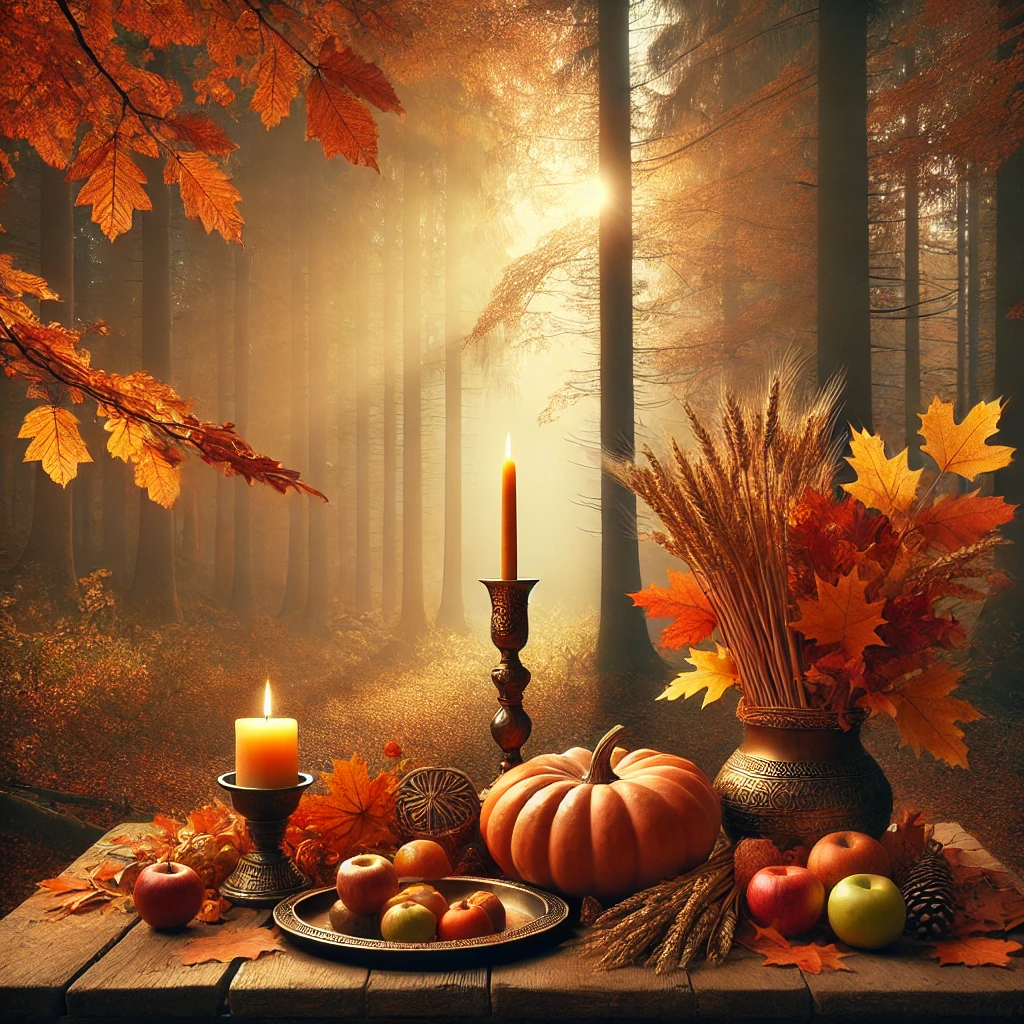
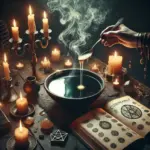
As the wheel of the year turns and the sun’s journey across the sky begins to wane, the world transforms into a realm of enchanting beauty, heralding the arrival of the Autumn Equinox. In this ephemeral season, where the days grow shorter and the air becomes crisper, nature paints a tapestry of vibrant hues upon the landscape, a symphony of reds, oranges, and golds that dances in the gentle breeze. This breathtaking spectacle serves as a profound harbinger, signaling the transition from the warmth of summer to the contemplative embrace of autumn. It is during this time that many Pagans and Wiccans joyfully gather to celebrate Mabon, a sacred and time-honored tradition rooted deep in the annals of human history.
Mabon
Mabon, a name that resonates with ancient echoes, is a celebration that pays homage to the wisdom of the past while embracing the evolving tapestry of the present. This sacred time embodies the essence of gratitude, a poignant moment when hearts and spirits unite in thankfulness for the abundant blessings bestowed upon us throughout the year. As the autumnal equinox approaches, it marks a moment of perfect equilibrium, where the radiant light of day balances in harmonious counterpoint with the gentle cloak of night. This balance between light and dark, an intricate dance that plays out in both the cosmos and the deepest corners of our souls, is a central theme of Mabon.
In the heart of this mystical season, Mabon beckons us to connect with the ever-changing tapestry of the natural world. It is a call to embrace the shifting seasons, to feel the heartbeat of the Earth as it transitions from the fecundity of summer to the introspective embrace of autumn’s cool embrace. It is a reminder that, like the cycles of the moon, our lives too are woven into the fabric of these eternal rhythms. In this article, we embark on a journey to explore the profound significance of Mabon and to uncover the diverse and captivating rituals that the Pagan and Wiccan communities have lovingly preserved and practiced during this enchanting time of year.
The Equinox and Mabon: A Cosmic Dance
The Autumn Equinox, a celestial spectacle that typically graces the Northern Hemisphere between September 21st and 23rd, stands as a celestial marvel that captures the essence of equilibrium. During this momentous event, night and day harmoniously share the stage, each basking in its allotted time upon the Earth’s grand theater. This celestial pause, where the eternal cosmic dance momentarily stills, mirrors a profound equilibrium—a balance between light and darkness that extends far beyond the realms of our planet. It’s a balance not only witnessed in the heavens but also an embodiment of the inner equilibrium sought by countless spiritual seekers.
Mabon, a name that resonates with the echoes of Welsh folklore, adds a layer of myth and wonder to the equinox. Bearing the name of the Welsh god of the harvest, Mabon’s association with this sacred time paints a vivid picture of abundance and gratitude. As the steward of the harvest, Mabon’s very essence is intertwined with the themes of fertility and plenty. According to myth, he draws his life force from the Earth Mother, Modron, an intimate bond that designates Mabon as a symbol of rebirth and the cyclical nature of existence.
Mabon’s birth from the Earth Mother, Modron, is itself a testament to the eternal rhythm of life’s renewal. Just as the seeds that are sown in the fertile soil of spring flourish into the bountiful harvests of autumn, so does Mabon’s emergence embody the idea of rebirth. He symbolizes the cyclical nature of life, where endings are but preludes to new beginnings. This interconnectedness between the god of the harvest and the seasonal transitions reinforces the idea that Mabon is more than a deity; he is a living embodiment of the eternal dance of nature. In celebrating Mabon, we not only honor the turning of the seasons but also acknowledge our place within this ever-flowing river of life and the profound lessons it imparts.
Modern Mabon Celebrations
While Mabon’s roots are firmly planted in history, modern Pagans and Wiccans have undertaken a remarkable journey of adaptation and expansion upon these ancient traditions, resulting in the creation of a vibrant and diverse tapestry of contemporary celebrations. In this evolving landscape of spirituality and reverence for the natural world, Mabon has not only survived the passage of time but has thrived, evolving into a celebration that resonates with the complexities of our modern lives while retaining its profound connection to the ancient rhythms of the Earth.
The Resilience of Mabon Traditions
Modern Mabon celebrations are a testament to the resilience and adaptability of these spiritual traditions. They represent a harmonious blend of the old and the new, weaving threads of ancient wisdom into the fabric of our contemporary existence. At their core, these celebrations remain anchored in the fundamental themes of gratitude, balance, and connection to nature that have defined Mabon for generations.
Inclusivity in Modern Mabon Celebrations
One of the most notable aspects of modern Mabon celebrations is their inclusivity. In a world that increasingly values diversity and unity, Mabon has opened its arms to individuals from all walks of life. Modern Pagans and Wiccans have embraced the opportunity to welcome diverse perspectives and belief systems, enriching the tapestry of Mabon celebrations with a wide range of practices and rituals. This inclusivity has allowed Mabon to transcend cultural and geographic boundaries, creating a global community of like-minded individuals who gather to honor the changing of the seasons.
The Role of Technology in Mabon
Technology has also played a role in modern Mabon celebrations. The advent of the internet and social media has allowed practitioners to connect with one another on a scale previously unimaginable. Online forums, virtual gatherings, and digital resources have made it easier than ever for people to share their Mabon experiences, exchange ideas, and learn from one another. This digital interconnectedness has strengthened the sense of community among modern Pagans and Wiccans, fostering a sense of unity that extends far beyond physical boundaries.
Innovative Rituals and Symbolism
Innovative approaches to ritual and symbolism have also emerged in modern Mabon celebrations. While traditional practices, such as offering libations to the land, remain integral, contemporary practitioners have introduced new elements that resonate with the challenges and aspirations of the present day. These may include eco-conscious practices, such as planting trees or participating in environmental cleanup efforts, as a way of honoring the Earth and demonstrating a commitment to its well-being.
Key Aspects of Modern Mabon Observances
Gratitude for Abundance
One of the central themes of Mabon is expressing gratitude for the bounties of the year’s harvest. This often involves communal feasts where friends and family come together to share the abundance of the season. It’s a time to savor the flavors of freshly harvested foods, like apples, pumpkins, and grains. Historically, harvest festivals have been celebrated across cultures, such as the British Harvest Home and the American Thanksgiving. These gatherings not only celebrate the harvest but also foster a sense of community and shared prosperity.
Balance and Equilibrium
Mabon reminds practitioners of the delicate balance between light and dark, both in nature and in our lives. It’s a time for introspection, a moment to acknowledge the dualities within us and in the world. This balance is often symbolized by the equal lengths of day and night during the equinox. In ancient times, the equinox was a significant event, marking the transition between seasons. The concept of balance can also be seen in the yin-yang philosophy of Chinese culture, which emphasizes harmony between opposing forces.
Harvest Rituals
Many Mabon rituals involve honoring the Earth’s bounty through offerings and ceremonies. Participants might create altars adorned with seasonal fruits, vegetables, and grains. These altars serve as focal points for meditation and offerings to deities associated with harvest and abundance. For example, in ancient Greek mythology, Demeter, the goddess of the harvest, was honored with offerings of grain and fruit. Similarly, Native American tribes held ceremonies to give thanks for the harvest and ensure future fertility.
Connecting with Nature
Mabon is an opportunity to immerse oneself in the natural world. Some Pagans and Wiccans choose to go on nature walks, collect fallen leaves, or perform rituals outdoors to strengthen their connection with the Earth. This practice echoes the ancient tradition of nature worship, where people revered natural elements like trees, rivers, and mountains. Modern practitioners might also engage in activities like gardening or bird-watching to deepen their bond with nature.
Lighting Candles
As the nights grow longer, the lighting of candles becomes a significant ritual. Candles symbolize the inner light that can guide us through the approaching darkness of winter. The flickering flames also pay homage to the waning sun. Historically, fire has been a powerful symbol in many cultures, representing life, warmth, and protection. During Mabon, lighting candles can also be a way to honor the sun gods and goddesses, such as the Celtic god Lugh.
Meditation and Contemplation
Mabon is a time for introspection and meditation. Many practitioners take moments of stillness to reflect on the past year, set intentions for the coming season, and embrace personal transformation. This practice is similar to the ancient tradition of retreating to sacred spaces for contemplation and renewal. In modern times, meditation can take many forms, from silent reflection to guided visualizations. The goal is to achieve a sense of inner peace and clarity as we transition into the darker months of the year.
Conclusion
Mabon, the Autumn Equinox, is a profound moment in the Pagan and Wiccan calendar, a time to celebrate the harvest, find balance, and connect with the changing seasons. While rooted in ancient traditions, Mabon has evolved to incorporate a rich tapestry of modern practices. It’s a time for gratitude, reflection, and renewal—a reminder of the eternal dance of light and darkness that weaves through the cosmos and within our souls. Whether through communal feasts, meditative rituals, or simply by enjoying the beauty of nature, Mabon offers a chance to harmonize with the rhythms of the Earth and find magic in the turning of the seasons.
In the tranquil embrace of the autumnal equinox, a mystical celebration known as Mabon emerges, inviting us to explore the delicate balance between light and darkness, both in the world around us and within our own souls. Among the many enchanting rituals that grace this sacred season, Balanced Meditation stands as a beacon of serenity and self-discovery. This ancient practice guides us to a place of profound equilibrium, where the shifting hues of fall foliage mirror the interplay between the active and introspective energies of our lives. Join us on a journey into the heart of Mabon’s Balanced Meditation, where we shall explore the art of harmonizing with the season’s energies, finding stillness amid transformation, and embracing the lessons of balance that this enchanted time bestows.
Ritual Basics
Before beginning any ritual, it is important to prepare yourself mentally and physically. You may want to take a cleansing bath, or shower, and meditate or perform some grounding exercises to center yourself. Gather any materials you will need, such as candles, incense, and offerings for the forest spirits.
In the waning days of summer, as the sun dips lower on the horizon and the vibrant green of the world takes on the warm, golden hues of autumn, we find ourselves at the threshold of Mabon, the autumn equinox. This season is marked by a profound transformation, as nature herself dons her cloak of change. It’s a time when the leaves begin their graceful descent to the earth, and the air takes on a crisper edge, carrying with it the whispers of coming winter.
During this transformation, we are presented with a profound lesson — the art of embracing change as a pathway to equilibrium. The Balanced Meditation, a sacred ritual of Mabon, beckons us to contemplate this very lesson. It guides us to find solace amid change, much as the trees surrender their leaves, trusting that new growth will come in their own time. This ritual reminds us that life is an eternal dance of balance, a delicate interplay between light and dark, growth and release, and it is through acceptance and understanding of this balance that we find our own equilibrium.
Mabon – Balanced Meditation
As we embark on the journey of the Balanced Meditation, we immerse ourselves in the beauty of the season, where every falling leaf is a reminder that change is not to be feared but embraced. The ritual encourages us to sit in quiet reflection, much like the trees themselves, as we release our worries, tensions, and attachments to that which no longer serves us. This act of letting go becomes a sacred dance, a harmonious step in the rhythm of the season, as we surrender to the transformative energies of Mabon.
A blanket and/or cushion(s).
A foci (this can be a crystal, a fall symbol, etc)
Preparation
Find a cozy nook in your haven, it can be indoors or out. It must be a safe place for you to be.
Use your blanket and/or cushion(s) to make the ritual space comfortable for you.
Nestle yourself into a comfortable position, either seated or lying down, as if preparing for a restful slumber. Let the tranquility of your chosen space envelop you.
Comfortably hold your foci, letting it bring you to peace.
Gently close your eyes, letting the quietude and peace settle around you like a soft mist. Inhale deeply, drawing in the hushed serenity of the surrounding woods and waters, and exhale any residual thoughts that may linger.
Visualizing the Equinox
As your inner canvas unfurls, paint a picture of yourself standing amidst nature’s embraces. Imagine the landscape shifting, revealing a lush forest glade, a vibrant meadow, or a serene beach along the Pacific coastline.
Watch as the foliage morphs, transitioning from one season’s attire to another. Allow the play of sunlight and shadows to paint a symphony of patterns around you, much like the intricate dance of your witchcraft practice.
Focusing on Balance
Shift your gaze to the balance teetering between the light and the darkness in your visualized sanctuary. Inhale, imbuing yourself with the radiant energy of the sun, its warmth filling you from within.
Exhale, envisioning any concerns, burdens, or worries as mere shadows that disperse and dissolve into the earth beneath you, absorbed by the ground.
Reflecting Within
Redirect your focus inward, like a seeker delving into the mysteries of the self. Contemplate the intricate scales of your life—how work finds its counterpoint in rest, joy waltzes with sorrow, and growth finds its partner in release.
As you inhale and exhale in rhythm, become a conduit for equilibrium, inviting its essence to flow through you.
Embracing Equilibrium
Visualize equilibrium as a gentle stream of radiant light. Imagine it coursing through your veins, each pulse resonating with the harmonious balance you seek.
Feel this luminous current enveloping every corner of your being, like the embrace of an old friend who understands the nuances of your journey.
Affirming Balance
Utter a mantra, seasoning your experience with affirmation: “I am in harmony with the cycles of life. I embrace both light and darkness, finding equilibrium within.”
Let this declaration infuse your being with the essence of balance.
Returning to the Present
Allow your awareness to trickle back into the present moment, like water finding its way back to the ocean. Inhale the freshness of the air, as if savoring the scent of newly foraged herbs.
With a tender smile, exhale, and as you gently open your eyes, bask in the gentle light of your surroundings, knowing that you’ve brewed an elixir of inner harmony.
Carry this sense of balance and mindfulness with you, just as you would carry a vial of your finest potion, allowing it to be a guiding star through the currents of your day.
In the acceptance of change, we find the essence of equilibrium. This ritual teaches us that true balance is not stagnant; it is a dynamic state, an ever-flowing stream of energy that courses through our lives. It is the recognition that light and darkness, joy and sorrow, growth and release are not opposing forces but interconnected aspects of the same cycle.
As we conclude the Balanced Meditation, we emerge with a profound sense of peace, knowing that change is not a disruption of our equilibrium but an integral part of it. It is through acceptance and the embrace of transformation that we find true balance, just as the autumn forest finds its equilibrium in the changing seasons.
Symbols of Autumn
Here are some physical autumn symbols that you can hold and use in your witchcraft practice:
Acorns: Acorns are a powerful symbol of potential and growth. Hold them in your hand during rituals or use them as part of your altar setup to represent the promise of future abundance and transformation.
Autumn Leaves: Collect colorful autumn leaves and hold them to connect with the changing of seasons. Use them in spells related to change, letting go, or personal transformation.
Pumpkins: Pumpkins are iconic symbols of autumn. Holding a small pumpkin or a pumpkin-shaped object can symbolize the harvest, protection, and abundance. Carve a protective symbol into a pumpkin and hold it during protection rituals.
Candles: Holding candles in autumnal colors like orange, red, or brown can help you attune to the season’s energies. Light the candle and focus on its flame during meditation or spellwork to invoke the corresponding qualities of the color.
Feathers: As birds migrate during the fall, feathers can symbolize freedom and the connection between the earthly and spiritual realms. Hold feathers to connect with your spirit guides or incorporate them into rituals for communication with the spirit world.
Cornucopia: The cornucopia, or horn of plenty, is a symbol of abundance and harvest. Hold a small cornucopia or use one in your altar setup to attract prosperity and bountiful blessings.
Apples: Apples represent wisdom, healing, and immortality. Holding an apple during meditation or rituals can help you tap into these qualities. You can also use apples as offerings to deities or spirits.
Pinecones: Pinecones are associated with evergreen trees and the resilience of nature. Hold a pinecone to connect with the earth’s enduring energy and use it in rituals for grounding and stability.
Miniature Brooms: Miniature brooms or besoms symbolize purification and sweeping away negativity. Hold one during rituals focused on cleansing and purifying your space or your life.
Harvest Tools: Hold small representations of harvest tools like a sickle, scythe, or a miniature basket filled with symbolic fruits and vegetables to connect with the theme of abundance and the reaping of rewards.
Gemstones: Carry gemstones associated with autumn, such as carnelian, citrine, or amber, in your pocket or hold them during meditation and rituals to amplify their energy and align with the season’s intentions.
Autumn Herbs: Bundle together or hold autumn herbs like sage, rosemary, or thyme to infuse your rituals with their earthy and purifying energies.
Remember that the power of these symbols is deeply personal, and your connection to them is what makes them meaningful in your practice. Holding and meditating upon these symbols during autumn can help you tap into the seasonal energies and bring your intentions to life in your witchcraft practice.
Mabon
Rituals
Conclusion
In the profound teachings of the Balanced Meditation, we unearth a timeless wisdom that transcends the boundaries of seasons and rituals. It is a revelation that true equilibrium is not a static state but a dynamic force that surges through the currents of our existence, much like the ever-flowing stream of time. As we draw this sacred practice to a close, we carry with us the profound understanding that light and darkness, joy and sorrow, growth and release are not adversaries in our journey, but rather intimate companions in the dance of life.
Just as the autumn forest gracefully adapts to the changing seasons, we too can embrace the transformative energies that life offers. We emerge from Balanced Meditation with a serene sense of peace, armed with the knowledge that change is not a disruption of our equilibrium but a pivotal element of it. In our acceptance of change, we find the very essence of balance—the harmonious coexistence of all facets of existence. As we journey forth into the world, we carry with us the wisdom of the autumn equinox, recognizing that equilibrium is not an end goal but a perpetual voyage, and in the embrace of transformation, we discover the true heart of balance.
The Autumn Equinox, known by various names such as Mabon, the September Equinox, or the Fall Equinox, is a significant celestial event that marks the transition from summer to fall in the Northern Hemisphere. This equinox occurs when the sun crosses the celestial equator, resulting in nearly equal periods of daylight and darkness. In this article, we will explore the Autumn Equinox, its historical and modern practices, and its importance in both traditional and contemporary cultures.
Understanding the Equinox: Nature’s Balance Beam
The Autumn Equinox typically falls on or around September 21st in the Northern Hemisphere, though the exact date can vary slightly from year to year. It’s a pivotal moment in the astronomical calendar when day and night are in perfect harmony, each lasting approximately the same duration. This equilibrium symbolizes the delicate balance between light and darkness, a theme that resonates deeply in various cultures and traditions.
A Global Perspective on the Autumn Equinox
The Autumn Equinox is a celestial event that holds universal significance, resonating not only in the Northern Hemisphere but also in the Southern Hemisphere, albeit with a reversal of seasons. This equinox typically occurs on or around September 21st in the Northern Hemisphere and around March 21st in the Southern Hemisphere. However, it’s essential to note that the exact date can vary slightly from year to year due to the intricacies of Earth’s orbit.
In the Northern Hemisphere, the Autumn Equinox is a pivotal moment in the astronomical calendar. It marks the juncture when day and night are in perfect equilibrium, each lasting approximately the same duration. This exquisite balance of light and darkness is a testament to the intricate dance between the Earth and the Sun. As the Northern Hemisphere bids farewell to the warmth of summer and welcomes the cool embrace of autumn, this equilibrium symbolizes the delicate transition from one season to another. It is a theme that resonates deeply in various cultures and traditions, reflecting the universal recognition of the significance of balance in our lives and the world around us.
Conversely, in the Southern Hemisphere, the Autumn Equinox ushers in the arrival of spring. As the days grow longer, the world awakens from its winter slumber, and the Earth begins to teem with new life. The Southern Hemisphere’s Autumn Equinox mirrors its counterpart in the Northern Hemisphere, offering a moment of balance and transition between the seasons.
In both hemispheres, the Autumn Equinox serves as a reminder of the cyclical nature of our planet’s journey around the Sun. It underscores the interconnectedness of all life and the ever-shifting rhythms of the natural world. Whether it’s the Northern Hemisphere’s preparation for the harvest or the Southern Hemisphere’s embrace of new beginnings, the Autumn Equinox invites us to contemplate the delicate equilibrium that sustains our planet and to celebrate the beauty of this cosmic choreography that we are all a part of.
The Global Tapestry of Autumn Equinox Celebrations
The Autumn Equinox, a celestial event marking the transition from summer to fall, has left an indelible mark on cultures across the globe for centuries. While the specific customs and traditions vary widely, the common thread that unites these diverse celebrations is a deep reverence for the changing seasons and the symbolism of balance and abundance. Here, we embark on a journey around the world to explore how different cultures have embraced the Autumn Equinox throughout history.
China: The Mid-Autumn Festival: In China, the Mid-Autumn Festival, also known as the Moon Festival, is a time for families to come together, much like the American Thanksgiving. Celebrated on the 15th day of the eighth month of the lunar calendar, which usually falls close to the Autumn Equinox, it is a time to give thanks for the harvest and to appreciate the beauty of the full moon. Families gather to share mooncakes, a special pastry filled with sweet or savory fillings, under the glow of the moon.
Japan: Tsukimi Festival: Japan has its own version of a moon-viewing festival called Tsukimi, which occurs in September or early October, around the time of the Autumn Equinox. During Tsukimi, people celebrate the beauty of the full moon, traditionally by setting up altars adorned with offerings like rice dumplings and pampas grass. It’s a time for reflection and appreciation of the changing season.
Korea: Chuseok: Chuseok, the Korean Thanksgiving Day, coincides with the Autumn Equinox and is one of the most significant holidays in Korea. Families gather to honor their ancestors, share a bountiful feast featuring traditional dishes like songpyeon (rice cakes), and engage in various cultural activities. Chuseok embodies themes of gratitude and unity, much like other harvest festivals around the world.
India: Navaratri and Durga Puja: In India, the Autumn Equinox is marked by a multitude of celebrations. Navaratri, a nine-night festival dedicated to the goddess Durga, typically falls around this time. It’s a time of fasting, dancing, and worship, celebrating the triumph of good over evil. Durga Puja, a major Hindu festival, is celebrated with grand processions and the installation of elaborately crafted idols of the goddess.
Native American Harvest Festivals: Various Native American tribes across North America have celebrated harvest festivals around the Autumn Equinox for generations. These festivals often involve communal feasting, music, dance, and ceremonies to express gratitude for the earth’s bounty. The Cherokee Nation, for example, celebrates the Great New Moon Ceremony during this time to give thanks for the harvest and pray for a bountiful winter.
European Traditions: Michaelmas and Harvest Home: In Europe, the Autumn Equinox is marked by a range of traditions. Michaelmas, celebrated on September 29th, honors the Archangel Michael, and serves as a time to give thanks for the harvest and ask for protection throughout the coming winter. In England, the Harvest Home festival involves decorating churches with harvested fruits and vegetables, and the celebrations often include communal feasts and music.
A Global Tapestry of Gratitude
The Autumn Equinox has woven a rich tapestry of celebrations around the world, each culture adding its unique colors and threads to the fabric of human tradition. While the specifics of these celebrations may differ, they all share a fundamental reverence for the Earth’s bounty and the significance of balance, unity, and gratitude. In this shared appreciation for the changing seasons, we find a reminder of our interconnectedness with nature and with each other, regardless of geographical or cultural boundaries.
Traditional Practices and Significance of the Autumn Equinox
The Autumn Equinox, celebrated around the world under various names and traditions, holds a rich tapestry of traditional practices and deep significance. This celestial event, marked by nearly equal hours of daylight and darkness, symbolizes themes of balance, harvest, and transition. Here, we delve into some of the traditional practices and the profound significance associated with the Autumn Equinox:
Harvest Festivals: Across cultures, the Autumn Equinox is synonymous with the harvest season’s culmination. It’s a time when communities come together to reap the rewards of their hard work in the fields. Traditional practices often involve communal feasting, dancing, and the sharing of the year’s bounty. In the United States, Thanksgiving is a prominent example of a harvest festival celebrated around the Autumn Equinox.
Mythological Symbolism: Many ancient mythologies incorporate the concept of balance and transition associated with the equinox. For instance, in Greek mythology, the story of Persephone’s descent into the underworld and her return to her mother, Demeter, mirrors the changing seasons. Her return from the underworld in the spring signifies the renewal of life, while her descent into darkness during the fall equates to the earth’s waning vitality.
Equinox Alignments: Numerous ancient sites, such as Stonehenge in England and Chichen Itza in Mexico, were constructed with alignments that highlight the equinoxes. At these sites, the rising or setting sun aligns with specific architectural features during the equinoxes, underscoring the importance of these celestial events in ancient cultures’ calendars.
Nature-Based Practices: Indigenous cultures often marked the Autumn Equinox with nature-based rituals. These practices could involve observing the changing behaviors of animals and plants, acknowledging the migration of birds, or engaging in ceremonies that honored the earth’s rhythms.
Chinese Moon Festival: In China, the Autumn Equinox is celebrated with the Mid-Autumn Festival, also known as the Moon Festival. Families gather to appreciate the full moon’s beauty, share mooncakes, and express gratitude for the harvest. The round shape of mooncakes symbolizes completeness and unity.
Japanese Tsukimi Festival: Japan celebrates the Tsukimi Festival, a moon-viewing festival that coincides with the Autumn Equinox. People create altars adorned with offerings like rice dumplings and pampas grass to honor the full moon’s beauty and express gratitude for the harvest.
Korean Chuseok: Chuseok, the Korean Thanksgiving Day, aligns with the Autumn Equinox. It’s a time for ancestral worship, communal feasting, and cultural activities that celebrate the harvest’s abundance.
Spiritual and Reflective Practices: Many individuals and spiritual groups mark the Autumn Equinox with rituals and ceremonies that encourage reflection, gratitude, and intention setting. These practices often involve meditation, prayer, and connecting with the natural world.
The Autumn Equinox’s significance lies in its role as a bridge between the seasons. It represents a moment of balance in the ever-turning wheel of the year. It’s a time to express gratitude for the earth’s abundance, acknowledge the impermanence of life, and prepare for the colder months ahead. The equinox teaches us the value of balance and reminds us of our connection to the rhythms of nature.
In summary, the Autumn Equinox is a time when traditional practices and cultural significance converge to celebrate the harvest, reflect on the changing seasons, and honor the delicate equilibrium between light and darkness. Whether through communal feasts, mythological stories, or nature-based ceremonies, the Autumn Equinox continues to be a time-honored and cherished event worldwide.
Modern Interpretations and Celebrations of the Autumn Equinox
While the Autumn Equinox has deep-rooted traditional practices, it has also adapted and evolved to suit modern lifestyles and belief systems. In contemporary celebrations, people from diverse backgrounds find innovative ways to connect with the themes of balance, harvest, and transition associated with this celestial event. Here, we explore some of the modern interpretations and celebrations of the Autumn Equinox:
Pagan and Wiccan Observations: For many Pagans and Wiccans, the Autumn Equinox is known as Mabon. This celebration remains deeply rooted in ancient traditions but has evolved to include a variety of practices. Modern Pagans often use this time to express gratitude for the year’s blessings, acknowledge the balance between light and dark, and perform rituals that align with the changing seasons. These rituals may involve meditation, lighting candles, and connecting with nature.
Secular Celebrations: In secular contexts, the Autumn Equinox is celebrated as a time to embrace the beauty of the changing seasons. Many people take advantage of the pleasant weather to engage in outdoor activities like hiking, picnicking, or simply enjoying the fall foliage. It’s a time for nature walks, appreciating the colors of autumn, and taking a break from the hustle and bustle of daily life.
Environmental Awareness: Some modern celebrations of the Autumn Equinox focus on environmental stewardship and sustainability. People participate in activities like tree planting, park clean-ups, and discussions about climate change. These initiatives highlight the importance of preserving the Earth’s balance and resources, aligning with the equinox’s theme of harmony.
Artistic Expression: Many individuals channel their creativity during the Autumn Equinox by crafting seasonal decorations, painting, writing, or creating symbolic artworks that capture the essence of the season. This creative expression serves as a way to connect with the equinox’s themes and share them with others.
Personal Reflection: In a fast-paced world, the Autumn Equinox offers a moment for personal reflection and intention setting. People engage in meditation, journaling, or simply take a moment to consider their goals and desires for the upcoming season. It’s a time to let go of what no longer serves us and prepare for the winter months ahead.
Harvest Festivals: While traditional harvest festivals still exist, many have adapted to modern sensibilities. These festivals often incorporate elements of local culture, music, and cuisine, making them enjoyable events for all members of the community. Farmers’ markets and food festivals that celebrate locally sourced produce are examples of contemporary harvest celebrations.
Educational Initiatives: Schools and educational institutions often use the Autumn Equinox as an opportunity to teach students about astronomy, the changing seasons, and the importance of nature conservation. These initiatives foster a deeper understanding of the Earth’s rhythms and encourage environmental responsibility.
Family Traditions: Many families create their own unique traditions for the Autumn Equinox. These may include outdoor adventures, crafting seasonal decorations, cooking special meals, or simply spending quality time together. These personal rituals help families bond and create lasting memories.
While the traditional practices associated with the Autumn Equinox remain relevant and cherished, modern celebrations have expanded to accommodate contemporary lifestyles and beliefs. Whether through spiritual rituals, outdoor adventures, environmental initiatives, or personal reflection, people from all walks of life continue to find meaningful ways to connect with the equinox’s themes of balance, harvest, and transition.
The Autumn Equinox: A Time of Balance and Transition
The Autumn Equinox, or Mabon, is a time of profound reflection and celebration, bridging the gap between ancient traditions and modern interpretations. As we honor the delicate balance of light and darkness, we acknowledge the interconnectedness of life and our place within the cycles of nature. Whether through traditional practices rooted in various cultures or through contemporary rituals and personal reflections, the Autumn Equinox invites us to embrace the changing seasons with gratitude and mindfulness. It is a moment to celebrate the harvest, foster a deeper connection with the earth, and prepare for the introspective journey that the approaching winter months bring. In this convergence of old and new, we find a rich tapestry of meaning that continues to resonate across time, reminding us to live in harmony with the rhythms of the natural world.
A Comprehensive Guide to Foraging and Utilizing this Versatile Plant
Amaranth, a versatile and nutritious plant, has been a staple in diets across the world for centuries. Known for its vibrant hues and rich nutrient profile, Amaranth is more than just a leafy green—it is a treasure trove of culinary, medicinal, and magical potential. In this guide, we will explore everything you need to know about foraging Amaranth, including its variants, identification tips, habits, uses, and safety considerations.
What is Amaranth?
Amaranth, a botanical marvel within the Amaranthaceae family, represents a genus of plants that has captured the imagination and culinary preferences of cultures worldwide. Revered for its vibrant colors and rich history, Amaranth is much more than just a plant—it is a symbol of resilience, adaptability, and nourishment. Originating from the Americas, particularly Central and South America, Amaranth has been a staple in indigenous diets for thousands of years, celebrated not only for its aesthetic appeal but also for its incredible nutritional value.
The name “Amaranth” itself is derived from the Greek word “amarantos,” meaning “unfading,” which is fitting given the plant’s enduring presence across continents and centuries. The genus encompasses a wide variety of species, each known for its striking foliage, which can range in color from deep red to brilliant, purple, and lush green. These vibrant hues are not only visually captivating but also indicate the plant’s rich content of phytonutrients, antioxidants, and vitamins.
Amaranth is uniquely versatile, offering both edible leaves and seeds that have been integral to traditional diets and continue to be embraced in modern culinary practices. The young leaves of Amaranth are tender and flavorful, making them a popular choice for salads, sautés, and soups. As the plant matures, its leaves can still be enjoyed cooked, offering a slightly nutty and earthy taste.
In addition to its leaves, Amaranth is also cultivated for its tiny, nutrient-dense seeds. These seeds, which are often referred to as pseudocereals, are gluten-free and rich in protein, fiber, and essential minerals like calcium, magnesium, and iron. Unlike many other grains, Amaranth seeds contain a complete protein, providing all the essential amino acids the human body needs. This makes Amaranth a vital food source in regions where access to diverse protein sources may be limited.
The adaptability of Amaranth is another of its defining characteristics. It thrives in a wide range of climates and soil conditions, from the high altitudes of the Andes to the plains of Africa and Asia. This resilience has allowed Amaranth to spread globally, where it has been naturalized in many parts of the world, including North America, Europe, Africa, and Asia. In many cultures, Amaranth is not only a dietary staple but also a symbol of agricultural sustainability, offering a reliable crop that can withstand harsh growing conditions and provide nourishment even in times of scarcity.
Amaranth’s potential as both a leafy green and a grain crop makes it a unique and valuable addition to any garden or foraging expedition. Whether you are harvesting the tender leaves for a fresh salad, cooking the mature greens in a hearty stew, or collecting the seeds to grind into flour or pop like popcorn, Amaranth offers endless possibilities for culinary creativity and nutritional enrichment.
Amaranth is a plant of great cultural, nutritional, and ecological significance. Its striking appearance, coupled with its adaptability and health benefits, has made it a cherished crop throughout history and a continuing source of inspiration for those seeking to connect with nature through foraging, gardening, and cooking.
Variants of Amaranth
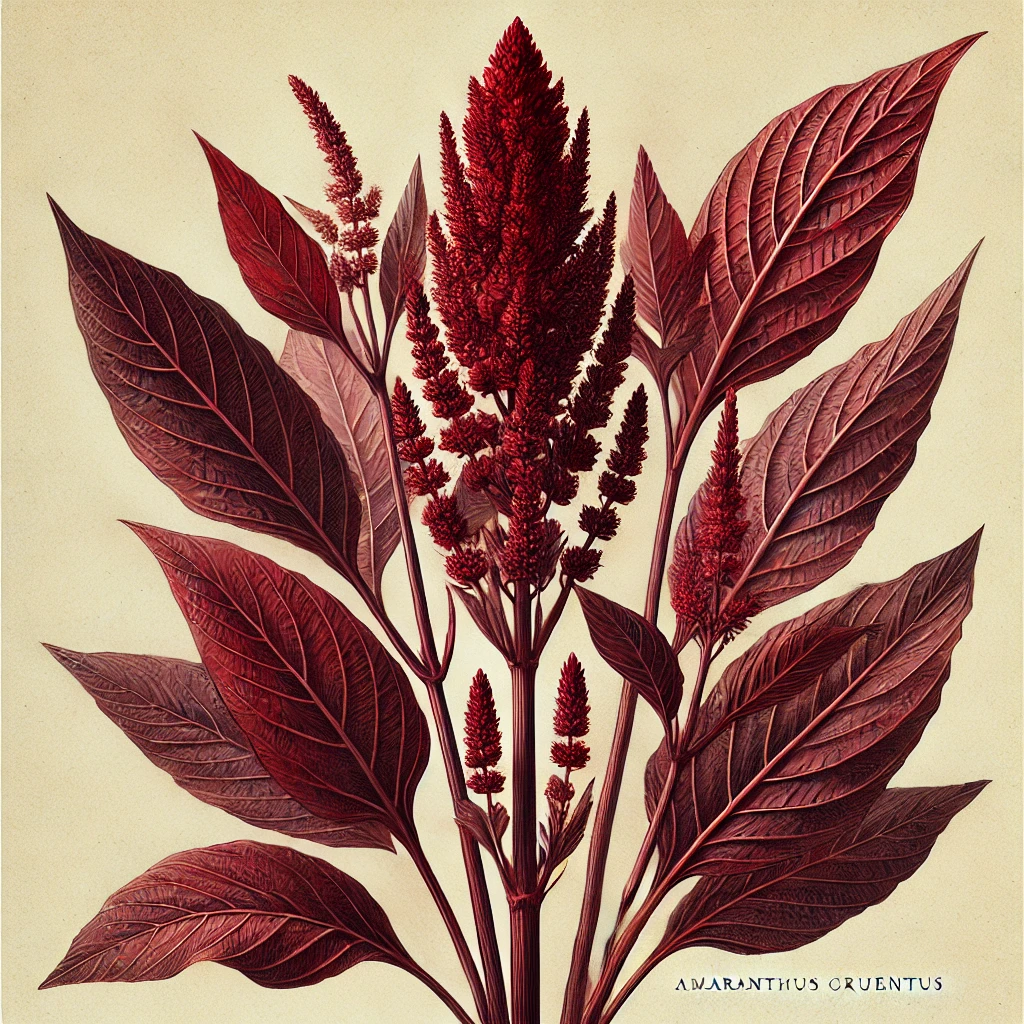
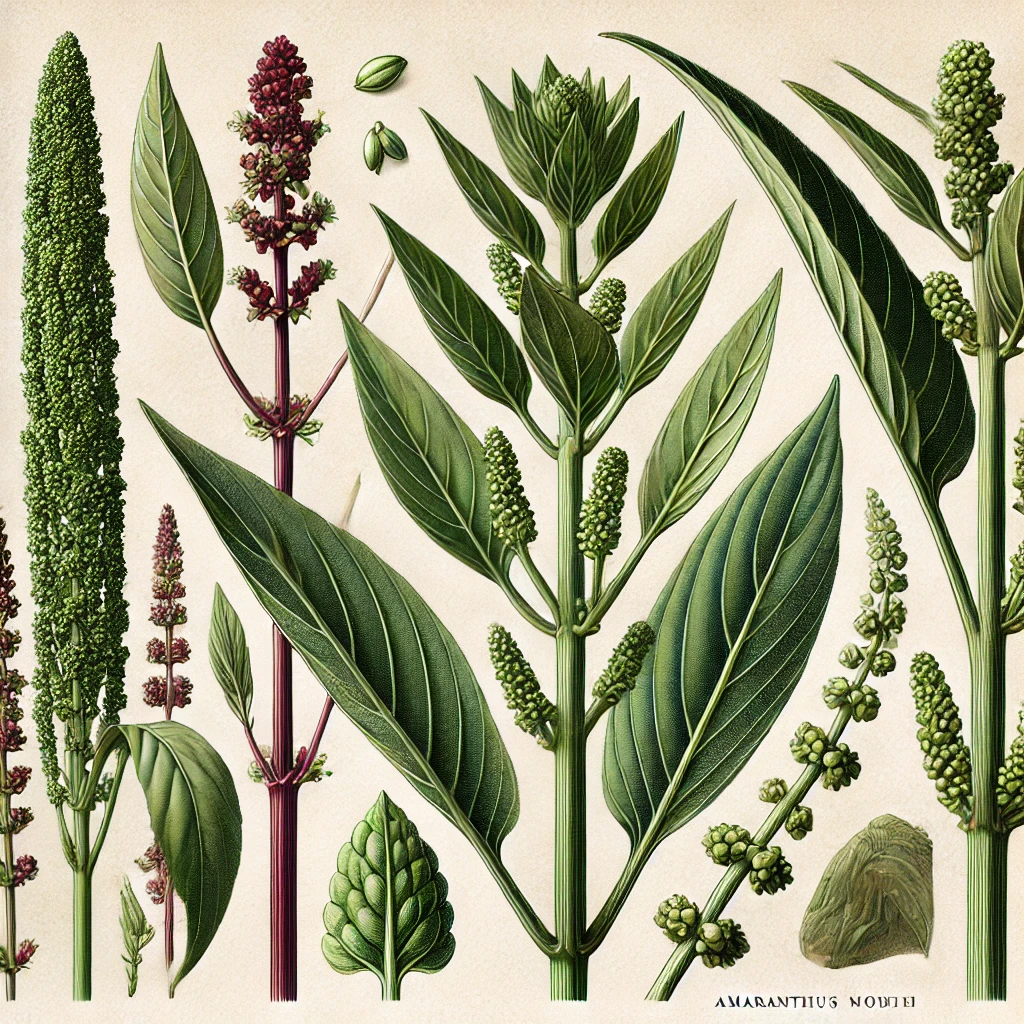
1. Amaranthus cruentus (Red Amaranth): Known for its striking red leaves and vibrant seed heads, Red Amaranth is commonly used in cooking and traditional medicine. It is valued for its aesthetic appeal and nutritional benefits.
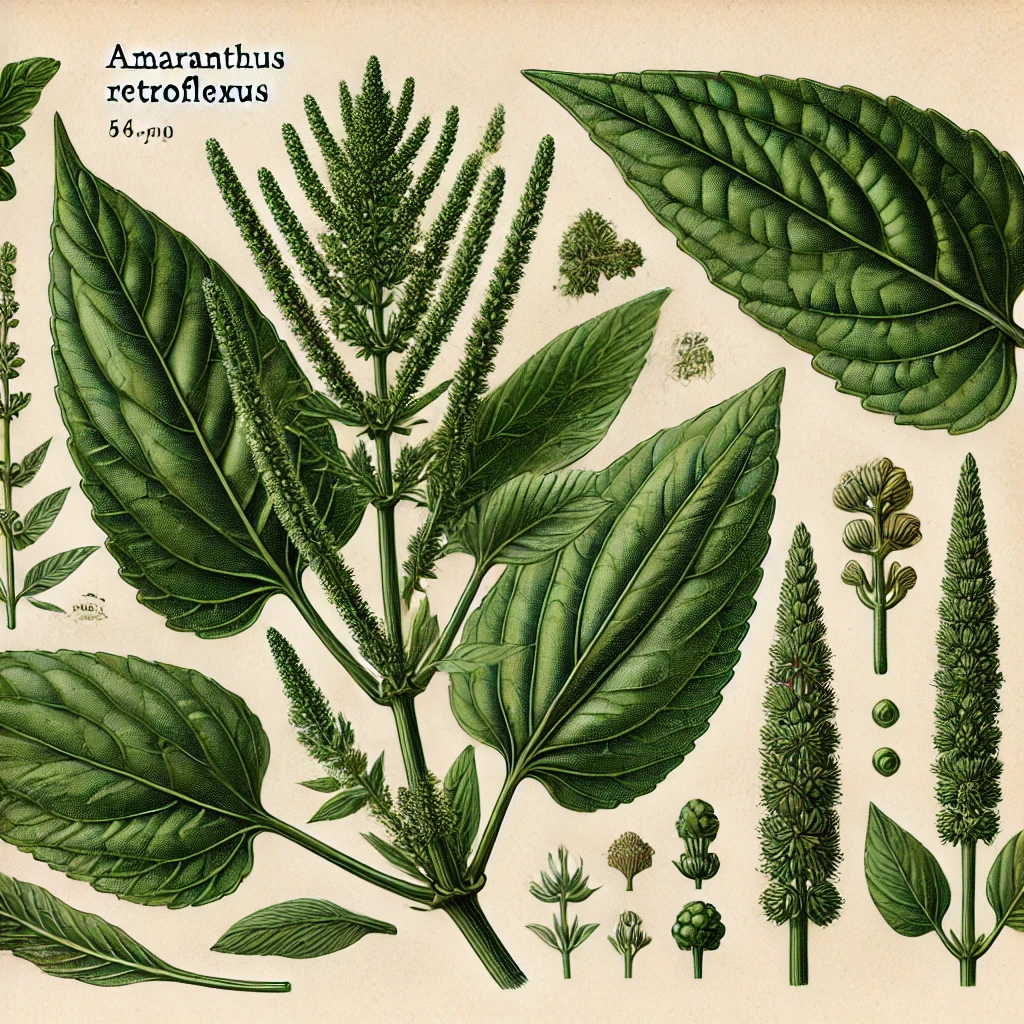
2. Amaranthus retroflexus (Redroot Pigweed): This variety features green to reddish stems and a broad range of leaf shapes. It is often found in gardens and disturbed areas and is known for its adaptability.
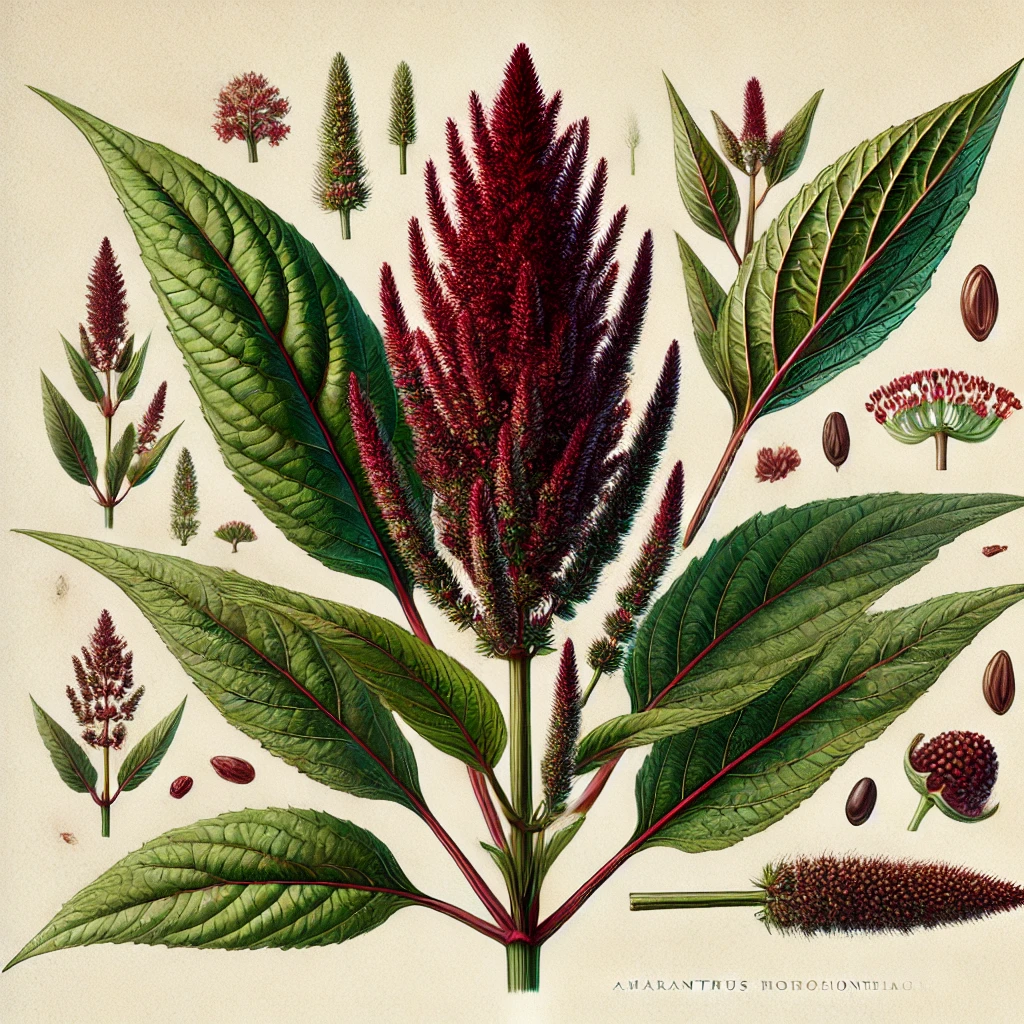
3. Amaranthus hypochondriacus (Prince’s Feather): Recognizable by its tall, upright growth and bright red or purple plumes, Prince’s Feather is grown both for its ornamental qualities and its edible seeds.
4. Amaranthus dubius (Slender Amaranth): Characterized by its slender stems and leaves, this variant is commonly used in tropical and subtropical regions.
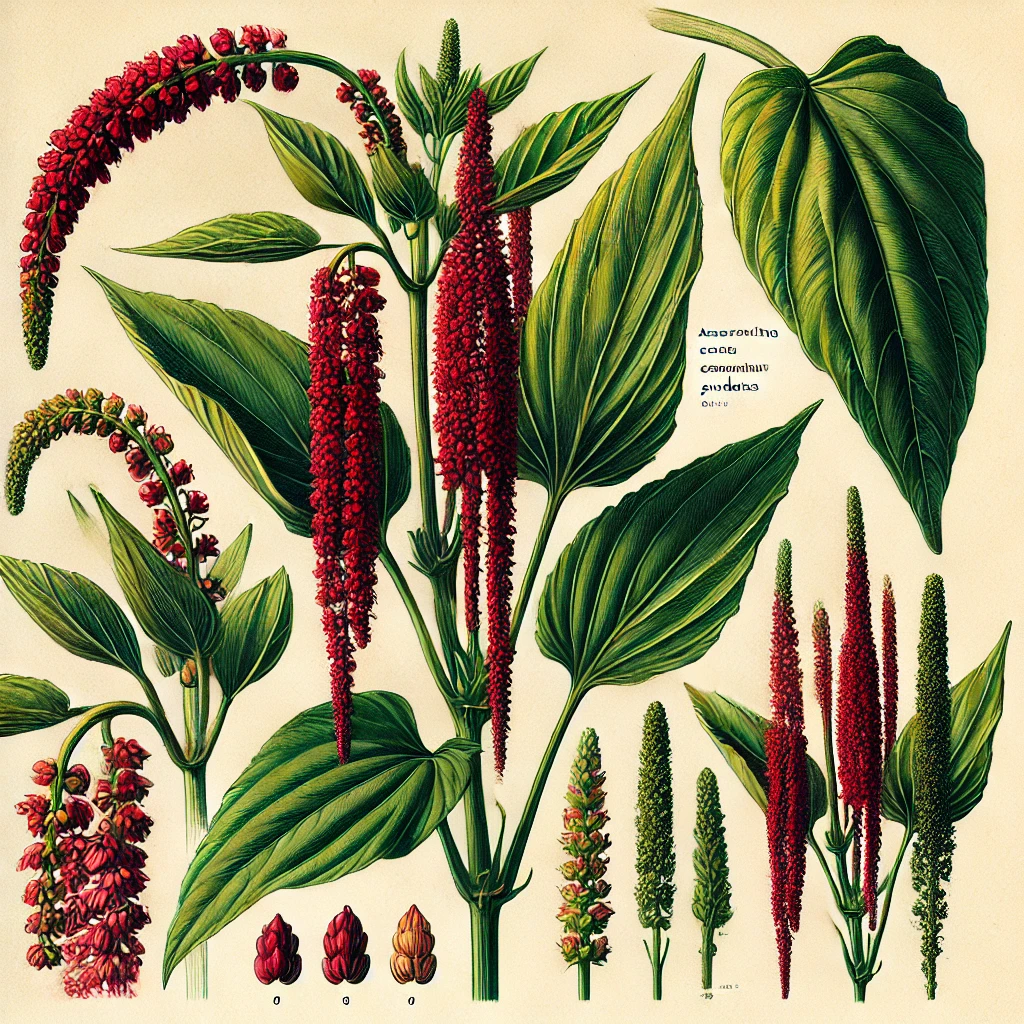
5. Amaranthus caudatus (Love-Lies-Bleeding): This variant is noted for its long, drooping clusters of red flowers and is used both decoratively and in cooking.
How to Identify Amaranthus cruentus (Red Amaranth)
Amaranthus cruentus, commonly known as Red Amaranth, is one of the most visually striking and nutritionally rich species within the Amaranth genus. Its vibrant colors and unique features make it easy to identify in the wild or in cultivated gardens. Below are the key identifying characteristics of Red Amaranth, including details on its leaf shape and color, stem color, flower structure, and seed heads.
Leaf Shape and Color
Shape: The leaves of Amaranthus cruentus are broad and lance-shaped with a slightly pointed tip. They have a smooth, glossy surface and may display subtle veining.
Color: As the name suggests, the leaves are typically a deep, rich red or burgundy color, although they can also exhibit shades of purple or green, depending on the growing conditions. Young leaves often have a more intense color, while mature leaves may develop a mix of red and green hues.
Stem Color
Color: The stems of Red Amaranth are another distinguishing feature, often highlighting a striking red or burgundy hue that complements the color of the leaves. The stems are usually sturdy and upright, providing strong support for the large foliage and flower structures.
Texture: The stem surface can be slightly rough to the touch and may have a ribbed texture. The red coloration of the stems can sometimes extend to the leaf petioles (the stalks that attach the leaves to the stem), enhancing the plant’s overall visual appeal.
Flower Structure
Inflorescence: Red Amaranth produces large, dense flower clusters, known as inflorescences, which can grow in upright spikes or sometimes droop slightly due to their weight. The inflorescences are made up of tiny, densely packed flowers.
Color: The flowers themselves are usually red to burgundy, matching the color of the leaves and stems, though they can sometimes appear more pinkish or purple. The vibrant flower spikes add to the plant’s ornamental value and make it easily identifiable during its blooming period.
Season: Red Amaranth typically flowers in mid to late summer, depending on the climate, and the inflorescences can persist well into the fall.
Seed Heads
Structure: After the flowers have bloomed, they give way to small, round seed heads. These seed heads are packed tightly within the inflorescences and can range in color from red to dark brown or black.
Seeds: The seeds of Red Amaranth are tiny, often appearing black or dark brown. They are glossy and can be easily harvested by shaking or rubbing the mature flower spikes. These seeds are highly nutritious and can be used in a variety of culinary applications.
Additional Tips for Identification
Growth Habit: Red Amaranth is typically a tall plant, often reaching heights of 4 to 6 feet, depending on growing conditions. Its upright growth habit and large, colorful leaves make it stand out in gardens and wild settings.
Location: This species of Amaranth is often found in gardens, cultivated fields, or wild areas with rich, well-drained soil. It prefers full sun but can also tolerate partial shade.
By focusing on these key identifying features—leaf shape and color, stem color, flower structure, and seed heads—you can confidently identify Amaranthus cruentus (Red Amaranth) in the wild or in cultivated settings. Its vibrant red hues and distinctive growth patterns make it a memorable plant that is both beautiful and nutritious.
How to Identify Amaranthus retroflexus (Redroot Pigweed)
Amaranthus retroflexus, commonly known as Redroot Pigweed, is a widespread and hardy species within the Amaranth family. It is known for its resilience and adaptability, often thriving in disturbed soils such as agricultural fields, gardens, and roadsides. Identifying Redroot Pigweed requires careful observation of its distinct characteristics, including leaf shape and color, stem color, flower structure, and seed heads. Below are the key features to look for when identifying this common plant.
Leaf Shape and Color
Shape: The leaves of Redroot Pigweed are typically oval to lance-shaped, with a slightly wavy or smooth margin. They are broader near the base and taper to a rounded or slightly pointed tip.
Color: The leaves are medium to dark green, with a dull surface. The underside of the leaves may be lighter in color and can sometimes exhibit a slight reddish hue, particularly in younger leaves or under certain environmental conditions.
Stem Color
Color: The stems of Amaranthus retroflexus are usually green but can exhibit a reddish tinge, especially near the base of the plant. This reddish coloration is particularly prominent in young plants and gives the plant its common name, Redroot Pigweed.
Texture: The stem is often thick and sturdy, with a rough, ridged texture. The reddish coloration can extend along the length of the stem, especially in mature plants.
Flower Structure
Inflorescence: Redroot Pigweed produces dense, bristly flower clusters that form at the tips of the stems and in the leaf axils (where the leaves attach to the stem). These inflorescences are often elongated and have a spiky appearance.
Color: The flowers themselves are small and greenish, blending in with the surrounding foliage. They are not particularly showy but can be identified by their dense, clustered arrangement.
Season: Flowering typically occurs in late summer to early fall, depending on the region, and the flowers eventually give way to seed production as the season progresses.
Seed Heads
Structure: After flowering, Redroot Pigweed produces small, round seed heads that develop within the bristly inflorescences. These seed heads are densely packed and can be difficult to see without close inspection.
Seeds: The seeds of Redroot Pigweed are tiny, black, and shiny. They are enclosed within the bristly flower clusters and are released as the seed heads mature and dry out. These seeds are highly prolific, contributing to the plant’s reputation as a persistent weed in agricultural settings.
Additional Tips for Identification
Growth Habit: Redroot Pigweed is typically an erect plant, growing between 1 to 6 feet tall, depending on environmental conditions. It has a branching growth habit, with stems often emerging from a central point near the base.
Root System: The plant’s root system is notable for its reddish taproot, which can be a key identifying feature when pulling the plant from the ground. The taproot is thick and sturdy, anchoring the plant firmly in the soil.
Location: Amaranthus retroflexus is commonly found in disturbed soils, such as gardens, crop fields, and roadsides. It thrives in full sun and can tolerate a wide range of soil types, making it a prevalent species in many areas.
By focusing on these key identifying features—leaf shape and color, stem color, flower structure, and seed heads—you can accurately identify Amaranthus retroflexus (Redroot Pigweed) in various environments. Its characteristic reddish taproot, dense flower clusters, and widespread presence make it a recognizable and notable member of the Amaranth family.
How to Identify Amaranthus hypochondriacus (Prince’s Feather)
Amaranthus hypochondriacus, commonly known as Prince’s Feather, is a striking and ornamental member of the Amaranth family. Known for its tall stature and vibrant, feathery flower spikes, Prince’s Feather is both a decorative plant and a valuable source of edible seeds. Below are the key identifying features to help you accurately identify Amaranthus hypochondriacus in the garden or wild, including its leaf shape and color, stem color, flower structure, and seed heads.
Leaf Shape and Color
Shape: The leaves of Prince’s Feather are typically lance-shaped to oval, with a broad base that tapers to a pointed tip. The leaf margins are smooth, and the surface of the leaf is often slightly glossy, with prominent veins running through it.
Color: The leaves are green, although they can sometimes display a reddish or purplish tint, particularly in younger plants or under certain growing conditions. This subtle coloration can add to the plant’s ornamental appeal, especially when contrasted with the vibrant flower spikes.
Stem Color
Color: The stems of Amaranthus hypochondriacus are usually green but can also take on a reddish or purplish hue, particularly near the nodes (where the leaves attach to the stem). This coloration can extend along the entire stem, depending on the variety and environmental factors.
Texture: The stem is smooth and sturdy, supporting the plant’s tall and upright growth habit. The stem’s thickness and rigidity are key to supporting the large, feathery flower spikes that give Prince’s Feather its name.
Flower Structure
Inflorescence: One of the most distinctive features of Prince’s Feather is its large, feathery flower spikes, which can grow up to several feet in length. These inflorescences are dense and composed of numerous small flowers clustered together, giving them a plume-like appearance.
Color: The flower spikes are typically deep red, burgundy, or magenta, though some varieties may have lighter pink or even golden-yellow inflorescences. The vibrant color of the flowers makes Prince’s Feather a popular choice for ornamental gardens.
Season: Flowering typically occurs in mid to late summer, with the dramatic flower spikes lasting well into the fall. These flowers are not only beautiful but also attract pollinators, making the plant a valuable addition to any garden.
Seed Heads
Structure: As the flowers mature, they give way to small seed heads hidden within the dense inflorescences. These seed heads are usually formed within the flower spikes and can be difficult to see without close inspection.
Seeds: The seeds of Prince’s Feather are small, round, and typically dark brown to black. They are edible and have been used traditionally as a grain in various cultures. The seeds are easily harvested by shaking or rubbing the mature flower spikes, which release the tiny seeds.
Additional Tips for Identification
Growth Habit: Prince’s Feather is a tall and robust plant, often reaching heights of 4 to 8 feet. Its upright growth habit, combined with its large, feathery flower spikes, makes it a commanding presence in any garden or natural setting.
Location: This species is often found in cultivated gardens, ornamental landscapes, and sometimes in wild or semi-wild areas where it may have escaped cultivation. It prefers full sun and well-drained soil, thriving in warm climates but adaptable to a variety of conditions.
By focusing on these key identifying features—leaf shape and color, stem color, flower structure, and seed heads—you can confidently identify Amaranthus hypochondriacus (Prince’s Feather). Its tall stature, vibrant flower spikes, and rich coloration make it a distinctive and memorable plant that is as useful as it is beautiful. Whether growing in a garden or found in the wild, Prince’s Feather is sure to capture your attention with its striking appearance and versatile uses.
Amaranthus dubius, commonly known as Slender Amaranth, is a versatile and widely distributed species within the Amaranth family. This plant is frequently found in tropical and subtropical regions and is known for its edible leaves and seeds. Identifying Amaranthus dubius involves paying close attention to its characteristic leaf shape and color, stem color, flower structure, and seed heads. Below are the key features to help you recognize Slender Amaranth in various environments.
Leaf Shape and Color
Shape: The leaves of Slender Amaranth are typically ovate to lance-shaped, with a broad base that tapers smoothly to a pointed tip. The leaves are relatively small compared to other Amaranth species, contributing to the plant’s slender appearance.
Color: The leaves are green, though they can range from light to dark green depending on the plant’s age and growing conditions. The leaf surface is smooth, and the veins are usually not as prominent as in other Amaranth species. Young leaves tend to be more tender and brighter in color.
Stem Color
Color: The stems of Amaranthus dubius are usually green but can also exhibit a reddish or purplish tint, especially at the base or where the leaves attach. This coloration may become more pronounced as the plant matures, though it is less vivid than in other Amaranth species like Red Amaranth or Prince’s Feather.
Texture: The stem is slender, smooth, and can sometimes appear slightly glossy. Despite its thinner structure, the stem is strong enough to support the plant’s growth, which is typically upright and branching.
Flower Structure
Inflorescence: Slender Amaranth produces small, clustered flower spikes that grow at the tips of the stems and in the leaf axils. These inflorescences are less dense and less showy compared to those of other Amaranth species, but they are still an important identifying feature.
Color: The flowers are usually greenish to pale, blending in with the surrounding foliage. They are small and not particularly eye-catching, but their clustered arrangement in elongated spikes is a key characteristic.
Season: Flowering occurs throughout the year in tropical climates, but in more temperate regions, it typically occurs in late spring to early fall.
Seed Heads
Structure: After the flowers have bloomed, they produce small seed heads within the inflorescences. These seed heads are modest in size and less conspicuous compared to those of larger Amaranth species.
Seeds: The seeds of Slender Amaranth are tiny, round, and typically black or dark brown. They are produced in abundance and are easily dispersed by wind or water, contributing to the plant’s widespread distribution.
Additional Tips for Identification
Growth Habit: Amaranthus dubius is a smaller and more delicate plant compared to other Amaranth species, typically growing between 1 to 4 feet tall. Its slender stems and smaller leaves give it a more delicate appearance, which contrasts with the more robust growth habits of its relatives.
Location: Slender Amaranth thrives in warm, tropical, and subtropical regions. It is commonly found in gardens, fields, roadsides, and other disturbed areas where the soil is rich and well-drained. It prefers full sun but can tolerate partial shade.
By focusing on these key identifying features—leaf shape and color, stem color, flower structure, and seed heads—you can accurately identify Amaranthus dubius (Slender Amaranth) in its natural habitat. Its slender appearance, modest inflorescences, and adaptability to various environments make it a unique and valuable member of the Amaranth family, especially in regions where it is cultivated for its edible leaves and seeds.
How to Identify Amaranthus caudatus (Love-Lies-Bleeding)
Amaranthus caudatus, commonly known as Love-Lies-Bleeding, is one of the most visually striking members of the Amaranth family. Known for its long, drooping clusters of vibrant red or magenta flowers, this plant is both an ornamental wonder and a valuable source of edible seeds. To accurately identify Love-Lies-Bleeding, focus on its key characteristics, including leaf shape and color, stem color, flower structure, and seed heads.
Leaf Shape and Color
Shape: The leaves of Amaranthus caudatus are typically ovate to lance-shaped, with a broad base tapering to a pointed tip. They have a smooth margin and are often slightly curved or wavy along the edges.
Color: The leaves are bright to deep green, though they can sometimes have a reddish or purplish tint, especially in younger plants or in certain growing conditions. The leaf surface is smooth, and the veins are slightly raised, giving the leaves a textured appearance.
Stem Color
Color: The stems of Love-Lies-Bleeding are usually green but can range from green to reddish or purplish, particularly near the nodes where the leaves attach. The reddish stems are more common in mature plants and add to the plant’s ornamental appeal.
Texture: The stems are strong and sturdy, capable of supporting the plant’s tall growth and heavy, pendulous flower clusters. The texture is smooth, with a slightly ribbed appearance.
Flower Structure
Inflorescence: The most distinctive feature of Amaranthus caudatus is its dramatic flower structure. The plant produces long, drooping clusters of flowers, known as inflorescences, which can cascade several feet downwards. These inflorescences resemble ropes or tassels and are densely packed with tiny flowers.
Color: The flowers are typically deep red, magenta, or burgundy, though some varieties may produce pink or greenish flowers. The vibrant color of the inflorescences is a hallmark of Love-Lies-Bleeding and makes it a popular choice for ornamental gardens.
Season: Flowering usually occurs in mid to late summer, with the tassels often lasting well into the fall. The flowers are long-lasting and maintain their vibrant color even as they dry.
Seed Heads
Structure: As the flowers mature, they give way to small seed heads embedded within the dense flower clusters. These seed heads are well hidden within the tassels and can be difficult to spot without close inspection.
Seeds: The seeds of Love-Lies-Bleeding are tiny, round, and typically golden or black. They are highly nutritious and can be harvested by gently shaking or rubbing the mature flower clusters to release the seeds. These seeds have been used traditionally in various cultures as a grain.
Additional Tips for Identification
Growth Habit: Amaranthus caudatus is a tall, upright plant that can reach heights of 3 to 8 feet, depending on growing conditions. Its most striking feature is the long, drooping flower tassels that make it stand out in any garden or wild setting.
Location: Love-Lies-Bleeding is often cultivated in ornamental gardens due to its dramatic appearance, but it can also be found in wild or semi-wild areas where it may have escaped cultivation. It prefers full sun and well-drained soil, thriving in warm climates.
By focusing on these key identifying features—leaf shape and color, stem color, flower structure, and seed heads—you can confidently identify Amaranthus caudatus (Love-Lies-Bleeding). Its long, cascading flower tassels, vibrant colors, and tall stature make it one of the most recognizable and visually appealing members of the Amaranth family. Whether cultivated for its beauty or harvested for its seeds, Love-Lies-Bleeding is a plant that captures attention and admiration wherever it grows.
Habits of Amaranth
Amaranth is a dynamic and resilient annual plant, widely celebrated for its adaptability and vigorous growth. This versatile species, encompassing a variety of colorful and nutrient-rich plants, thrives in a range of environmental conditions, making it a favorite among gardeners, foragers, and farmers alike. Whether you are cultivating Amaranth in a well-tended garden or encountering it in the wild, understanding its growth habits and preferences can help you make the most of this remarkable plant.
Growth Characteristics
Amaranth is renowned for its rapid growth, often reaching impressive heights between 3 to 6 feet within a single growing season. Some species, like Amaranthus hypochondriacus (Prince’s Feather), can even surpass this height under optimal conditions, creating towering, vibrant displays. The plant’s upright and often branching structure supports large leaves and dense flower clusters, which are the hallmark of many Amaranth species.
The plant’s ability to thrive in a wide array of climates and soil conditions contributes to its persistence in both cultivated and wild areas. Amaranth’s hardy nature allows it to sprout vigorously in well-drained soils and sunny locations, quickly establishing itself and outcompeting less robust plants. This resilience is further enhanced by its prolific self-seeding behavior. Once established, Amaranth can reseed itself year after year, ensuring its continued presence in gardens, fields, and untamed landscapes.
Growing Conditions
Amaranth’s adaptability is one of its most remarkable traits, making it a versatile choice for a variety of growing environments. To maximize its growth and yield, however, certain conditions can be optimized:
Climate: Amaranth thrives in warm climates, where it can take full advantage of the long growing season. It is particularly well-suited to temperate and tropical regions but is also capable of adapting to cooler environments. While it prefers temperatures between 70°F to 85°F (21°C to 29°C), Amaranth can endure a broader range of temperatures as long as it is not subjected to prolonged cold or frost, which can inhibit its growth.
Soil: Amaranth grows best in well-drained, fertile soils with a slightly acidic to neutral pH, typically ranging from 6.0 to 7.5. While it can tolerate poorer soils, Amaranth truly flourishes in nutrient-rich conditions where organic matter is abundant. The plant’s deep root system allows it to access nutrients and moisture even in less-than-ideal soils, though heavy clay or overly compacted soils may impede its growth.
Light: Amaranth is a sun-loving plant that thrives in full sun, where it can photosynthesize efficiently and grow rapidly. It requires at least 6 to 8 hours of direct sunlight per day to reach its full potential. However, Amaranth is also capable of tolerating partial shade, especially in hotter climates where some relief from the midday sun can prevent leaf scorching. In shaded areas, however, the plant may grow taller and spindlier as it reaches for light, potentially reducing its overall yield.
Resilience and Persistence
Amaranth’s resilience is one of the key factors behind its widespread cultivation and naturalization in various regions around the world. This plant is not only tolerant of a range of growing conditions but is also highly resistant to many common pests and diseases. Its robust nature allows it to thrive where other crops might struggle, making it a reliable choice for both home gardeners and larger agricultural operations.
Moreover, Amaranth’s self-seeding habit ensures that once it is introduced to an area, it is likely to return year after year. The seeds, small and numerous, are easily dispersed by wind, water, or human activity, allowing the plant to colonize new areas quickly. This can be a boon for gardeners looking for a low-maintenance crop, but it also means that Amaranth can become invasive if not managed carefully.
Medicinal Uses of Amaranth
Amaranth, a plant cherished across the globe for its vibrant colors and culinary versatility, is equally valued for its impressive medicinal properties. Both the leaves and seeds of Amaranth are packed with nutrients that offer a range of health benefits, making this ancient grain a powerful ally in promoting overall wellness. Let us delve deeper into the specific medicinal uses of Amaranth and how it can contribute to a healthier lifestyle.
Nutrient-Rich Superfood
Amaranth is often hailed as a nutrient-dense superfood, providing a rich source of essential vitamins, minerals, and macronutrients.
Protein: Unlike most plant-based foods, Amaranth is a complete protein, meaning it contains all nine essential amino acids that the human body cannot produce on its own. This makes it an excellent dietary choice for vegetarians, vegans, and anyone looking to boost their protein intake from plant-based sources. The high protein content in Amaranth helps in muscle repair, immune function, and overall body maintenance.
Vitamins: Amaranth leaves and seeds are abundant in vitamins such as Vitamin A, C, and folate. Vitamin A is crucial for maintaining healthy vision, immune function, and skin integrity. Vitamin C acts as a powerful antioxidant, protecting the body against free radicals, supporting immune health, and aiding in the absorption of iron. Folate, an essential B-vitamin, plays a vital role in DNA synthesis and repair, making it particularly important for pregnant women to prevent neural tube defects in the developing fetus.
Minerals: Amaranth is a rich source of key minerals such as calcium, iron, and magnesium. Calcium is essential for strong bones and teeth, as well as for proper muscle function and nerve signaling. Iron is critical to produce hemoglobin, the protein in red blood cells that carries oxygen throughout the body. Magnesium supports a wide range of biochemical reactions in the body, including energy production, muscle and nerve function, and the regulation of blood pressure.
Incorporating Amaranth into your diet can help ensure that you meet your daily nutritional needs, supporting overall health and vitality.
Anti-Inflammatory Benefits
Amaranth has been recognized for its potential anti-inflammatory properties, which can play a significant role in managing and reducing chronic inflammation—a condition linked to numerous health issues such as heart disease, diabetes, and autoimmune disorders.
Bioactive Compounds: Amaranth contains various bioactive compounds, including peptides and phytochemicals, which have been studied for their ability to modulate the body’s inflammatory response. These compounds can help reduce the production of inflammatory markers, potentially lowering the risk of chronic inflammatory conditions.
Aiding in Recovery: For individuals experiencing inflammation-related conditions, such as arthritis or inflammatory bowel disease, incorporating Amaranth into their diet may offer supportive benefits. The anti-inflammatory properties of Amaranth can help alleviate symptoms such as pain, swelling, and discomfort, aiding in the overall management of these conditions.
Regular consumption of Amaranth, either as part of a balanced diet or in the form of supplements, can contribute to reducing inflammation and promoting long-term health.
Digestive Health and Gut Support
Amaranth’s high fiber content makes it an excellent food for supporting digestive health and maintaining a healthy gut microbiome.
Fiber Content: Both the leaves and seeds of Amaranth are rich in dietary fiber, which is essential for healthy digestion. Fiber adds bulk to the stool, facilitating regular bowel movements and preventing constipation. It also helps to regulate blood sugar levels by slowing down the absorption of glucose, which can be particularly beneficial for individuals with diabetes or those at risk of developing the condition.
Prebiotic Effects: The fiber in Amaranth also acts as a prebiotic, meaning it serves as food for the beneficial bacteria in the gut. A healthy gut microbiome is crucial for overall health, influencing everything from digestion and nutrient absorption to immune function and mental well-being. By promoting the growth of beneficial bacteria, Amaranth can help maintain a balanced gut environment and support overall digestive health.
Gut-Healing Properties: In traditional medicine, Amaranth has been used to soothe the digestive tract and alleviate symptoms of gastrointestinal distress. The plant’s mucilaginous properties, particularly in the seeds, can help protect the lining of the gut, making it a useful remedy for conditions like gastritis, acid reflux, and irritable bowel syndrome (IBS).
Incorporating Amaranth into your diet can promote regular digestion, improve gut health, and contribute to a balanced and healthy digestive system.
Culinary Uses of Amaranth
Amaranth, with its rich history as a staple food in many cultures, continues to shine in modern kitchens thanks to its incredible versatility and nutritional value. Both the leaves and seeds of Amaranth can be used in a wide array of dishes, making it a valuable addition to any culinary repertoire. Below, we explore the diverse culinary applications of Amaranth, from fresh salads to hearty stews, highlighting how this ancient plant can enhance your meals.
Leafy Greens
Amaranth leaves, particularly when young and tender, are a delicious and nutritious addition to many dishes. These vibrant greens have a mild, slightly nutty flavor that complements a variety of other ingredients.
Salads: Fresh, young Amaranth leaves can be used as a base for salads, providing a nutrient-dense alternative to traditional salad greens like lettuce or spinach. Their subtle flavor pairs well with a range of dressings, from light vinaigrettes to creamy options. You can combine them with other greens, fruits, nuts, and cheeses to create a well-rounded and flavorful salad. The leaves’ tender texture and slight nuttiness make them an excellent choice for raw preparations.
Sautéed Dishes: Amaranth leaves are also excellent when lightly sautéed with garlic, olive oil, and a pinch of salt. Sautéing the leaves enhances their flavor, bringing out a slight earthiness while retaining their nutritional benefits. They can be used as a side dish on their own or mixed with other vegetables, grains, or proteins. For a simple yet satisfying dish, sauté Amaranth leaves with onions and serve them over quinoa or rice, topped with a sprinkle of lemon juice for added brightness.
Seeds
Amaranth seeds are a powerhouse of nutrition and can be used in numerous ways, making them a versatile ingredient in both sweet and savory dishes.
Cooked Grains: Amaranth seeds can be cooked similarly to quinoa or rice. When cooked, the seeds develop a slightly sticky texture, making them a great base for grain bowls, salads, or as a side dish. To cook Amaranth seeds, simply simmer them in water or broth for about 20 minutes until they reach a tender consistency. You can season them with herbs, spices, or sauces to suit your taste. Cooked Amaranth seeds can also be used as a filling for stuffed vegetables like bell peppers or squash.
Baking: Ground Amaranth seeds can be used to create flour, which is ideal for gluten-free baking. Amaranth flour adds a slightly sweet, nutty flavor to baked goods like bread, muffins, and pancakes. You can substitute a portion of regular flour with Amaranth flour in your favorite recipes to boost the nutritional content and add a unique flavor profile. Additionally, whole Amaranth seeds can be mixed into batter or dough for added texture and crunch in cookies, granola bars, and other baked treats.
Popped Amaranth: Amaranth seeds can be popped like popcorn, creating a light and crispy snack. Popping Amaranth is easy—simply heat a dry skillet over medium-high heat, add a tablespoon of Amaranth seeds, and cover with a lid. Shake the pan gently until the seeds start to pop. Popped Amaranth can be eaten on its own as a snack or used as a topping for yogurt, salads, or cereal. It is also a great addition to homemade granola or energy bars, adding a delightful crunch and extra nutrition.
Porridge: Amaranth seeds can be cooked into creamy porridge, like oatmeal. To make Amaranth porridge, cook the seeds in water or milk until they break down and thicken into a smooth consistency. You can sweeten the porridge with honey, maple syrup, or fruit, and enhance it with spices like cinnamon or nutmeg. Amaranth porridge is a hearty and satisfying breakfast option, providing a complete protein source to start your day on the right foot.
Soups and Stews
Amaranth leaves are an excellent addition to soups and stews, where they impart both flavor and nutrition.
Flavor Enhancement: The slightly nutty and earthy flavor of Amaranth leaves adds depth to broths, making them an ideal ingredient in vegetable, chicken, or beef soups. They blend well with other vegetables and can be added to the pot during the last few minutes of cooking to retain their color and texture. Amaranth leaves are particularly popular in traditional soups in various cultures, such as Indian saag or African callaloo, where they contribute to the dish’s overall richness and heartiness.
Nutrient Boost: Amaranth leaves are packed with vitamins, minerals, and antioxidants, making them a nutrient-rich addition to any soup or stew. They are an excellent source of Vitamin A, Vitamin C, and iron, which are essential for maintaining good health. Adding a handful of Amaranth leaves to your favorite soup recipe is an effortless way to boost its nutritional content, especially during the colder months when your body needs extra nourishment.
Smoothies
For a quick and nutritious boost, Amaranth leaves can be blended into smoothies, providing an extra dose of vitamins and minerals without altering the flavor of the drink.
Nutritional Boost: Young Amaranth leaves are tender enough to be blended smoothly into beverages. When added to smoothies, they contribute a mild, slightly earthy flavor that pairs well with fruits like bananas, berries, and mangoes. The leaves also provide a healthy dose of fiber, helping to keep you full and satisfied. For a green smoothie packed with nutrients, combine Amaranth leaves with spinach, kale, a banana, almond milk, and a spoonful of nut butter.
Versatile Ingredient: Amaranth leaves are highly versatile and can be used in various smoothie combinations. They blend well with both sweet and savory ingredients, making them an easy addition to your morning routine. Whether you prefer a tropical fruit blend, a green detox smoothie, or a protein-packed post-workout drink, adding Amaranth leaves is a straightforward way to enhance your smoothie’s nutritional profile.
How to Properly Forage Amaranth
Foraging Amaranth is a rewarding experience that allows you to connect with nature while harvesting a plant rich in nutrients and culinary potential. However, it is important to approach foraging with care and respect for the environment to ensure that you collect Amaranth safely and sustainably. Here is a detailed guide on how to properly forage Amaranth, focusing on key foraging techniques to help you get the most out of your harvest while preserving the plant’s natural habitat.
1. Identify the Plant
Accurate identification is crucial when foraging for Amaranth. With several species within the Amaranth genus, each with its unique characteristics, it is important to familiarize yourself with the specific traits of the species you are targeting.
Leaf Shape: Amaranth leaves can vary in shape, from broad, lance-shaped leaves to narrower, more delicate ones. Depending on the species, leaves might be smooth or slightly wavy along the edges. For example, Amaranthus cruentus (Red Amaranth) typically has deep red, lance-shaped leaves, while Amaranthus retroflexus (Redroot Pigweed) has green, oval-shaped leaves with a slightly wavy margin.
Stem Color: The color of the stem is another key identifying feature. Amaranth stems can range from green to deep red or even purple, depending on the species and growing conditions. For instance, the vibrant red stems of Amaranthus cruentus make it easy to distinguish from other Amaranth species or similar-looking plants.
Flower Structure: Amaranth flowers are small and clustered into dense spikes or plumes. The color of the flowers can vary, with some species producing bright red or purple inflorescences, while others may have green or more muted flower colors. Identifying the specific flower structure, such as the long, drooping clusters of Amaranthus caudatus (Love-Lies-Bleeding) or the upright spikes of Amaranthus hypochondriacus (Prince’s Feather), is essential for accurate identification.
Before you start foraging, take the time to study images and descriptions of the Amaranth species you plan to harvest. Familiarize yourself with their distinguishing features to avoid confusing them with other plants that may not be edible or could even be harmful.
2. Harvesting
When harvesting Amaranth, it is important to consider what part of the plant you intend to use, whether for culinary or medicinal purposes. The method and timing of your harvest will depend on whether you are collecting the leaves or the seeds.
For Culinary Use (Leaves): If you are harvesting Amaranth leaves for cooking or fresh use, aim to collect the young, tender leaves. These leaves are milder in flavor and have a more pleasant texture compared to older, tougher leaves. Young leaves are ideal for salads, sautés, and smoothies. Use a pair of sharp scissors or garden shears to snip the leaves cleanly from the stem, taking care not to damage the main plant. This allows the plant to continue growing and producing more leaves throughout the season.
For Seeds: Harvesting Amaranth seeds requires patience, as you will need to wait until the plant has fully matured and the seed heads have dried on the plant. Mature seed heads will typically turn brown or golden and become dry to the touch. To harvest the seeds, use scissors or shears to cut the seed heads from the plant. Hold a container or cloth underneath to catch any seeds that may fall during the process. Once harvested, the seeds can be further dried if necessary, and then stored in an airtight container for future use.
Drying Seeds: After harvesting, allow the seed heads to dry completely in a well-ventilated area. This ensures that the seeds are fully mature and reduces the risk of mold or spoilage during storage. Once dried, gently rub or shake the seed heads to release the seeds, which can then be sifted to remove any chaff or debris.
3. Sustainability
Sustainability is a core principle of responsible foraging. By practicing sustainable harvesting techniques, you help ensure that Amaranth populations remain healthy and abundant for future foragers, as well as for the local ecosystem.
Harvest Only What You Need: One of the key tenets of sustainable foraging is to take only what you need. This applies to both leaves and seeds. Avoid over-harvesting any single plant or area, as this can stress the plants and reduce their ability to regenerate. If you are foraging for culinary use, take only enough leaves for your immediate needs, leaving plenty of foliage behind to support the plant’s continued growth.
Leave Enough for Regeneration: When harvesting seeds, be mindful to leave some seed heads on the plant. This allows the Amaranth to self-seed, ensuring that new plants will grow in the following season. This is especially important in wild or naturalized populations, where the plant’s ability to reproduce is essential for maintaining its presence in the ecosystem.
Consider the Ecosystem: Be aware of the impact your foraging activities may have on the surrounding environment. Avoid trampling on other plants and take care not to disturb wildlife or their habitats. If you are foraging in a shared or public space, be respectful of other foragers and ensure that there is enough left for others to enjoy.
Spread Your Harvest: Instead of harvesting all your Amaranth from one location, consider spreading your efforts across multiple plants or areas. This reduces the impact on any single population and helps maintain the ecological balance. It also increases the likelihood that Amaranth will continue to thrive in the area, providing ongoing opportunities for future foragers.
Storage of Amaranth
Proper storage of Amaranth is essential to maintaining its freshness, flavor, and nutritional value. Whether you are dealing with the delicate leaves or the hardy seeds, knowing how to store each component effectively will ensure that you can enjoy the benefits of Amaranth long after you have harvested it. Here is a detailed guide on how to store Amaranth leaves and seeds to preserve their quality and maximize their shelf life.
Storing Amaranth Leaves
Amaranth leaves, whether used fresh in salads or cooked in various dishes, are highly perishable and require careful handling to keep them fresh and flavorful.
Short-Term Storage:
Refrigeration: Fresh Amaranth leaves can be stored in the refrigerator for up to a week, depending on their initial freshness and the storage conditions. To store them properly, first, gently rinse the leaves in cold water to remove any dirt or debris. After rinsing, pat the leaves dry with a clean towel or use a salad spinner to remove excess moisture. Moisture is a key factor in the degradation of leafy greens, so ensuring the leaves are dry is crucial to extending their shelf life.
Storage Method: Once the leaves are dry, wrap them in a slightly damp paper towel to maintain the right level of moisture without causing them to wilt. Place the wrapped leaves in a plastic bag or an airtight container and store them in the crisper drawer of your refrigerator. This method helps maintain the leaves’ crispness and prevents them from becoming soggy or slimy. Be sure to check the leaves periodically and remove any that show signs of wilting or spoilage.
Long-Term Storage:
Blanching and Freezing: For longer storage, Amaranth leaves can be blanched and then frozen. Blanching is a process that involves briefly cooking the leaves in boiling water, which helps to preserve their color, texture, and nutritional value by inactivating enzymes that cause spoilage. To blanch Amaranth leaves, bring a pot of water to a rolling boil. Add the leaves to the boiling water and let them cook for about 1 to 2 minutes, just until they become vibrant green and slightly tender.
Freezing: Immediately after blanching, transfer the leaves to a bowl of ice water to stop the cooking process. This step is crucial for preserving the leaves’ texture and color. Once the leaves have cooled, drain them thoroughly and pat them dry with a clean towel. Spread the blanched leaves on a baking sheet in a single layer and place them in the freezer until they are fully frozen. Once frozen, transfer the leaves to a freezer-safe bag or airtight container, label them with the date, and store them in the freezer for up to 6 months. When you are ready to use the frozen leaves, simply thaw them in the refrigerator or add them directly to soups, stews, or sautés.
Storing Amaranth Seeds
Amaranth seeds, known for their longevity and nutritional density, are much more durable than the leaves and can be stored for extended periods with proper care.
Drying Seeds:
Harvesting: After harvesting, it is essential to ensure that Amaranth seeds are fully dry before storage. If the seeds were harvested while still slightly moist, they could develop mold or spoil during storage. Spread the seeds out on a clean, dry surface in a well-ventilated area, away from direct sunlight. Allow the seeds to air dry for several days, stirring them occasionally to ensure even drying. The seeds should feel hard and dry to the touch before they are ready for storage.
Storage Method:
Airtight Containers: Once the seeds are completely dry, transfer them to an airtight container. Glass jars with tight-fitting lids, vacuum-sealed bags, or food-grade plastic containers are ideal for this purpose. The key is to prevent exposure to air, moisture, and pests, all of which can degrade the quality of the seeds over time.
Cool, Dry Place: Store the airtight container in a cool, dry place, such as a pantry or cupboard, away from direct sunlight and sources of heat. The ideal storage temperature is between 50°F to 60°F (10°C to 15°C). Properly stored Amaranth seeds can last for up to a year or even longer without losing their nutritional value or flavor. If you have a large quantity of seeds, consider dividing them into smaller portions and storing them separately to reduce the risk of contamination or spoilage.
Freezing Seeds:
Long-Term Storage: For even longer storage, or if you live in a particularly humid climate, you can store Amaranth seeds in the freezer. Freezing halts any residual enzyme activity and prevents the seeds from going rancid. Simply place the seeds in a freezer-safe bag or container, label them with the date, and store them in the freezer. Frozen seeds can last for several years while maintaining their quality. When you are ready to use the seeds, allow them to thaw at room temperature or in the refrigerator before incorporating them into your recipes.
Safety Concerns When Foraging and Consuming Amaranth
While Amaranth is a highly nutritious and versatile plant, it is important to be aware of certain safety concerns associated with its consumption. Understanding these concerns will help you make informed decisions about how to incorporate Amaranth into your diet safely. Below, we delve deeper into two key issues: the presence of oxalates in Amaranth leaves and the potential for allergic reactions.
Oxalates in Amaranth Leaves
What Are Oxalates? Oxalates are naturally occurring compounds found in many plants, including Amaranth leaves. These compounds can bind with minerals, particularly calcium, to form insoluble crystals. In substantial amounts, oxalates can interfere with the body’s ability to absorb calcium, potentially leading to a condition known as hyperoxaluria. This condition is characterized by an excess of oxalate in the urine, which can increase the risk of developing kidney stones.
How Do Oxalates Affect Health? For most people, consuming foods with moderate levels of oxalates is not a concern, especially when part of a balanced diet. However, individuals with a history of kidney stones or those at risk of developing them may need to be cautious about their oxalate intake. High oxalate levels can lead to the formation of calcium oxalate stones, the most common type of kidney stone. Additionally, excessive oxalate consumption over time can contribute to other health issues, such as mineral deficiencies, by limiting the absorption of calcium and other essential nutrients.
How to Reduce Oxalate Levels in Amaranth Leaves Fortunately, there are ways to reduce the oxalate content in Amaranth leaves, making them safer to consume:
Cooking: Cooking Amaranth leaves is one of the most effective methods for reducing oxalate levels. Boiling or steaming the leaves can significantly decrease the oxalate content, as the oxalates are water-soluble and can leach out into the cooking water. After cooking, it is advisable to discard the water to ensure that the oxalates are removed. This method not only reduces oxalates but also preserves most of the nutrients in the leaves, allowing you to enjoy their benefits without the associated risks.
Pairing with Calcium-Rich Foods: Another strategy to mitigate the effects of oxalates is to pair Amaranth leaves with calcium-rich foods. When consumed together, the calcium in these foods can bind to the oxalates in the digestive tract, reducing the amount of oxalate that is absorbed into the bloodstream. This can help lower the risk of kidney stone formation and improve overall calcium absorption.
For individuals who are concerned about oxalate intake or have been advised to follow a low-oxalate diet, it is important to consume Amaranth leaves in moderation and to balance them with other low-oxalate foods.
Allergies and Sensitivities
Potential for Allergic Reactions While Amaranth is well-tolerated, some individuals may experience allergic reactions, particularly if they have sensitivities to plants in the Amaranthaceae family. This family includes not only Amaranth but also other common plants like quinoa, spinach, and beets. Allergic reactions can range from mild to severe and may include symptoms such as itching, swelling, hives, digestive discomfort, or in rare cases, anaphylaxis.
Cross-Reactivity In some cases, individuals who are allergic to one member of the Amaranthaceae family may also react to other members of the same family. This is known as cross-reactivity, where the immune system recognizes similar proteins in different plants and triggers an allergic response. For example, someone with a known allergy to quinoa might also experience a reaction to Amaranth, given their close botanical relationship.
Precautionary Measures If you suspect that you might be allergic to Amaranth or have known sensitivities to related plants, it is important to take the following precautions:
Start Small: If you are trying Amaranth for the first time, start with a small amount to gauge your body’s reaction. This is especially important if you have a history of food allergies or sensitivities. Monitor yourself for any signs of an allergic reaction, such as itching, swelling, or gastrointestinal discomfort. If any symptoms occur, discontinue use, and consult a healthcare professional.
Consultation with Healthcare Providers: If you have a known allergy to other Amaranthaceae plants, such as quinoa or spinach, it is advisable to consult with an allergist or healthcare provider before introducing Amaranth into your diet. They may recommend allergy testing to determine whether you are likely to react to Amaranth.
Emergency Preparedness: If you have a history of severe allergic reactions, such as anaphylaxis, always carry an epinephrine auto-injector (EpiPen) and ensure that those around you are aware of your condition and know how to respond in an emergency.
Magical Uses of Amaranth
Amaranth, with its vibrant colors and deep-rooted history, is not only a plant of great nutritional and medicinal value but also one imbued with rich magical and symbolic properties. Throughout history, Amaranth has been revered in various cultures for its association with eternity, immortality, protection, prosperity, and spiritual growth. Whether you are a seasoned practitioner of the magical arts or someone exploring the mystical side of nature, Amaranth offers a versatile and potent tool for enhancing your spiritual practices. Let us delve deeper into the magical uses of Amaranth and how you can incorporate it into your rituals and spells.
Eternity and Immortality
Symbolism of the Unfading Flower The name “Amaranth” is derived from the Greek word “amarantos,” meaning “unfading” or “undying,” which directly ties the plant to concepts of eternity and immortality. In Greek mythology, Amaranth was believed to be a sacred plant that never withered, symbolizing the idea of eternal life and the enduring spirit. This symbolism makes Amaranth a powerful ingredient in spells and rituals designed to invoke the energies of longevity, resilience, and unending vitality.
Rituals for Longevity Amaranth can be used in rituals and spells that focus on extending life, preserving youth, or maintaining health over time. For instance, you might create a longevity charm by placing dried Amaranth flowers in a small pouch along with other herbs associated with vitality, such as rosemary and lavender. Carry this charm with you or place it under your pillow to draw upon the plant’s enduring energy.
Eternal Love and Relationships In love magic, Amaranth can be used to symbolize eternal love and commitment. Incorporating Amaranth into love spells or rituals can help strengthen bonds and ensure that relationships endure the test of time. For example, you could weave Amaranth into a wreath or bouquet for a wedding or anniversary ceremony to represent the unending love between partners. Additionally, placing Amaranth on an altar during love rituals can enhance the intention of fostering a long-lasting and stable relationship.
Protection and Prosperity
Amaranth as a Protective Amulet Amaranth is often associated with protection, especially against negative energies and harm. The plant’s robust and resilient nature lends itself well to magical practices focused on safeguarding individuals or spaces from unwanted influences. You can create a protective amulet by placing dried Amaranth flowers or seeds in a small bag, along with other protective herbs like sage, black tourmaline, or garlic. Carry this amulet with you, hang it in your home, or place it in a protective charm bag to ward off negativity and keep you safe from harm.
Prosperity Spells In addition to its protective qualities, Amaranth is also linked to prosperity and abundance. Its ability to thrive in a variety of conditions and produce bountiful seeds symbolizes growth and the flourishing of wealth. To harness this energy, you can incorporate Amaranth into prosperity spells or rituals. For instance, sprinkle Amaranth seeds around your home or garden to attract wealth and financial stability. Alternatively, you can place a small bowl of Amaranth seeds on your altar during prosperity rituals, alongside coins, candles, and other symbols of abundance, to amplify your intentions for growth and success.
Growth and Abundance Rituals Given Amaranth’s association with growth, it is an ideal plant to include in rituals that aim to manifest new opportunities, whether in your career, personal life, or spiritual journey. You might use Amaranth in a ritual to bless a new business venture or project, encouraging it to grow and prosper. To do this, scatter Amaranth seeds around the site of your new venture or include them in a ritual bath to cleanse yourself of doubts and fears, inviting in the energy of prosperity and success.
Spiritual Growth and Enlightenment
Meditation and Reflection Amaranth’s connection to eternity and immortality also extends to the spiritual realm, making it a valuable ally in meditation and practices aimed at personal growth and enlightenment. The plant’s energy can help deepen your meditative state, allowing you to connect with higher consciousness and explore the eternal aspects of your spirit. To enhance your meditation practice, place Amaranth flowers or seeds on your meditation altar or hold them in your hands while you meditate. Their presence can help you access deeper levels of awareness and promote spiritual clarity.
Enhancing Spiritual Practices Incorporating Amaranth into your spiritual practices can foster a sense of balance, grounding, and connection to the divine. You might place Amaranth on your altar as an offering to deities or spirits, particularly those associated with life, death, and rebirth. Its presence can serve as a reminder of the cyclical nature of existence and the ongoing journey of spiritual growth.
Rituals for Personal Transformation Amaranth can also be used in rituals that focus on personal transformation and spiritual evolution. As a symbol of resilience and the unending cycle of life, Amaranth can help you navigate periods of change and growth, providing support as you shed old patterns and embrace new beginnings. For a personal transformation ritual, create a sacred space with candles, incense, and Amaranth flowers. Reflect on the areas of your life where you seek change and use the energy of Amaranth to guide you through the process of transformation.
Conclusion
In the world of wild edibles, few plants offer the diverse and profound benefits that Amaranth does. This remarkable herb, with its rich history and versatile applications, opens the door to a multitude of possibilities for those who seek to connect with nature and harness its gifts. From its vibrant species and practical foraging techniques to its potent medicinal and magical properties, Amaranth is a true treasure in the plant kingdom. Whether you are incorporating it into your diet to nourish your body, leveraging its healing properties to support your well-being, or exploring its spiritual significance to enhance your rituals and practices, Amaranth invites you to engage deeply with the natural world. It is a plant that not only enriches your meals but also your health, spirit, and connection to the earth. As you embark on your journey with Amaranth, may you find inspiration, nourishment, and a sense of wonder in every leaf, seed, and ritual. Happy foraging!
Casting a circle is a cornerstone practice in many pagan and Wiccan traditions. It creates a sacred space that serves as a boundary between the mundane world and the spiritual realm, providing protection and amplifying the energy raised during rituals and spellwork. This article will guide you through the steps to cast a circle, offering insights into the significance and techniques involved.
Ritual Basics
Before beginning any ritual, it is important to prepare yourself mentally and physically. You may want to take a cleansing bath, or shower, and meditate or perform some grounding exercises to center yourself. Gather any materials you will need, such as candles, incense, and offerings for the forest spirits.
Casting a circle is more than just a ritualistic step; it is a spiritual practice that enhances your connection to the divine, grounds your energy, and creates a focused environment for your magical workings. Here are some reasons why casting a circle is essential:
Protection: A circle acts as a barrier against negative energies and unwanted influences, ensuring that the space within remains pure and sacred.
Energy Amplification: By containing the energy raised during a ritual, a circle intensifies and directs it towards your intention or spell.
Sacred Space Creation: The circle delineates a space that is spiritually significant, allowing you to connect deeply with the elements, deities, and your inner self.
Focus and Intention: Casting a circle helps to center your mind, body, and spirit, aligning them with the purpose of your ritual.
Casting a Circle – Creating a Sacred Space for Ritual and Magic
Casting a circle is a cornerstone practice in many pagan and Wiccan traditions. It creates a sacred space that serves as a boundary between the mundane world and the spiritual realm, providing protection and amplifying the energy raised during rituals and spellwork. This article will guide you through the steps to cast a circle, offering insights into the significance and techniques involved.
Wand or athame (ritual knife)
Candles representing the elements (Earth, Air, Fire, Water)
Incense
Salt
Water
Any additional ritual items (e.g., crystals, altar decorations)
Preparation
Choose a quiet, undisturbed area, either indoors or outdoors.
Cleanse the area physically and spiritually (e.g., sweep the floor, smudge with sage).
Set your intentions for the circle casting and the ritual to follow.
Steps to Cast a Circle
Purify the Space
Physically clean the area and spiritually cleanse it using incense or a smudging stick. Walk around the perimeter, allowing the smoke to purify the space.
Ground and Center
Stand or sit comfortably in the center of your chosen space. Close your eyes, take deep breaths, and visualize roots extending from your feet into the Earth, grounding you.
Create Sacred Space
Starting in the North (or East, depending on your tradition), walk clockwise (sunwise) around the perimeter, visualizing a circle of light forming as you go. Use your wand or athame to trace the boundary.
Call the Quarters
Face each cardinal direction, invoking the elements and their guardians.
North (Earth): “Guardians of the North, powers of Earth, I call upon you to protect and bless this circle.”
East (Air): “Guardians of the East, powers of Air, I call upon you to protect and bless this circle.”
South (Fire): “Guardians of the South, powers of Fire, I call upon you to protect and bless this circle.”
West (Water): “Guardians of the West, powers of Water, I call upon you to protect and bless this circle.”
Raise Energy
Stand in the center of the circle and raise your arms. Visualize energy building within and around you. You can chant, drum, or dance to raise this energy, filling the circle with light and power.
Set the Boundary
Finalize the circle by mentally or physically completing the boundary. Imagine a shimmering dome of light enclosing the space. Declare the circle cast, saying, “This circle is cast, a sacred space between the worlds.”
Working Within the Circle
Once the circle is cast, you can proceed with your ritual or spellwork. Whether you are performing a seasonal celebration, invoking deities, or casting a spell, the circle serves as a container for your focused intention and energy.
Closing the Circle
When your ritual is complete, it’s important to close the circle properly:
Thank the Quarters
Face each direction and thank the elemental guardians for their presence and assistance. For example, “Guardians of the North, powers of Earth, thank you for your protection and blessings. Depart in peace.”
Release the Circle
Walk counterclockwise (widdershins) around the circle, visualizing the energy dissipating. Use your wand or athame to “cut” the circle, releasing the energy back to the universe.
Ground Yourself
Take a moment to ground any excess energy. Eat or drink something nourishing, connect with the Earth, or simply sit quietly and breathe deeply.
May your circles be strong, your energy focused, and your rituals blessed.
Blessed Be!
General Magic
Rituals
Conclusion
Casting a circle is a deeply personal and powerful practice that enhances your spiritual and magical work. By creating a sacred space, you connect more profoundly with the elements, deities, and your inner self, fostering a sense of protection, focus, and intention. Whether you are new to this practice or an experienced practitioner, casting a circle is a valuable skill that enriches your rituals and deepens your connection to the spiritual realm.
May your circles be strong, your energy focused, and your rituals blessed. Blessed Be!
In the vast tapestry of magical practice, where the threads of intention and energy intertwine to shape the fabric of reality, curses stand as ominous specters, cloaked in darkness, and steeped in ancient lore. Like shadows cast by a flickering flame, they wield formidable power, capable of wreaking havoc and instilling fear in the hearts of those who encounter their malevolent influence. But what defines a curse within the intricate weave of witchcraft, and how does it distinguish itself from the myriad other enchantments that populate the magical landscape? In this exploration of the mystical realms, we invite you to journey with us into the depths of curses, where secrets lie dormant and mysteries beckon with whispered promises of forbidden knowledge. Together, let us unravel the essence of curses, discern their intent, probe the depths of their duration, and illuminate the distinctions that set them apart from other mystical practices. Join us as we navigate the labyrinthine corridors of magic, guided by curiosity, wisdom, and an unyielding determination to uncover the truths that lie hidden within the shadows.
Understanding the Nature of Curses
At the heart of every curse lies a potent brew of malevolence and intention, meticulously crafted to inflict harm, sow misfortune, and unleash suffering upon its hapless target. Unlike the playful pranks of jinxes or the focused intensity of hexes, curses wield a force of unparalleled magnitude, capable of penetrating every facet of a person’s existence with relentless ferocity. Their effects are far-reaching and devastating, leaving behind a wake of destruction that reverberates through the very fabric of reality.
Curses are like poison, seeping into the soul and corroding the essence of their victims with insidious precision. They can manifest in myriad forms, from subtle whispers of ill fate to cataclysmic upheavals that shatter lives and destinies. Financial ruin may descend upon the cursed like a vulture’s shadow, draining resources and opportunities with merciless efficiency. Health ailments may plague their every step, gnawing away at vitality and resilience with each passing day. Relationships may crumble beneath the weight of distrust and betrayal, leaving behind fractured bonds and shattered hearts. Personal tragedies may unfold like a never-ending nightmare, engulfing the cursed in a maelstrom of anguish and despair.
But perhaps most chilling of all is the legacy of pain and despair that curses leave in their wake, lingering like a ghostly specter long after the initial enchantment has been cast. They become whispers in the wind, echoes of suffering that haunt future generations with their malevolent presence. From the blood-soaked battlefields of ancient wars to the quiet corners of forgotten tombs, the echoes of curses resonate through the annals of history, bearing witness to the enduring power of dark magic and the depths of human depravity.
In the end, curses serve as a chilling reminder of the darkness that lurks within the human heart and the consequences of wielding magic for selfish or malevolent ends. They are a cautionary tale, a warning to tread carefully in the realms of enchantment, lest we awaken forces beyond our control and unleash chaos upon the world. As we navigate the labyrinthine corridors of magic, let us remember the lessons of curses and strive to wield our power with wisdom, compassion, and integrity, lest we become ensnared in the same web of darkness that we seek to unravel.Top of Form
Intent and Duration of Curses
The intent behind a curse is a potent brew of emotion, brewed in the cauldron of deep-seated anger, resentment, or a burning desire for vengeance. It is a primal force, unleashed with the fervor of a tempest and wielded as a weapon to inflict untold suffering upon its unfortunate target. Whether borne of personal grievances or invoked in service to a greater cause, curses carry a weighty resonance that reverberates through the very fabric of existence, leaving behind a trail of devastation that defies comprehension.
Anger, like a smoldering ember, fuels the flames of a curse, igniting a raging inferno of dark magic that consumes everything in its path. It is born of betrayal, injustice, and the relentless pursuit of retribution, driving practitioners to harness their magical abilities in pursuit of vengeance. Resentment festers like a wound left untended, poisoning the soul with bitterness and spite, and twisting the intentions of even the most virtuous practitioner into malevolent ends. And vengeance, a primal instinct as old as time itself, drives practitioners to unleash the full force of their magical prowess upon those who have wronged them, heedless of the consequences that may follow.
Unlike jinxes, which may be short-lived in duration, and hexes, which can endure for extended periods, curses possess a longevity that defies comprehension. They are like ancient curses etched into the very fabric of reality, persisting through the ages to haunt their victims and their descendants with their malevolent presence. Like a dark stain upon the tapestry of existence, curses span lifetimes, weaving a tangled web of suffering and despair that echoes through the annals of history.
From the blood-soaked battlefields of ancient wars to the quiet corners of forgotten tombs, the echoes of curses resonate with a chilling clarity, bearing witness to the enduring power of dark magic and the depths of human depravity. They are a testament to the capacity for cruelty that lies within the human heart, a stark reminder of the consequences of wielding magic for selfish or malevolent ends. And as practitioners navigate the labyrinthine corridors of magic, they would do well to heed the lessons of curses and tread carefully, lest they become ensnared in the same web of darkness that they seek to unravel.
Differences Between Curses, Jinxes, and Hexes
While curses, jinxes, and hexes all fall under the umbrella of magical influence, they differ in their severity, intent, and duration:
Curses: Curses represent the most severe form of magical working, characterized by their intention to cause profound harm, suffering, or destruction to their targets. Curses may involve invoking dark or malevolent forces and can persist for generations, casting a shadow of darkness that spans lifetimes.
Hexes: Hexes, in contrast, are potent spells crafted with the intent of causing harm, disruption, or misfortune to their targets. While hexes carry a greater degree of potency than jinxes, they are generally shorter-lived in duration and may focus on specific areas of a person’s life rather than encompassing every aspect.
Jinxes: Jinxes manifest as minor annoyances or inconveniences and are often crafted with a playful or mischievous intent. Unlike curses and hexes, which may carry more severe consequences, jinxes tend to be short-lived in duration and may dissipate once their intended effect has been achieved or when the practitioner chooses to revoke them.
While curses, jinxes, and hexes all harness the power of magic to influence the lives of others, they vary in their severity, intent, and duration. Curses represent the pinnacle of dark magic, wielding a formidable force that can leave lasting scars upon their victims and their descendants. As practitioners navigate the complexities of magical practice, it is essential to approach curses with caution, mindful of the profound consequences that can arise from invoking their dark and potent energies.
The Blackened Rose: An Example of a Curse
In the quiet village of Thornwood, nestled amidst the whispering trees and winding paths of the forest, there lived a young maiden named Elara. Blessed with beauty that rivaled the blooming roses in her garden, Elara’s presence was like a ray of sunlight on a cloudy day, bringing joy and warmth to all who crossed her path. Yet, beneath her radiant exterior lurked a darkness that few dared to glimpse—a curse that had woven its tendrils around her life like thorns around a blackened rose.
The curse had been cast by a jealous rival, envious of Elara’s beauty and beloved by all who knew her. Fueled by resentment and spite, the rival had summoned dark forces to twist Elara’s fate and plunge her into a nightmare from which she could not awaken. The curse took root like a poisonous vine, coiling around Elara’s heart and soul with relentless determination, sapping her vitality and robbing her of joy.
As the curse took hold, Elara’s once-bountiful garden withered and died, the vibrant blooms wilting beneath the weight of its malevolent influence. The villagers whispered ill omens and dark magic, casting fearful glances at Elara’s doorstep as if expecting to see shadows lurking in the corners. And with each passing day, Elara felt the curse’s grip tighten around her, like chains of iron binding her to a fate from which there was no escape.
The effects of the curse were manifold and devastating. Elara’s once-lustrous hair turned ashen and dull, her skin pale and wan as if drained of life itself. Her laughter, once as bright as a summer’s day, became a hollow echo of its former self, tinged with sorrow and despair. And worst of all, the curse seeped into her very soul, poisoning her thoughts and dreams with visions of darkness and despair, until she could no longer distinguish between reality and nightmare.
Yet, amidst the darkness that threatened to consume her, a flicker of hope remained—a tiny ember of resilience that refused to be extinguished. For Elara knew that even in the darkest depths of despair, there was always a glimmer of light waiting to be found. And though the road ahead was fraught with peril and uncertainty, she vowed to fight against the curse that sought to claim her, armed with nothing but her courage and the unwavering belief that love would conquer all.
And so, the tale of Elara and the blackened rose serves as a cautionary reminder of the dangers of curses and the power of love to overcome even the darkest of shadows. Though the path may be fraught with danger and despair, there is always hope to be found for those who dare to believe. And in the end, it is not the curse itself that defines us, but rather our response to it—a testament to the resilience of the human spirit and the enduring power of love to conquer all.
Beware the Abyss: A Warning of Dangerous Curses
In the arcane depths of magical practice, where shadows dance with the flicker of candlelight and intentions shapes the very fabric of reality, lurk the malevolent forces of curses—dark enchantments capable of unleashing untold chaos and suffering upon their unsuspecting victims. Herein lies a cautionary tale, a warning whispered on the winds of the mystical realms, of the dangers that await those who dare to tread too close to the abyss.
How It Happens
The genesis of a dangerous curse often lies in the depths of human emotion—a cauldron of anger, resentment, or envy simmering beneath the surface, waiting to be unleashed upon its unsuspecting target. Fueled by primal instincts and twisted intentions, curses are crafted with meticulous precision, woven with dark incantations, and bound with the very essence of malevolence. They may be cast by practitioners seeking revenge, wielding their magical abilities as a weapon to inflict suffering upon those they perceive as enemies, or by unwitting individuals who stumble upon forbidden knowledge and unleash forces beyond their control.
Not Doing It
The consequences of casting a dangerous curse are dire indeed, for they carry with them the weight of untold suffering and despair. Like a blade forged in darkness, curses can cut through the very fabric of reality, leaving behind a trail of devastation that defies comprehension. Those who dare to wield such power risk not only the wrath of those they curse but also the repercussions that inevitably follow. The darkness that they unleash upon the world may ultimately consume them, twisting their souls until they are naught but shadows of their former selves.
How to Avoid Them
Avoiding dangerous curses requires vigilance, wisdom, and a deep respect for the mysteries of the arcane. Practitioners must tread carefully in the realms of magic, mindful of the consequences that may arise from wielding power beyond their comprehension. They must cultivate a strong moral compass, guided by principles of compassion, integrity, and humility, lest they be seduced by the lure of dark magic and the promises of forbidden knowledge. And above all, they must remember that the true measure of a practitioner lies not in the strength of their spells but in the purity of their intentions and the depth of their wisdom.
Beware the dangers that lurk in the shadows of the mystical realms, for curses are not to be trifled with lightly. Though the temptation to wield dark magic may be great, the consequences of succumbing to its allure are far greater still. Let this warning serve as a beacon of caution to all who seek to delve into the depths of magic, reminding them to tread carefully, lest they be consumed by the darkness that lurks within.
How to Spot a Curse
In the labyrinth of mystical energies and arcane forces, curses linger like shadows, hidden from view yet leaving a trail of subtle clues for those with eyes to see and ears to hear. Recognizing the presence of a curse, whether upon oneself or upon an object, requires keen intuition, careful observation, and a deep understanding of the subtle nuances of magical energy. Herein lies a guide to unveiling the veil, a roadmap to navigating the treacherous terrain of curses and uncovering their hidden presence.
Signs of a Curse
Unexplained Misfortune: One of the telltale signs of a curse is a string of unexplained misfortunes that seem to plague the cursed individual or object. From sudden accidents and financial losses to health ailments and relationship difficulties, curses often manifest as a series of unfortunate events that defy rational explanation.
Unusual Behavior: Curses may also cause individuals or objects to exhibit unusual behavior that is out of character or unexplained. This may include sudden mood swings, irrational fears or phobias, or inexplicable changes in personality or demeanor.
Physical Symptoms: In some cases, curses may manifest as physical symptoms or sensations that cannot be attributed to any known medical condition. These may include unexplained aches and pains, feelings of lethargy or malaise, or a general sense of unease or discomfort.
Strange Occurrences: Curses often leave behind a trail of strange occurrences or phenomena that defy rational explanation. These may include mysterious noises or voices, objects moving on their own accord, or inexplicable changes in the environment.
Suspecting You Are Cursed
If you suspect that you are cursed, it is essential to trust your intuition and take action to address the situation. Begin by carefully documenting any unusual occurrences or patterns of misfortune that you have experienced, noting the date, time, and circumstances surrounding each incident. Seek guidance from trusted friends, family members, or spiritual advisors who may be able to offer insight or assistance in navigating the complexities of curse removal.
Recognizing a Cursed Object
Recognizing a cursed object requires a similar approach of careful observation and intuition. Look for signs of unusual behavior or occurrences surrounding the object, such as unexplained accidents or injuries, feelings of unease or discomfort when near the object, or a general sense of foreboding or dread. Trust your instincts and take appropriate measures to remove the curse from the object, such as cleansing or purifying rituals, or seeking assistance from a qualified practitioner.
Recognizing the presence of a curse requires keen intuition, careful observation, and a willingness to trust in the unseen forces that shape our reality. By remaining vigilant and attuned to the subtle clues that may indicate the presence of a curse, we can navigate the labyrinth of mystical energies with confidence and clarity, reclaiming our power and restoring balance and harmony to our lives.
Breaking the Chains: How to Break a Curse
Breaking a curse is a delicate and intricate process that requires a combination of spiritual insight, magical prowess, and unwavering determination. Whether seeking to release oneself or others from the grip of malevolent enchantments, it is essential to approach the task with caution, respect, and a deep understanding of the forces at play. Herein lies a guide to breaking the chains of a curse, tracing its origins back to the caster, and releasing oneself or others from its dark influence.
Breaking the Curse
Breaking a curse requires a multifaceted approach that addresses both the spiritual and energetic aspects of enchantment. Begin by cleansing and purifying yourself or the affected individual, utilizing techniques such as smudging with sage, bathing in saltwater, or engaging in purification rituals. This serves to clear away any lingering negative energies and create a sacred space in which to perform the necessary work.
Next, engage in rituals or spells specifically designed to break the curse and sever its energetic ties. This may involve the use of protective charms, incantations, or visualization techniques to dismantle the curse’s hold and release its grip upon the individual or object. It is essential to approach this step with clarity of intention, unwavering focus, and a deep sense of empowerment, trusting in the potency of your magical abilities to overcome the darkness that surrounds you.
Tracing the Curse Back to the Caster
Tracing a curse back to its originator requires keen intuition, careful observation, and a willingness to delve into the shadows of the mystical realm. Begin by reflecting upon any personal grievances or conflicts that may have led to the casting of the curse, considering individuals who may harbor resentment, envy, or malice towards you or the affected individual. Pay attention to any clues or synchronicities that may point towards the identity of the caster, such as unusual occurrences or patterns of behavior.
Once you have identified a potential suspect, employ divination techniques such as scrying, pendulum dowsing, or tarot reading to confirm their involvement and uncover their motivations. Trust in your intuition and allow the guidance of the divine to lead you towards the truth, remaining open to the possibility of unexpected revelations or insights.
Releasing Yourself or Others from the Curse
Releasing oneself or others from the grip of a curse requires a combination of spiritual purification, energetic protection, and psychological healing. Engage in rituals or spells designed to cleanse and purify the affected individual, removing any lingering traces of the curse’s influence and restoring balance and harmony to their energetic field. This may involve the use of protective talismans, amulets, or sigils to ward off future attacks and prevent the curse from taking hold once more.
Additionally, focus on psychological healing and emotional well-being, addressing any trauma or negative beliefs that may have been perpetuated by the curse. Engage in practices such as meditation, journaling, or therapy to process and release any lingering feelings of fear, anger, or resentment, allowing yourself or the affected individual to reclaim their power and move forward with strength and resilience.
Breaking a curse requires courage, determination, and a steadfast belief in the power of magic to overcome even the darkest of shadows. By following these steps and approaching the task with intention, clarity, and compassion, you can release yourself or others from the grip of malevolent enchantments and reclaim your rightful place in the light.
Preventing the Shadow’s Grasp: Protection from Curses
Before the tendrils of darkness can entwine themselves around us, it is essential to fortify our defenses and shield ourselves from the malevolent intentions of others. Protection from curses begins with an awareness of the energies that surround us and a commitment to nurturing a strong and resilient energetic field. Herein lies a brief guide to safeguarding ourselves from the shadows before they have the chance to take hold.
Warding Rituals: Engage in regular warding rituals to create a protective barrier around yourself or your home, warding off negative energies and malevolent intentions. This may involve the use of protective symbols, sigils, or runes, drawn in sacred spaces or placed strategically around the perimeter of your home.
Psychic Shielding: Develop and maintain a strong psychic shield to deflect incoming negative energies and prevent curses from taking hold. Visualize a sphere of white light surrounding you, acting as a barrier against harmful influences and allowing only love and positivity to penetrate its protective embrace.
Energetic Hygiene: Practice energetic hygiene by regularly cleansing and purifying your energetic field, removing any stagnant or negative energies that may have accumulated over time. This may involve techniques such as smudging with sage, bathing in saltwater, or engaging in purification rituals to clear away any lingering traces of darkness.
Intentional Living: Live with intention and mindfulness, cultivating a sense of inner peace, balance, and harmony that acts as a shield against the chaotic energies of the outside world. Surround yourself with people, places, and experiences that uplift and inspire you, fostering a positive and supportive environment that repels negativity and attracts abundance.
Protection from curses begins with a proactive approach to nurturing and safeguarding our energetic well-being. By practicing regular warding rituals, developing strong psychic shields, maintaining energetic hygiene, and living with intention, we can create a powerful barrier against the shadows that seek to ensnare us, allowing us to move forward with confidence, strength, and resilience.
Conclusion
In the intricate tapestry of the mystical realms, where shadows dance with the flicker of candlelight and intentions shapes the very fabric of reality, curses stand as ominous specters, wielding formidable power and holding the potential to unleash chaos and suffering upon their unsuspecting targets. Yet, through our journey of exploration, we have peeled back the veil of darkness to uncover the essence of curses—their nature, intent, and duration. We have learned to recognize the signs of their presence, to trace their origins back to the castor, and to break their chains with courage, determination, and unwavering belief in the power of magic to overcome even the darkest of shadows. As we navigate the labyrinthine corridors of the mystical realms, let us carry with us the wisdom gained from our journey, ever vigilant against the dangers that lurk in the shadows, yet steadfast in our belief that love, light, and positivity will always triumph over darkness in the end.
In the mystical realms of modern witchcraft and pagan traditions, the eve of August 13th marks a momentous occasion, a festival that resonates with the cosmic energies of Hecate, the ancient goddess of the moon, magic, and the unseen. Hecate’s Night, celebrated with fervor and reverence, unfolds as a tapestry of rituals, offerings, and the kindling of torches or candles at crossroads—an embodiment of Hecate’s sacred domains. This special night becomes a communal celebration, a collective expression of gratitude, seeking Hecate’s blessings, and acknowledging her timeless influence over the realms of magic and the unseen.
Crafting the Ritual Tapestry
A Preparation of Devotion
As the eve of August 13th draws near, practitioners eagerly step into a phase of meticulous preparation, a sacred dance of anticipation that heralds the arrival of Hecate’s Night. This momentous occasion invites devotees to immerse themselves in the art of crafting intricate rituals that mirror the multifaceted nature of the goddess. The air becomes charged with an otherworldly energy, and devotees embark on a journey of spiritual preparation, weaving a tapestry of devotion to Hecate that resonates with the ancient rhythms of magic.
In the days leading up to Hecate’s Night, practitioners engage in a delicate dance of symbolism, carefully selecting elements that capture the essence of Hecate’s multifaceted attributes. The preparation involves a deep dive into the rich tapestry of Hecate’s mythology and symbolism, extracting threads of wisdom, magic, and transformation to infuse into the forthcoming rituals.
Offerings, meticulously chosen to symbolize devotion and respect, play a pivotal role in the preparatory phase. Devotees select items that resonate with Hecate’s sacred domains, such as keys, herbs, or symbolic representations of the triple goddess. Each offering becomes a token of connection, a physical manifestation of the devotee’s reverence and commitment to the goddess.
Ritual tools, whether athames, candles, or symbolic objects, undergo a process of empowerment during the preparatory phase. Devotees take the time to inscribe these tools with symbols, runes, or words that carry the intention of the rituals to come. This act becomes a sacred infusion of energy, aligning the tools with the devotee’s purpose and inviting Hecate’s presence to amplify their magical efficacy.
Devotees turn their attention to the creation of sacred spaces where the rituals will unfold. Altars are adorned with symbols of Hecate—crossroads, keys, lunar imagery—and offerings are carefully arranged. The act of setting up these sacred spaces becomes a ritual, a meditative process that attunes the physical and spiritual realms, inviting Hecate’s presence to permeate the ritual space.
As devotees immerse themselves in the preparatory phase, there is a conscious effort to commune with the ancients, tapping into the timeless wisdom of Hecate. This may involve meditation, divination, or simply quiet contemplation, allowing practitioners to attune themselves to the subtle currents of Hecate’s energy and seek guidance for the rituals ahead.
The meticulous preparation for Hecate’s Night culminates in a crescendo of anticipation. The air is thick with the fragrance of offerings, the energy of intention, and the subtle hum of magical currents. Devotees, now fully immersed in the sacred art of crafting intricate rituals, stand at the threshold of a night where the veils between worlds thin, inviting Hecate to join in the symphony of devotion and magic.
The preparation for Hecate’s Night becomes a profound and transformative journey. Devotees, guided by the wisdom of the ancients and fueled by a deep well of devotion, stand ready to weave a tapestry of magic that honors the goddess in all her multifaceted glory. As the eve of August 13th unfolds, practitioners’ step into the sacred dance, embracing the mystical energy of Hecate’s Night with open hearts and a profound sense of connection to the goddess and the ancient traditions that have echoed through time.
Offerings as Symbols of Devotion and Respect
A Gesture of Sacred Exchange
In the intricate preparations for Hecate’s Night, the selection of offerings emerges as a profound and symbolic aspect, where devotees engage in a deliberate dance of meaning and intention. This ritualistic act transcends the material realm, transforming into a sacred exchange that seeks to create a harmonious connection between the mortal and the divine, invoking Hecate’s transformative energy in the process.
Devotees embark on a thoughtful journey to select offerings that encapsulate the essence of their devotion and respect for Hecate. Each item chosen becomes a symbol, a representation of the devotee’s understanding of the goddess’s multifaceted nature. Keys, which symbolize access to the mysteries and the unlocking of hidden knowledge, may find a place on the altar. Herbs associated with Hecate, such as mugwort or mandrake, might be chosen for their magical properties and connections to the spirit world.
Before being presented to the goddess, each offering undergoes a process of intentional charging. Devotees infuse the items with their personal intentions, desires, and the energy of their devotion. This act transforms the offerings from mere physical representations into vessels of spiritual significance. A key, for example, may carry the intention of unlocking personal growth or accessing spiritual insights, while herbs may be charged to invoke protection or enhance divination.
The act of offering transcends the physical act of presenting an item; it becomes a symbolic bridge between the mortal realm and Hecate’s divine essence. Devotees understand that their offerings are not merely material tokens but conduits through which a sacred exchange occurs. The symbolism embedded in each offering becomes a language, a form of communication that resonates with the energies of the goddess.
As devotees place their offerings on the altar, the gesture transforms into a sacred exchange—an intricate dance of giving and receiving that transcends the boundaries of the material and spiritual worlds. The act of offering becomes a gesture of respect, humility, and recognition of Hecate’s presence. In this exchange, devotees seek not only to give physical items but to open themselves to receiving the blessings, guidance, and transformative energy that Hecate offers in return.
The offerings, charged with intention and presented with reverence, serve as vessels for invoking Hecate’s transformative energy. Devotees understand that the symbolic exchange is a form of ritualistic alchemy, where the mundane is transformed into the magical. The offerings act as keys that unlock the gates to the unseen, inviting the goddess’s presence to permeate the ritual space and infuse it with her wisdom, protection, and guidance.
The meticulous selection and charging of offerings for Hecate’s Night transcend the realm of material gifts; they become a sacred language of devotion, a symbolic bridge that connects the devotee with the divine. This act of offering is woven into the fabric of the ritual, creating a harmonious exchange that resonates with the transformative energies of Hecate, enriching the spiritual journey of those who seek her embrace.
Crossroads Illumination
Symbolic Beacons at the Thresholds
A pivotal and profound act that defines the essence of Hecate’s Night is the ceremonial lighting of torches or candles at crossroads. This ritualistic practice transcends the physical act of kindling flames; it becomes a symbolic and spiritual gesture that transforms these liminal spaces into portals for profound connection with the goddess Hecate. The flickering flames, dancing at the crossroads, symbolize more than mere illumination—they become symbolic beacons, drawing Hecate’s attention, and beckoning her to join the revelry of shared devotion among her dedicated followers.
Crossroads, both in the physical and metaphysical sense, hold significant symbolism in various cultures and mystical traditions. They represent points of choice, decision, and the convergence of divergent paths. In the realm of Hecate’s Night, these crossroads transcend the mundane—they become thresholds where the boundaries between the physical and spiritual realms blur, creating spaces where the goddess’s influence is believed to be particularly potent.
As torches are lit at these symbolic intersections, practitioners acknowledge the crossroads as more than mere meeting points of roads. They become liminal spaces, where the veils between worlds become thin, and mystical encounters are possible. The illumination from the torches serves not only to dispel physical darkness but also to pierce through the spiritual veil, creating pathways for communion with the goddess. The crossroads, once ordinary intersections, transform into gateways, inviting Hecate to traverse between worlds and bless the gathering with her presence.
The flickering flames of torches and candles become symbolic beacons that draw the attention of Hecate, the goddess of crossroads and liminality. In the dance of fire, practitioners believe they are sending signals to the divine, inviting Hecate to join the sacred ritual. The flames not only illuminate the physical space but also act as ethereal signals, guiding the goddess’s attention to the crossroads where her devotees stand in anticipation.
The lighting of torches at crossroads is not a solitary act; it is a communal ritual that binds practitioners together in shared devotion. As the flames flicker in unison, they symbolize the collective energy of the gathering, a harmonious symphony of devotees reaching out to Hecate. The ritual becomes a shared endeavor, where the mystical energy at the crossroads is amplified by the collective intent, drawing the goddess into the heart of the ritual and into the shared experiences of her devotees.
The lighting of torches at crossroads during Hecate’s Night is a profound act that transcends the physical realm. It symbolizes the convergence of choice, spirituality, and shared devotion. The flickering flames, dancing at the intersections, serve as beacons guiding Hecate’s attention, inviting the goddess to join in the revelry and infuse the gathering with her transformative energy. As the torchlight illuminates the crossroads, it becomes a beacon of shared devotion, drawing the goddess into the mystical space where choices, both mundane and magical, are made and embraced with the guidance of Hecate’s enduring presence.
The Profound Significance of Crossroads Illumination
Guiding Through Thresholds
The ceremonial act of crossroads illumination during Hecate’s Night carries profound significance, transcending the mere physical act of lighting torches or candles. This ritual becomes a symbolic and spiritual gesture that encapsulates the essence of Hecate’s influence, symbolizing the crossing of thresholds—both literal and spiritual—where practitioners invite the goddess to guide them through the intricate intersections of life’s journey. The flickering flames at these mystical crossroads evolve into more than mere sources of light; they become conduits for spiritual communion, invoking the transformative power of Hecate to illuminate the paths of those who seek her guidance.
Crossing thresholds is an archetypal symbol found in myths, folklore, and spiritual traditions across the world. It signifies transitions, transformations, and the navigation of pivotal points in one’s journey. In the context of Hecate’s Night, the crossing of thresholds takes on a multifaceted meaning. Practitioners acknowledge both the literal crossroads where they stand, as well as the metaphorical intersections in their lives where choices and decisions shape their destinies.
The act of crossroads illumination becomes a deliberate invocation, a call to Hecate to stand as a guide at the crossroads of practitioners’ lives. As the flames flicker in unison, practitioners seek the presence of Hecate to provide clarity, wisdom, and guidance in navigating the complexities of their earthly and spiritual journeys. The literal act of lighting the crossroads symbolizes the desire to illuminate the obscured paths and make informed decisions under the watchful gaze of the goddess.
The flickering flames at the mystical crossroads act as conduits for spiritual communion. They signify the ethereal bridges connecting the mortal realm with the divine. Practitioners believe that the dance of flames represents the goddess’s response, a subtle acknowledgment of the invitation extended by her devotees. The illuminated crossroads become a meeting point between the material and spiritual, a sacred space where the goddess’s transformative energies can flow freely.
The transformative power of Hecate is invoked through the illumination of crossroads. The goddess, associated with magic, wisdom, and liminality, is believed to infuse the paths of those who seek her guidance with clarity and purpose. The torchlight becomes a metaphorical key, unlocking the mysteries of one’s journey and revealing the hidden truths that may be obscured in the shadows. Through the act of crossroads illumination, practitioners open themselves to the transformative energies of Hecate, allowing her light to guide them through life’s intricate web of choices and transitions.
The act of crossroads illumination during Hecate’s Night holds profound spiritual significance. It represents a deliberate invitation for the goddess to guide practitioners through the thresholds of their lives. The flickering flames become more than a visual spectacle; they become symbolic beacons, illuminating the spiritual paths with the transformative power of Hecate. As practitioners stand at the mystical crossroads, they embrace the goddess’s guidance, acknowledging her as a timeless guide through life’s intersections and gratefully welcoming her transformative light into their earthly and spiritual journeys.
Communal Celebration
A Harmonious Symphony of Devotion
Hecate’s Night stands as a distinctive celebration that transcends the typically solitary nature of many magical practices. Instead, it evolves into a vibrant communal festival, where devotees gather to weave a harmonious symphony of devotion. This shared celebration transforms the atmosphere into a sacred space, where practitioners come together, creating a powerful vortex of magic that resonates with the very essence of the goddess Hecate.
Unlike individual magical practices, Hecate’s Night becomes a collective endeavor, a communal alchemy where the energies of many intertwine to create a potent tapestry of magic. Devotees, drawn by a shared reverence for Hecate, converge to collectively express gratitude, seek blessings, and invoke the transformative energy of the goddess. The air becomes charged with the vibrancy of shared devotion, fostering a sense of unity that elevates the ritual into a profound communal experience.
Within the festival, devotees participate in shared rituals and offerings that amplify the magic of Hecate’s Night. Altars are adorned with symbols representing the goddess’s multifaceted nature, and offerings are carefully arranged, each devotee contributing to the collective energy. The shared symphony of devotion echoes through the air, creating a harmonious resonance that invokes the goddess to join in the collective celebration.
As practitioners collectively express their gratitude and seek Hecate’s blessings, the very air becomes charged with the energy of shared reverence. The convergence of individual intentions and the collective desire to honor the goddess creates a magical vortex—an energetic whirlpool that amplifies the potency of the rituals. This vortex serves as a conduit, drawing Hecate’s attention and inviting her transformative energy to infuse the festival with its profound magic.
Hecate’s Night not only serves as a moment to connect with the goddess but also fosters a sense of camaraderie and unity among practitioners. The shared experience of the festival builds a spiritual community where devotees feel a deep connection with one another. Through the shared celebration, bonds are strengthened, and a supportive network of like-minded individuals emerges, reinforcing the sense of collective purpose and shared devotion.
Hecate’s Night transforms into a communal tapestry where individual threads of devotion interlace to create a vibrant and interconnected whole. The festival becomes a shared space, where practitioners collectively express gratitude, seek blessings, and invoke the goddess’s transformative energy. As the harmonious symphony of devotion echoes through the air, devotees embrace the essence of Hecate, building a spiritual community that extends beyond the festival, creating lasting connections forged in the crucible of shared magic and reverence.
Acknowledging Hecate’s Timeless Influence
A Connection Beyond Time and Space
As the flickering torchlight and candle glow illuminate the crossroads during Hecate’s Night, practitioners collectively acknowledge the goddess’s timeless influence over the realms of magic and the unseen. The crossroads, bathed in the warm embrace of the goddess’s energy, becomes a symbolic meeting point where the ancient and the modern converge. In this liminal space, practitioners recognize Hecate as a guardian of mystic realms, and her palpable presence infuses the shared rituals with a profound sense of magic.
The torches and candles at the crossroads serve as more than sources of light; they become symbols of enlightenment and guidance. The dance of light and shadows mirrors the intricate dance of Hecate herself, weaving through the veils that separate the seen and the unseen. Practitioners, standing at this intersection of paths, acknowledge the symbolic illumination as a manifestation of Hecate’s enduring influence, guiding them through the mysteries of magic and the choices presented in both the mundane and mystical realms.
Hecate’s timeless influence becomes palpable as devotees engage in shared rituals, creating a collective outpouring of gratitude and reverence. The goddess’s essence is woven into the fabric of the celebration, and her presence is felt in the whispers of incantations, the rhythmic beats of drums, and the aroma of offerings wafting through the air. The shared experience becomes a communion with the ancient spirit of Hecate, bridging the gap between the devotees’ modern practices and the ageless wisdom of the goddess.
Hecate’s Night becomes a moment where time bends and folds upon itself. The ancient influence of the goddess intertwines seamlessly with the modern celebration, creating a bridge between the past and the present. In the glow of torchlight, practitioners sense a temporal shift, feeling the echoes of ancient rituals resonating through the crossroads. The celebration becomes a sacred continuum, where the timeless essence of Hecate permeates every ritual act, transcending the constraints of linear time.
Amid shared devotion, the practitioners stand at the crossroads, not only physically but also metaphorically, connecting with the timeless spirit of Hecate. The ancient goddess becomes a guiding force, offering wisdom and insight to those who seek her presence. The bridge between the past and the present becomes a conduit for the goddess’s influence to flow through, creating a tapestry of connection that spans across ages, reminding practitioners that they are part of an unbroken chain of devotion to Hecate’s enduring mysteries.
As torches and candles cast their glow at the crossroads during Hecate’s Night, practitioners recognize and honor the goddess’s timeless influence. The celebration becomes a moment where time bends, allowing Hecate’s ancient presence to intertwine with the modern practices, creating a bridge between the past and the present that fosters a profound connection with the enduring spirit of the goddess.
Hecate’s Night Ritual
Embracing the Wisdom of the Crossroads
A black candle
A key (symbolic or real)
A bowl of dark soil or earth
Mugwort or vervain for purification
Offerings: garlic (honey, or pomegranate seeds)
A piece of parchment and a pen
Preparation
Begin by selecting a quiet and dimly lit space, preferably outdoors. This ritual is most potent when performed during the dark phase of the moon or on a moonless night.
Set up your altar with the black candle at its center. Surround it with the bowl of dark soil, the key, and the purification herbs.
Light the black candle, symbolizing the presence of Hecate, the goddess of the crossroads and keeper of the mysteries.
The Ritual
Cleansing and Purification – Take a few moments to ground yourself. Inhale deeply, absorbing the energy of the night around you. Light the mugwort or vervain, allowing the smoke to purify the space and yourself. Stand at the altar, visualize any negativity or obstacles dissolving in the smoke. Feel the energy of the space becoming clear and charged.
Invocation – Speak aloud an invocation to Hecate, acknowledging her as the guide of the crossroads and the keeper of ancient wisdom. You can create your own or use traditional invocations, expressing your reverence and inviting her presence.
Offerings – Place offerings of garlic, honey, or pomegranate seeds at the base of the black candle. These are symbols of protection, sweetness, and the mysteries of life. Express your intentions and desires for guidance, transformation, or protection to Hecate. Speak from the heart, knowing that she understands the language of sincerity.
Crossroads Meditation – Hold the key in your hands, symbolizing your access to the mysteries. Close your eyes and meditate on the concept of the crossroads—where paths converge, and choices are made. Feel the energy of possibilities surrounding you.
Divination – Using the parchment and pen, pose a question or seek guidance from Hecate. Enter a meditative state and allow your intuition to guide your writing. You may use a divination method like tarot or runes for additional insights.
Closing – Thank Hecate for her presence and guidance. Blow out the black candle, signifying the end of the ritual. Keep the key in a sacred space, as a symbol of your connection to the mysteries of the crossroads. This Hecate’s Night ritual is a personal and potent way to connect with the
Hecate
General Magic
Rituals
Conclusion
In essence, Hecate’s Night is a sacred and transformative festival, where devotees craft a tapestry of devotion, invoke the goddess’s presence through offerings and crossroads illumination, and join in a communal celebration that transcends the boundaries of time and space. It is a moment where the ancient and the modern converge, and the cosmic energies of Hecate infuse the ritual space with magic, wisdom, and the transformative power that has echoed through the ages.
Unlocking the Mysteries of Epazote: A Journey into Culinary, Medicinal, and Mystical Uses
In the vast tapestry of wild edibles, a few herbs command the attention and reverence bestowed upon Epazote (Chenopodium ambrosioides). With its robust flavor and myriad of applications, this versatile herb has carved a permanent niche in the annals of culinary and herbal traditions worldwide. From the bustling markets of Mexico to the serene gardens of herbalists, Epazote has long been celebrated for its unique characteristics and profound influence on cuisine and wellness practices. In this comprehensive foraging article, we embark on a journey to unravel the mysteries of Epazote, delving deep into its diverse variants, distinct identification features, intriguing habits, and the rich tapestry of its medicinal, culinary, and even mystical uses. Join us as we explore the vibrant world of Epazote and unlock the secrets hidden within its aromatic leaves and storied history.
Understanding Epazote
Epazote, a botanical marvel revered for its culinary prowess and medicinal virtues, emerges as a verdant sentinel amidst the verdant landscapes of Central and South America, its ancestral homeland. Revered by indigenous cultures for centuries, this aromatic herb, known by many monikers including wormseed and Mexican tea, has transcended geographic boundaries to grace landscapes across the globe, including the fertile soils of North America. Nestled within the esteemed Chenopodium genus, Epazote boasts a distinct botanical profile characterized by its serrated, lance-shaped leaves that exude a captivatingly pungent aroma upon even the slightest touch. It is within the embrace of these fragrant leaves that a rich tapestry of culinary and medicinal traditions intertwines, weaving a narrative steeped in the cultural heritage of Mexican and Latin American cuisines. From the bustling markets of Oaxaca to the tranquil gardens of herbalists, Epazote has long been hailed as a culinary cornerstone, infusing dishes with its unmistakable essence, and captivating the senses with its nuanced flavors. Yet, beyond its gastronomic allure lies a trove of medicinal properties, cherished by healers and practitioners for its ability to soothe digestive woes and offer respite from ailments both minor and profound. As we delve deeper into the essence of Epazote, we unravel the threads of its storied past and embrace the boundless possibilities that lie within its fragrant embrace.
Variants of Epazote
While Chenopodium ambrosioides is the most encountered variant of Epazote, there are other species within the Chenopodium genus that may share similar characteristics and culinary uses. Variants of Epazote include:
Dysphania ambrosioides: This species is closely related to Chenopodium ambrosioides and is sometimes considered synonymous with it. It shares similar culinary and medicinal properties.
Dysphania botrys: Also known as Jerusalem oak, this variant is sometimes used as a substitute for Epazote in culinary applications but may have slightly different flavor profiles.
Exploring Dysphania ambrosioides
In the realm of wild herbs and botanical treasures, Dysphania ambrosioides emerges as a fascinating specimen closely akin to its renowned counterpart, Chenopodium ambrosioides. Familiar to some as wormseed or Mexican tea, Dysphania ambrosioides, while often considered synonymous with its Chenopodium relative, possesses its own unique charm and merits worthy of exploration. Join us on an enlightening journey as we delve into the depths of Dysphania ambrosioides, uncovering its culinary and medicinal properties, and learning how to identify and utilize this botanical gem.
Understanding Dysphania ambrosioides
Dysphania ambrosioides, a species entwined with the fabric of traditional cuisines and herbal medicine, shares a lineage with its more renowned cousin, Chenopodium ambrosioides. Native to Central and South America, this aromatic herb has journeyed across continents, naturalizing in various regions of the world. Possessing a striking resemblance to its Chenopodium counterpart, Dysphania ambrosioides boasts serrated leaves and a pungent aroma reminiscent of citrus and herbs. Its culinary and medicinal applications parallel those of Chenopodium ambrosioides, making it a versatile and sought-after herb in traditional practices.
Identifying Dysphania ambrosioides
Dysphania ambrosioides can be recognized by its lance-shaped leaves with serrated edges and its strong, citrus-like scent. It typically grows in disturbed soils, along roadsides, and in sunny or partially shaded areas with well-drained soil. While its appearance may closely resemble that of Chenopodium ambrosioides, a keen eye for detail and familiarity with its habitat can aid in accurate identification.
Culinary and Medicinal Uses
Much like its Chenopodium counterpart, Dysphania ambrosioides is prized for both its culinary and medicinal properties. In culinary applications, it adds a unique flavor to dishes, particularly in Latin American cuisines where it is used to season beans, stews, and soups. Medicinally, Dysphania ambrosioides is valued for its digestive benefits, with herbalists using it to alleviate gas, bloating, and indigestion. Additionally, it has been historically employed to expel intestinal parasites and regulate menstrual cycles.
Foraging Dysphania ambrosioides
Foraging Dysphania ambrosioides requires careful observation and respect for its natural habitat. Seek out disturbed soils, sunny patches, and areas with well-drained soil to find this aromatic herb. Harvest young leaves for culinary or medicinal use, being sure to leave enough plant material to sustain growth and regeneration.
Safety Considerations
While Dysphania ambrosioides is generally safe for consumption when used in moderation, it’s essential to be mindful of potential allergic reactions, particularly in individuals with sensitivities to plants in the Chenopodium genus. Pregnant and nursing women should also exercise caution and consult with a healthcare professional before incorporating Dysphania ambrosioides into their diet or wellness regimen.
Dysphania ambrosioides, though closely related to Chenopodium ambrosioides, possesses its own unique allure and utility in both culinary and medicinal realms. As foragers and stewards of the land, embracing the bounty of Dysphania ambrosioides invites us to deepen our connection with the natural world and explore the rich tapestry of flavors and healing properties it has to offer. Whether adding zest to culinary creations or offering solace to weary souls, Dysphania ambrosioides stands as a testament to the resilience and generosity of nature.
Discovering Dysphania botrys
Amidst the tapestry of wild herbs and botanical wonders, Dysphania botrys emerges as a fascinating variant, revered for its unique qualities and culinary intrigue. Commonly known as Jerusalem oak, this herbaceous plant holds a special place in the realm of foraging, offering a tantalizing alternative to its more renowned counterpart, Epazote. Join us as we embark on a journey to unravel the mysteries of Dysphania botrys, exploring its culinary applications, medicinal properties, and the art of foraging this botanical gem.
Unveiling Dysphania botrys
Dysphania botrys, affectionately known as Jerusalem oak, is a species that commands attention with its slender stems and delicate foliage. Native to the Mediterranean region and parts of Asia, this herbaceous plant has found its way into culinary traditions across the globe. While it shares similarities with its cousin, Epazote, Dysphania botrys boasts its own distinct flavor profile, offering a nuanced alternative for culinary experimentation.
Identifying Dysphania botrys
Dysphania botrys can be identified by its finely divided, fern-like leaves and slender stems. It typically grows in sunny or partially shaded areas with well-drained soil, often appearing in disturbed habitats such as roadsides and fields. While its appearance may bear resemblance to other plants in the Dysphania genus, its unique fragrance and flavor set it apart, making it a prized find for foragers and culinary enthusiasts alike.
Culinary Applications
In culinary circles, Dysphania botrys serves as a versatile herb, adding depth and complexity to a variety of dishes. While it shares similarities with Epazote and is sometimes used as a substitute, Dysphania botrys boasts its own distinctive flavor profile. Its aromatic leaves lend a subtle, earthy essence to soups, stews, and bean dishes, enhancing their overall flavor and aroma. Whether simmered in a hearty chili or sprinkled atop a fresh salad, Dysphania botrys offers a culinary experience that is both familiar and unique.
Foraging Dysphania botrys
Foraging Dysphania botrys requires a keen eye and a respect for its natural habitat. Seek out sunny or partially shaded areas with well-drained soil, paying close attention to disturbed habitats where this herbaceous plant is likely to thrive. Harvest the leaves and tender stems for culinary use, being mindful to leave enough plant material to support future growth and regeneration.
Safety Considerations
While Dysphania botrys is generally safe for consumption when used in moderation, it’s essential to exercise caution and avoid ingesting large quantities of any wild plant. As with all foraging endeavors, be sure to properly identify Dysphania botrys and avoid harvesting from areas that may be contaminated with pesticides or other pollutants.
Dysphania botrys, also known as Jerusalem oak, stands as a testament to the rich diversity of wild herbs and botanical treasures waiting to be discovered. As foragers and stewards of the land, embracing the bounty of Dysphania botrys invites us to deepen our connection with the natural world and explore the intricate flavors and aromas it has to offer. Whether used as a culinary seasoning or savored for its medicinal properties, Dysphania botrys is a testament to the resilience and abundance of nature.
Identifying Epazote
Recognizing Epazote amidst the foliage of the wild requires attention to its unique characteristics:
Serrated, Lance-Shaped Leaves: Epazote leaves are narrow, lance-shaped, and deeply serrated along the edges, giving them a distinctive appearance.
Pungent Aroma: Crushed Epazote leaves emit a strong, pungent aroma reminiscent of citrus and herbs, making it easily identifiable by scent.
Habitat: Epazote often grows in disturbed soils, along roadsides, and in sunny or partially shaded areas with well-drained soil.
Habits of Epazote
Epazote, a fascinating annual herbaceous plant with a rich history and diverse set of attributes, exhibits distinctive habits that contribute to its widespread cultivation and foraging appeal. Flourishing in warm climates with ample sunlight, Epazote showcases a remarkable growth pattern, reaching towering heights of up to three feet during its growing season. Its robust stems sprawl outwards, forming a verdant canopy of foliage that serves as a beacon for foragers and gardeners alike.
As Epazote matures, it produces small, inconspicuous flowers that dot its sprawling foliage, offering subtle hints of its reproductive cycle. These delicate blooms eventually give way to seeds as the season progresses, a testament to Epazote’s resilience and determination to perpetuate its lineage. Notably, Epazote possesses a remarkable ability to self-seed with ease, dispersing its progeny throughout its surroundings and ensuring a continuous cycle of growth and renewal.
This inherent adaptability and self-sufficiency make Epazote a sought-after herb in both cultivated gardens and wild habitats. Its prolific nature allows it to thrive in a variety of environments, from sunny fields to urban landscapes, enriching the ecosystem and providing a valuable resource for humans and wildlife alike. Whether admired for its ornamental beauty, culinary prowess, or medicinal properties, Epazote stands as a testament to the resilience and adaptability of nature’s botanical wonders.
Medicinal Uses of Epazote
Epazote possesses a range of medicinal properties and has been used traditionally to:
Relieve Digestive Discomfort: Epazote is valued for its carminative properties, which help alleviate gas, bloating, and indigestion.
Antiparasitic Effects: Epazote has been used historically to expel intestinal parasites, earning it the nickname “wormseed” in some cultures.
Menstrual Regulation: Some traditional practices utilize Epazote to regulate menstrual cycles and alleviate symptoms of menstrual discomfort.
Culinary Uses of Epazote
Epazote is renowned for its distinctive flavor and is a staple ingredient in many Mexican and Latin American dishes. Its culinary uses include:
Bean Dishes: Epazote is often added to bean dishes, such as black beans and refried beans, to impart a unique flavor and aid in digestion.
Salsas and Moles: Epazote leaves can be chopped and added to salsas, moles, and other sauces to enhance their flavor and aroma.
Tamales: Epazote is a traditional ingredient in tamale fillings, adding depth of flavor and complementing the richness of the masa dough.
How to Properly Forage Epazote
Foraging Epazote requires careful attention to its distinctive characteristics and habitat. Here are some guidelines for responsible foraging:
Identification: Familiarize yourself with the appearance, aroma, and habitat of Epazote to ensure accurate identification.
Harvesting: Select young, tender leaves for the best flavor and aroma. Use scissors or garden shears to snip the leaves cleanly from the stem, leaving the plant intact to continue growing.
Location: Look for Epazote in sunny or partially shaded areas with well-drained soil, such as roadsides, fields, and garden edges.
Safety Concerns
While Epazote is generally safe for culinary and medicinal use when consumed in moderation, there are some safety considerations to keep in mind:
Pregnancy and Nursing: Pregnant and nursing women should avoid consuming Epazote in large quantities due to its potential effects on uterine contractions.
Allergic Reactions: Some individuals may experience allergic reactions to Epazote, particularly if they have sensitivities to other plants in the Chenopodium genus.
Magical Uses of Epazote
In addition to its culinary and medicinal properties, Epazote is believed to possess magical properties in certain traditions. Its uses may include:
Protection: Epazote is often used in rituals and spells for protection, particularly against negative energy and malevolent spirits.
Cleansing: Some practitioners use Epazote in purification rituals to cleanse spaces and objects of negative influences.
Spiritual Awareness: Epazote is believed to enhance spiritual awareness and psychic abilities, making it a valuable tool for meditation and divination practices.
Conclusion
Epazote, with its multifaceted nature and profound cultural significance, transcends mere botanical status to become a cherished ally in the realms of culinary exploration, herbal medicine, and spiritual enrichment. Its aromatic leaves, redolent with a distinctive fragrance, serve as a gateway to a world of sensory delights, awakening the palate and igniting culinary creativity with each fragrant encounter.
Beyond its culinary allure, Epazote nourishes the body with its wealth of medicinal properties, offering relief from digestive discomforts and serving as a potent ally in promoting overall wellness. Its rich cultural history, deeply intertwined with indigenous traditions and culinary heritage, adds layers of depth and meaning to each leaf and stem, enriching our understanding of the interconnectedness between nature and culture.
Yet, perhaps most enchanting of all is Epazote’s ability to stir the spirit, beckoning us to delve deeper into the mysteries of the natural world and explore the hidden realms of plant magic and folklore. As we forage for wild herbs, prepare traditional dishes infused with Epazote’s essence, or embark on journeys of self-discovery and spiritual growth, Epazote serves as a steadfast companion, guiding us along the winding paths of exploration and discovery.
In the verdant foliage of Epazote, we find not only sustenance for the body but also nourishment for the soul, a reminder of the boundless wonders that await us in the embrace of nature’s embrace. So, whether you’re harvesting Epazote from the wild, simmering it in a traditional dish, or meditating on its mystical properties, let its presence inspire you to embrace the magic that lies within and around you. With Epazote as your guide, the journey into the heart of the natural world becomes an enchanting odyssey filled with wonder, discovery, and endless possibilities. Happy foraging!
Unlocking the Secrets of the Subconscious: A Deep Dive into the Mystical Art of Automatic Writing
In the vast tapestry of divination practices, Automatic Writing emerges as a mesmerizing and deeply mysterious art form, beckoning seekers to embark on a journey into the depths of the subconscious mind and beyond. This ancient technique, steeped in mysticism and spiritual tradition, serves as a conduit between the earthly realm and the ethereal dimensions, offering a direct line of communication with the unseen forces that shape our existence. Through Automatic Writing, practitioners open themselves to the guidance of the subconscious mind or spiritual entities, allowing their hand to move freely across the page, unfettered by conscious thought or rationality. In this comprehensive exploration, we venture into the enigmatic realm of Automatic Writing, tracing its origins through the annals of history, elucidating its diverse methods of practice, and unveiling the intricate techniques for interpreting the profound insights and messages that emerge from this transcendent practice.
Understanding Automatic Writing
Automatic Writing, known by various names such as spirit writing or psychography, boasts a rich and diverse history, its origins deeply rooted in the annals of human spiritual exploration. Across cultures and continents, from ancient civilizations to modern practitioners, this mystical practice has served as a sacred gateway to the realms beyond the tangible, offering seekers a profound means of accessing insights and guidance from the depths of the subconscious mind and the ethereal planes.
At its core, Automatic Writing is a process of surrender—a journey into the depths of consciousness where the boundaries between the self and the unseen become blurred. In this transcendent state, practitioners enter a trance-like state, where the conscious mind relinquishes its grip on reality, allowing the subconscious or external entities to take the reins. It is a surrendering of control, a letting go of the ego’s grasp, as the hand moves across the page guided by unseen forces.
The resulting text that emerges from this sacred dance may be imbued with messages, insights, or guidance from a myriad of sources. It may be the voice of the subconscious mind, speaking in symbols and metaphors that illuminate hidden truths and unresolved emotions. It may be the whispers of departed loved ones, reaching out from the realms beyond to offer comfort, wisdom, or closure. It may be the guidance of spirit guides or other celestial beings, imparting timeless wisdom and cosmic truths to aid in the seeker’s journey of self-discovery and spiritual evolution.
In essence, Automatic Writing serves as a bridge between the realms of the seen and the unseen—a conduit through which the mysteries of the subconscious mind and the wisdom of the spirit world are brought into conscious awareness. It is a practice that transcends time and space, inviting seekers to delve into the depths of their own psyche and commune with the divine, unlocking hidden truths and profound insights that illuminate the path of the soul.
Historical and Cultural Context
Automatic Writing holds a rich tapestry of historical and cultural significance, its origins intertwined with a multitude of spiritual and mystical traditions spanning centuries and continents. Exploring its roots unveils a fascinating journey through the annals of human spiritual exploration, shedding light on the diverse ways in which Automatic Writing has been practiced and revered across different cultures and civilizations.
In ancient civilizations such as Egypt, Greece, and China, the practice of Automatic Writing was often intertwined with rituals of divination and communication with the divine. Temples and sacred spaces became venues for practitioners to enter trance-like states and allow their hands to be guided by unseen forces, channeling messages from the spiritual realms.
During the 19th and early 20th centuries, Automatic Writing experienced a resurgence in popularity with the rise of spiritualism and the exploration of psychic phenomena. Spiritualists and mediums claimed to communicate with spirits of the deceased through Automatic Writing, providing solace and closure to grieving families and offering insights into the afterlife.
In the realm of literature and art, Automatic Writing played a significant role in the Surrealist movement of the 20th century. Surrealist artists and writers such as André Breton and André Masson embraced Automatic Writing as a means of tapping into the subconscious mind, unleashing creative expression, and exploring the depths of the human psyche.
Across cultures and throughout history, Automatic Writing has been practiced in various forms and contexts, reflecting the diverse ways in which humanity has sought to connect with the unseen realms and unlock the mysteries of existence. Its evolution over time highlights its enduring relevance and adaptability as a tool for personal and spiritual exploration.
By delving deeper into the historical and cultural context of Automatic Writing, we gain a broader understanding of its significance and evolution over time. Through exploring its roots in various spiritual and mystical traditions, we uncover the profound impact this practice has had on human consciousness and spiritual evolution, inspiring seekers to continue exploring its depths and unlocking the mysteries of the subconscious mind and the spiritual realms.
Scientific Perspectives
While Automatic Writing is commonly approached from a spiritual or metaphysical standpoint, exploring scientific perspectives on the phenomenon can provide valuable insights into its underlying mechanisms and potential implications for human cognition and consciousness. Scientists and researchers have delved into various aspects of Automatic Writing, shedding light on its relationship to altered states of consciousness, the workings of the subconscious mind, and the neurological processes involved.
Altered States of Consciousness: Automatic Writing often occurs in altered states of consciousness, where individuals experience a shift in awareness and perception. Scientific research on altered states, such as meditation, hypnosis, and trance, offers valuable insights into the neural correlates and psychological mechanisms underlying Automatic Writing. Studies have shown that these states can alter brain activity and connectivity, potentially facilitating enhanced creativity, intuition, and receptivity to subconscious information.
The Subconscious Mind: The practice of Automatic Writing involves bypassing conscious control and allowing the subconscious mind to express itself freely. Research on the subconscious mind suggests that it plays a vital role in processing information, generating insights, and influencing behavior. Automatic Writing may provide a window into the workings of the subconscious, allowing hidden thoughts, emotions, and memories to surface and be expressed through writing.
Neurological Mechanisms: Neuroscientific studies have investigated the neurological mechanisms behind Automatic Writing, examining brain activity and connectivity during trance-like states. Functional neuroimaging techniques, such as functional magnetic resonance imaging (fMRI) and electroencephalography (EEG), have revealed changes in brain regions associated with attention, self-awareness, and executive control during Automatic Writing. These findings contribute to our understanding of how the brain processes information and generates spontaneous writing without conscious awareness or intention.
By integrating scientific perspectives into our exploration of Automatic Writing, we gain a deeper understanding of its underlying mechanisms and potential implications for human cognition and consciousness. While the practice may be rooted in spiritual and metaphysical traditions, scientific research offers valuable insights into its neurobiological basis and its potential as a tool for enhancing creativity, intuition, and self-awareness. As we continue to explore the mysteries of Automatic Writing, bridging the gap between science and spirituality can lead to new avenues of inquiry and a deeper appreciation of its transformative potential.
Ethical Considerations
As with any spiritual practice, Automatic Writing comes with its own set of ethical considerations that practitioners should keep in mind to ensure integrity, respect, and sensitivity in their interactions with others and the information received. Addressing ethical considerations can help practitioners navigate the practice with awareness and mindfulness, fostering a supportive and responsible environment for spiritual exploration. Here are some key ethical considerations related to Automatic Writing:
Respecting Privacy: When interpreting messages received through Automatic Writing, it’s important to respect the privacy and boundaries of others. Avoid prying into personal matters or accessing information that may be sensitive or confidential without permission. Focus on your own experiences and insights rather than attempting to access private information about others without their consent.
Maintaining Confidentiality: Automatic Writing sessions often involve sharing personal experiences, emotions, and insights. It’s crucial to maintain confidentiality and respect the privacy of individuals who participate in or contribute to these sessions. Avoid sharing details or content from Automatic Writing sessions without explicit consent and ensure that any shared experiences are kept confidential to protect the privacy and dignity of all involved.
Exercising Discernment: Not all messages received through Automatic Writing may be accurate or beneficial. Exercise discernment and critical thinking when interpreting guidance received and avoid taking messages at face value without considering their context, relevance, and potential implications. Trust your intuition and inner guidance to discern the validity and significance of the messages received and seek validation or clarification if needed.
Seeking Informed Consent: If you plan to engage in Automatic Writing with others or share insights from your sessions with a broader audience, obtain informed consent from all parties involved. Clearly communicate the purpose, process, and potential outcomes of Automatic Writing sessions, and ensure that participants understand their rights and responsibilities. Obtain explicit consent before sharing any personal information or insights obtained through Automatic Writing with others.
Cultivating Empathy and Compassion: Approach Automatic Writing with empathy, compassion, and sensitivity towards yourself and others. Recognize that the insights and messages received through Automatic Writing may be deeply personal and emotionally significant, and respond with kindness, understanding, and support. Cultivate a nonjudgmental attitude towards yourself and others and foster a supportive environment for spiritual exploration and growth.
By addressing ethical considerations related to Automatic Writing, practitioners can cultivate a practice that honors integrity, respect, and responsibility, fostering a supportive and empowering environment for spiritual exploration and personal growth. By approaching the practice with awareness, mindfulness, and compassion, practitioners can navigate the complexities of Automatic Writing with integrity and authenticity, allowing for deeper insights, healing, and transformation to unfold.
Integration and Application
Automatic Writing offers profound insights and guidance that can be integrated into daily life to support personal growth, spiritual development, and decision-making. By applying the wisdom gained from Automatic Writing sessions, practitioners can cultivate a deeper understanding of themselves, their path, and their purpose. Here are some ways to integrate and apply insights from Automatic Writing into daily life:
Journaling and Reflection: Maintain a journal to record insights, messages, and experiences from Automatic Writing sessions. Regularly review and reflect on these entries to gain deeper insights into recurring themes, patterns, and guidance. Journaling allows practitioners to track their progress, document their journey, and gain clarity on their spiritual path and personal development.
Goal setting and Action Plans: Use insights from Automatic Writing to set meaningful goals and intentions for personal growth and development. Identify areas of your life where you’d like to see change or improvement and create action plans based on the guidance received. Break down larger goals into manageable steps and take consistent action towards manifesting your desires and aspirations.
Spiritual Development: Incorporate insights from Automatic Writing into your spiritual practice and daily rituals. Use guidance received to deepen your connection with your higher self, spirit guides, or divine sources. Engage in meditation, prayer, or other spiritual practices to integrate and align with the wisdom and guidance received through Automatic Writing.
Decision-Making: Use Automatic Writing as a tool for making decisions and navigating life’s challenges. Consult your inner guidance and intuition to gain clarity on important choices and courses of action. Trust the wisdom that emerges from within and use it to inform your decision-making process with confidence and conviction.
Creative Expression: Use insights and messages from Automatic Writing to fuel creative expression and artistic endeavors. Allow the wisdom received to inspire writing, artwork, music, or other forms of creative expression. Use Automatic Writing as a catalyst for tapping into your innate creativity and expressing your authentic self.
By integrating insights from Automatic Writing into daily life and applying them to various aspects of personal growth, spiritual development, and decision-making, practitioners can harness the transformative power of this practice to create positive change and align with their highest potential. Through journaling, reflection, goal-setting, and creative expression, practitioners can deepen their understanding of themselves, their path, and their purpose, fostering a more meaningful and fulfilling life journey.
Practicing Automatic Writing
Automatic Writing is a deeply personal and intuitive practice, requiring a willingness to surrender to the flow of unconscious thoughts and messages. Follow these steps to embark on your journey of Automatic Writing:
1. Prepare Your Space: Begin by finding a quiet and comfortable space where you can engage in Automatic Writing without distractions. Create a serene atmosphere by dimming the lights, playing calming music, or lighting incense to aid in relaxation. Ensure that you have a comfortable chair and a flat surface to write on.
2. Set Your Intentions: Before you begin, take a few moments to set clear intentions for your Automatic Writing session. Reflect on the specific questions or areas of your life you seek guidance or insights into. Write down these intentions on a piece of paper to focus your mind and direct your energy.
3. Relaxation and Trance Induction: Sit comfortably in your chosen space and take several deep breaths to relax your body and quiet your mind. Some practitioners find it helpful to engage in meditation or visualization techniques to enter a trance-like state. Visualize yourself surrounded by a protective bubble of light, allowing yourself to feel safe and open to the guidance that will come through.
4. Let Go of Control: Hold a pen or pencil lightly in your hand, resting it on a piece of paper in front of you. Close your eyes and allow your hand to move freely, without consciously directing it. Release any expectations or judgments about what may emerge and trust that the process will unfold naturally.
5. Start Writing: With your eyes still closed, begin writing on the paper without consciously thinking about what you’re writing. Allow the words to flow naturally from your subconscious mind, even if they seem nonsensical or unrelated at first. Don’t worry about grammar, spelling, or punctuation—simply allow the process to unfold.
6. Trust the Process: As you continue to write, remain open and receptive to whatever comes through. Avoid analyzing or censoring the content as it emerges, and trust that the messages received are meant to guide and enlighten you. Remember that Automatic Writing is a form of channeling, and the information that comes through may be from your subconscious mind, departed loved ones, spirit guides, or other entities.
7. End the Session: When you feel ready, gently bring your awareness back to the present moment. Take a few deep breaths and slowly open your eyes. Review the content of your Automatic Writing, taking note of any significant insights, messages, or symbols that stand out to you. You may want to journal about your experience or meditate on the guidance received to further integrate it into your life.
By following these steps and practicing Automatic Writing regularly, you can deepen your connection to your subconscious mind and the spiritual realms, gaining valuable insights and guidance to navigate your life’s journey with clarity and purpose.
Interpreting Automatic Writing
As you engage with the messages and insights revealed through Automatic Writing, it’s essential to approach the interpretation process with an open mind and a willingness to explore the depths of symbolism and intuition. Here are some guidelines to help you navigate the interpretation of your Automatic Writing:
1. Embrace Symbolism: Automatic Writing often communicates through symbolic language or imagery that may not be immediately apparent. Pay close attention to recurring themes, symbols, or metaphors that emerge within the text. These symbols can hold profound meaning and may offer insights into your subconscious mind or spiritual journey. Consider how these symbols resonate with your life experiences and the questions you seek answers to.
2. Trust Your Intuition: Allow your intuition to be your guide as you interpret the messages received through Automatic Writing. Notice any visceral reactions or intuitive insights that arise within you as you read through the text. Trust that your inner knowing will lead you to discern the deeper meanings behind the words and symbols. Your intuition is a powerful tool for unlocking the wisdom encoded within the Automatic Writing and can provide valuable insights into your subconscious mind and spiritual path.
3. Reflect and Meditate: Take time to reflect on the content of your Automatic Writing and meditate on the messages received. Set aside quiet moments to allow these insights to sink into your subconscious mind, where deeper understanding and clarity may emerge. Through continued reflection and meditation, you may uncover layers of meaning and gain a deeper insight into the guidance offered by the Automatic Writing. Trust in the process of unfolding wisdom and remain open to receiving further revelations over time.
4. Seek Guidance: If you find yourself unsure about the meaning of certain messages or symbols within your Automatic Writing, don’t hesitate to seek guidance from trusted sources. Spiritual mentors, tarot readers, or psychologists who specialize in dream analysis and symbolism can offer valuable perspectives and insights to support your interpretation process. Discussing your Automatic Writing with others can provide additional clarity and validation, helping you to gain a deeper understanding of the messages received.
5. Keep a Journal: Maintain a journal to record your Automatic Writing sessions and interpretations. Documenting your experiences allows you to track your progress, identify patterns, and gain insight into your subconscious mind and spiritual journey over time. Reviewing past entries can offer valuable insights into your growth and evolution, as well as provide a reference point for future interpretation. By keeping a journal, you create a sacred space to honor and explore the messages received through Automatic Writing, fostering a deeper connection to your inner wisdom and intuition.
By following these guidelines for interpreting Automatic Writing, you can deepen your understanding of the messages and insights revealed, gaining clarity, guidance, and wisdom to support your journey of self-discovery and spiritual growth. Trust in the wisdom that emerges from within and embracing the transformative power of Automatic Writing as a tool for accessing the depths of your subconscious mind and the wisdom of the spiritual realms.
Safety Considerations
While Automatic Writing can be a powerful tool for self-discovery and spiritual exploration, it’s essential to approach the practice with care and mindfulness. Here are some safety considerations to keep in mind:
Emotional Well-being: Engaging in Automatic Writing may bring forth deeply buried emotions or unresolved issues from the subconscious mind. Be prepared to encounter challenging emotions or memories and ensure you have adequate support systems in place to process and integrate any insights that arise.
Boundaries: Maintain healthy boundaries with any spiritual entities or energies that may come through during the Automatic Writing process. Set clear intentions for the type of guidance you wish to receive and establish boundaries to protect your energetic and emotional well-being.
Grounding Techniques: Practice grounding techniques before and after each Automatic Writing session to help anchor yourself in the present moment and maintain a balanced state of mind. Activities such as deep breathing, meditation, or spending time in nature can help ground your energy and center your focus.
Self-care: Prioritize self-care practices to support your overall well-being, both physically and emotionally. Ensure you’re getting enough rest, eating nourishing foods, and engaging in activities that bring you joy and relaxation. Take breaks as needed during Automatic Writing sessions to prevent mental or emotional fatigue.
Seeking Support: If you find yourself feeling overwhelmed or encountering difficulties during the Automatic Writing process, don’t hesitate to seek support from trusted friends, family members, or mental health professionals. Speaking with a counselor or therapist can provide valuable guidance and assistance in navigating any challenges that may arise.
By keeping these safety considerations in mind and approaching Automatic Writing with mindfulness and intentionality, you can create a supportive and empowering environment for your spiritual practice, allowing you to explore the depths of your subconscious mind with confidence and clarity.
In Conclusion
Automatic Writing stands as a profound and deeply transformative practice, offering seekers a direct pathway to the depths of their subconscious mind and the vast realms of the spiritual. Through the art of Automatic Writing, we tap into hidden insights, receive guidance, and unearth messages that resonate with the deepest aspects of our being. By approaching this sacred practice with openness, trust, and receptivity, we open ourselves to the mysteries of the psyche and the profound wisdom that lies within. As you embark on your journey of Automatic Writing, may you cultivate a deep sense of clarity, guidance, and profound insights that illuminate your path forward, guiding you towards greater understanding, self-discovery, and spiritual growth.
Witchcraft: Exploring Their Nature, Intent, and Duration
In the labyrinth of witchcraft, where the ethereal glow of candlelight illuminates ancient tomes and whispers of incantations hang heavy in the air, the concept of hexes emerges as a formidable force of magical influence. Within the intricate web of spells and rituals, hexes stand as potent expressions of power, capable of shaping destinies and altering the very course of existence. Yet, amidst the swirling currents of magic, the precise nature of hexes remains shrouded in mystery, beckoning seekers to unravel its enigmatic secrets. What, then, distinguishes a hex from other forms of magical workings, such as jinxes and curses? Join us on a journey of exploration as we delve into the depths of hexes, uncovering their essence, intention, duration, and nuances that set them apart from other mystical practices.
Understanding the Nature of Hexes
At its core, a hex is a potent manifestation of magical energy, crafted with the deliberate intent to cause harm, disruption, or misfortune to its target. Unlike the whimsical mischief of jinxes, which may manifest as minor inconveniences or fleeting annoyances, hexes wield a heavier hand, inflicting more profound and enduring consequences upon those who fall under their influence.
The potency of a hex lies in its ability to penetrate the very fabric of reality, disrupting the delicate balance of energy and intention that shapes the lives of its victims. From financial ruin and health ailments to fractured relationships and personal setbacks, hexes have the power to cast a shadow of darkness upon every aspect of a person’s existence, leaving behind a trail of devastation and despair in their wake.
What sets hexes apart from other forms of magical workings is their ability to evoke a profound sense of fear and uncertainty in their targets. Unlike curses, which may be invoked with explicit malice or malevolence, hexes often operate beneath the surface, stealthily weaving their way into the lives of unsuspecting individuals, sowing seeds of doubt and discord with every twist of fate.
In essence, a hex is more than just a spell—it is a weapon of magical warfare, wielded with the intent to inflict suffering and hardship upon those who dare to cross its path. And while the effects of a hex may fade with time, its lingering presence serves as a grim reminder of the power and potency of dark magic in the hands of those who seek to wield it for their own ends.
Intent and Duration of Hexes
The intent behind a hex is a potent force, often stemming from deep-seated emotions such as anger, resentment, or a thirst for revenge. It is born from the raw energy of human emotions, fueled by the desire to wield magical abilities as a weapon to inflict suffering upon their targets. Whether driven by personal grievances or invoked in service to a greater cause, the intent behind a hex carries a weighty resonance that reverberates through the very fabric of existence.
Unlike the fleeting mischief of jinxes, which may dissipate with time or be easily dispelled, hexes possess a tenacity that can endure for extended periods. They are imbued with a dark energy that lingers in the air like a malevolent fog, casting a shadow over their victims’ lives long after the initial casting. Like a poison seeping into the soil, a hex can penetrate the deepest recesses of the soul, tainting every aspect of a person’s existence with its corrosive influence.
The duration of a hex is determined by the strength of the practitioner’s intent and the depth of their connection to the forces they invoke. Some hexes may linger for weeks, months, or even years, slowly eating away at the vitality and well-being of their victims with each passing day. Others may be so deeply ingrained in the fabric of reality that they become a permanent fixture, forever altering the course of their targets’ lives with their insidious influence.
In the realm of hexes, time is both a weapon and a curse. With each passing moment, the effects of a hex dig their claws deeper into the psyche of its victims, gnawing away at their peace of mind and sense of security. And yet, it is also a beacon of hope, for time has the power to heal wounds and dissipate even the darkest of shadows. Thus, while the duration of a hex may be long and arduous, it is not without end, and those who persevere in the face of adversity may yet find redemption and renewal on the other side.
Differences Between Hexes, Jinxes, and Curses
While hexes, jinxes, and curses all fall under the umbrella of magical influence, they differ in their severity, intent, and duration:
Hexes: Hexes are characterized by their potency and intention to cause harm, disruption, or misfortune to their targets. They often carry significant consequences and can endure for extended periods, casting a shadow of darkness upon every aspect of the victim’s life.
Jinxes: Jinxes, in contrast, manifest as minor annoyances or inconveniences and are often crafted with a playful or mischievous intent. While they may cause temporary setbacks, jinxes are generally short-lived in duration and carry less severe consequences than hexes.
Curses: Curses represent the most severe form of magical working, characterized by their intention to cause profound harm, suffering, or destruction to their targets. Curses may involve invoking dark or malevolent forces and can persist for generations, casting a shadow of darkness that spans lifetimes.
While hexes, jinxes, and curses all harness the power of magic to influence the lives of others, they vary in their severity, intent, and duration. Hexes, with their potent and malevolent nature, cast a shadow of darkness upon those who fall victim to their influence, serving as a reminder of the profound consequences that can arise from wielding magic with malicious intent.
Example of a Hex: The Shadow’s Embrace
In the dimly lit sanctum of her secluded cottage, nestled deep within the heart of the forest, a witch known only as Elara brews a potion of potent malice. With each carefully measured ingredient and whispered incantation, she weaves the threads of her intent into a tapestry of darkness, crafting a hex of unparalleled potency.
What It Is: The hex, which Elara dubs “The Shadow’s Embrace,” is a sinister enchantment designed to ensnare its victim in a web of despair and misfortune. Infused with the essence of darkness and despair, it seeks to shroud its target in a veil of gloom, twisting their reality with its malevolent influence.
How It Works: To activate the hex, Elara calls upon the spirits of the night, invoking their aid in weaving her dark magic. With a flick of her wrist and a whispered command, she sends the shadowy tendrils of the hex snaking through the ether, seeking out its unsuspecting victim with unerring precision.
Effects: As the hex takes hold, its victim finds themselves plagued by a relentless onslaught of misfortune and despair. Their once-bright future darkens with each passing day, as opportunities slip through their fingers and dreams turn to ashes. Relationships sour, health falters, and joy becomes but a distant memory as the shadow of the hex tightens its grip.
Expectations: Elara expects that her victim will suffer greatly under the weight of the hex, their life crumbling to ruin as the darkness consumes them from within. She anticipates their cries for mercy, their pleas for release falling on deaf ears as the shadow’s embrace grows ever tighter. And when the hex has run its course, she expects nothing less than the complete and utter annihilation of her victim’s spirit, leaving behind naught but a hollow shell of their former self.
The Shadow’s Embrace serves as a chilling reminder of the power of dark magic, a testament to the depths of despair that can be wrought when malice and malevolence are given free rein. And as Elara watches from the shadows, she revels in the knowledge that her victim’s suffering is but a small price to pay for the taste of true power that the hex has afforded her.
Beware the Shadows: A Warning Against Dangerous Hexes
In the shadowed corners of the mystical realm, where the boundaries between light and darkness blur, lurk the dangers of hexes—potent spells of malevolence and malice that wield the power to wreak havoc upon their unsuspecting victims. Yet, while the allure of dark magic may beckon with promises of power and retribution, the consequences of invoking such forces can be dire indeed.
How It Happens: Dangerous hexes often arise from a place of unchecked anger, resentment, or desire for revenge, as practitioners seek to wield their magical abilities as a weapon against those they perceive as adversaries. Motivated by personal grievances or fueled by the whispers of shadowy entities, they cast their spells with callous disregard for the consequences, blindly unleashing forces they cannot control.
Not Doing It: The path of the dangerous hex is fraught with peril, leading only to darkness and despair. To engage in such practices is to court disaster, inviting karmic repercussions that reverberate through the very fabric of existence. The consequences of invoking dark magic are far-reaching and unpredictable, often resulting in suffering and devastation not only for the intended target but also for the practitioner themselves.
How to Avoid Them: Avoiding dangerous hexes requires a steadfast commitment to ethical conduct and moral integrity. Practitioners must resist the temptation to wield their magical abilities as a weapon of vengeance or retribution, instead choosing to align themselves with the principles of compassion, empathy, and respect for the free will of others.
Furthermore, practitioners should seek guidance from experienced mentors and teachers who can provide wisdom and insight into the ethical use of magic. By cultivating a deep understanding of the interconnectedness of all things and the ripple effects of our actions, practitioners can navigate the complexities of magical practice with integrity and grace, steering clear of the shadows that lurk in the depths.
While the allure of dark magic may beckon with promises of power and control, practitioners must heed the warning against dangerous hexes and embrace the path of light and love. By aligning themselves with the principles of ethical conduct and moral integrity, practitioners can navigate the magical realm with humility, compassion, and reverence for the sacred mysteries that lie within.
How to Spot a Hex
In the labyrinthine tapestry of magical practice, where intentions weave delicate threads of energy, the presence of a hex can often lurk in the shadows, casting its sinister influence upon the unsuspecting. To navigate the twists and turns of the magical realm with clarity and discernment, one must possess the keen insight to recognize the signs of a hex and the courage to confront its dark presence. Here, we unveil the subtle indicators that may signal the presence of a hex, empowering practitioners to guard against its insidious influence.
Suspecting You Are Hexed
If you find yourself ensnared in a web of misfortune and despair, it may be a sign that you have fallen victim to the influence of a hex. Pay close attention to the patterns and repetitions in your experiences, as these may offer clues to the source of the hex’s influence. Do you encounter a string of unexplained setbacks, health issues, or relationship troubles? Are you plagued by persistent feelings of unease or anxiety? These may all be indicators that a hex has been cast upon you.
Furthermore, trust your intuition and inner knowing. If you sense a subtle shift in the energy around you or feel a lingering sense of darkness or oppression, it may be a sign that you are under the influence of a hex. Listen to your instincts and heed their guidance, for they often serve as the first line of defense against unseen threats.
Suspecting an Object Is Hexed
Objects can also become conduits for hexes, harboring the lingering energies of dark magic within their depths. If you encounter an object that exudes a sense of malevolence or discomfort, it may be a sign that it is hexed. Trust your intuition and observe how you feel in the presence of the object. Do you experience a sense of heaviness or foreboding? Does the object emit an aura of negativity or hostility? These are all potential indicators that the object may be carrying a hex.
Additionally, pay attention to any unusual occurrences or disturbances associated with the object. Do you notice a pattern of misfortune or chaos when the object is nearby? Has its presence coincided with a series of unexplained events or accidents? These observations can provide valuable insights into the nature of the hex and its effects on its surroundings.
Recognizing a Hex
Recognizing a hex requires a combination of intuition, observation, and discernment. Look for subtle signs and synchronicities that may indicate the presence of magical influence. These can include unexpected coincidences, recurring patterns, or inexplicable shifts in energy. Trust your instincts and inner knowing and be open to the guidance of your intuition as you navigate the complexities of magical practice.
Additionally, seek guidance from experienced practitioners or mentors who can offer insight and support in identifying and addressing hexes. Their wisdom and expertise can provide valuable perspective and guidance as you navigate the intricacies of magical workings.
Spotting a hex requires a blend of intuition, observation, and discernment. By remaining attuned to the subtle energies at play and trusting your inner knowing, you can uncover the presence of a hex and take appropriate action to address it. With mindfulness and awareness, you can navigate the twists and turns of the magical path with clarity, grace, and empowerment.
Breaking the Chains: How to Release Yourself or Others from a Hex
Encountering a hex can be a harrowing experience, but fear not, for there are ways to break free from its malevolent grip and restore balance and harmony to your life. Whether you find yourself ensnared by the effects of a hex or seek to release another from its dark influence, the following techniques offer pathways to liberation and renewal.
Breaking the Hex: Rituals and Techniques
Breaking a hex requires courage, determination, and a willingness to confront the darkness head-on. There are various rituals and techniques that can be employed to break a hex and release oneself or others from its influence:
Purification Rituals: Perform purification rituals to cleanse yourself or the affected individual of the hex’s lingering energies. This may involve smudging with sage, bathing in saltwater, or visualizing a cleansing waterfall washing away the darkness.
Protection Spells: Cast protective spells or create amulets infused with protective energies to shield yourself or others from further hexes. Visualize a barrier of light surrounding you, repelling any negative energies or intentions directed towards you.
Counter-Magic: Engage in counter-magic rituals to reflect the hex back to its sender and neutralize its effects. Mirror spells, reversal spells, or banishing rituals can all be effective in breaking the hex’s hold.
Tracing the Hex Back to the Caster
Before attempting to break a hex, it is essential to identify its source and trace it back to the caster. This may require divination, intuition, or careful observation of the circumstances surrounding the hex. Once you have determined the identity of the caster, you can take appropriate steps to address the situation directly with them or through magical means.
Releasing Yourself or Others from the Hex
Releasing oneself or others from the influence of a hex requires intention, focus, and a willingness to engage in the process of healing and transformation. Here are some steps to consider:
Self-Reflection: Take time to reflect on the circumstances that may have led to the hex and explore any underlying emotions or beliefs that may be contributing to its persistence.
Empowerment: Empower yourself or the affected individual by affirming their strength and resilience in the face of adversity. Cultivate a sense of inner strength and confidence as you work to release yourself or others from the hex.
Forgiveness: Practice forgiveness towards yourself and others involved in the situation. Release any feelings of anger, resentment, or blame that may be keeping you or the affected individual trapped in the cycle of the hex.
Release Rituals: Engage in release rituals to symbolize letting go of the hex and reclaiming your freedom. This may involve burning symbolic objects, writing down intentions, or performing a ritual bath to cleanse the spirit.
Seeking Support: Reach out to trusted friends, family members, or spiritual advisors for support and guidance as you navigate the process of releasing yourself or others from the hex. Their presence and encouragement can offer invaluable assistance on the journey to liberation.
Breaking free from a hex requires a combination of courage, intention, and spiritual practice. By identifying the source of the hex, employing appropriate rituals and techniques, and cultivating a sense of empowerment and resilience, you can release yourself or others from its influence and reclaim your rightful place in the flow of life’s abundance and joy.
Preventing Hexes: Strengthening Your Spiritual Armor
In the ever-shifting landscape of the magical realm, where intentions hold sway and energies ebb and flow, safeguarding oneself against the malevolent influence of hexes is a vital aspect of magical practice. By proactively fortifying your spiritual armor and cultivating a shield of resilience, you can ward off the dark forces that seek to ensnare and entangle you in their web of darkness.
Cleansing and Purification: Regularly cleanse and purify your aura and surroundings to remove any lingering negative energies that may attract hexes. Utilize techniques such as smudging with sage, bathing in saltwater, or visualizing a cleansing waterfall washing away any unwanted energies.
Protective Charms and Amulets: Carry or wear protective charms and amulets imbued with protective energies, such as black tourmaline, obsidian, or hematite. These talismans act as potent shields against hexes and other negative influences, deflecting harmful energies before they can take hold.
Warding Spells and Rituals: Cast warding spells and perform rituals to create a barrier of spiritual defense around yourself and your space. Visualize a bubble of white light surrounding you, repelling any malevolent intentions or energies directed towards you.
Setting Boundaries: Establish clear boundaries and assert your sovereignty over your energy and space. Practice saying no to anything or anyone that threatens your well-being and trust your intuition to guide you in discerning what is in alignment with your highest good.
Cultivating Positive Energy: Focus on cultivating positive energy and maintaining a mindset of gratitude and abundance. Surround yourself with uplifting influences, engage in activities that bring you joy and fulfillment, and nurture your connection to the divine.
By implementing these protective measures, you can create a shield of resilience that repels hexes before they have the chance to take hold. By fortifying your spiritual armor and cultivating a mindset of empowerment, you can navigate the magical realm with confidence, knowing that you are shielded against any negative influences that may come your way.
Conclusion
In the intricate tapestry of magical practice, the phenomenon of hexes stands as a stark reminder of the dual nature of magic—a potent force that can be wielded for both creation and destruction. As we journey through the depths of mystical exploration, we must tread with caution, mindful of the power we harness and the intentions we manifest. By understanding the nature of hexes, recognizing their signs, and equipping ourselves with the tools and techniques to break free from their grip, we empower ourselves to navigate the labyrinthine paths of the magical realm with clarity, resilience, and integrity. In the end, it is not the presence of hexes that defines our journey, but rather our response to them—an unwavering commitment to growth, wisdom, and the pursuit of harmony in all things magical and mundane. As we stand at the crossroads of light and darkness, may we choose the path of love, compassion, and empowerment, knowing that within the depths of our souls lies the power to transcend even the darkest shadows and emerge into the radiant light of our true selves.
[aioseo_breadcrumbs]
Table of Contents
Coming Soon
[display-posts post_status="future" posts_per_page="4" include_date="true" image_size="medium" wrapper="div" wrapper_class="display-upcoming-posts image-left" order="ASC" include_link="false" no_posts_message="No New posts Scheduled, Check back in a few days!"]